
Healthcare costs for employers are expected to increase by 10.2% in 2025. Beyond the potential double-digit increase, unpredictable factors like high-cost claimants, GLP-1 drugs for obesity, gene cell therapies, tariffs, legislative changes and geopolitical uncertainty are creating budget variability and added unpredictability.
In today’s dynamic healthcare landscape, a proactive, data-driven approach to risk management is an absolute necessity. With the exponential power of modern computing and the transformative strengths of artificial intelligence, we're now better equipped than ever before to forecast future circumstances with remarkable accuracy.
This shift is evident. Our 2025 Benefit Trends Survey shows that future-focused analytics are gaining momentum with our clients: 20% are now actively adopting sophisticated risk analytics to stress-test and forecast future costs, up from only 7% in 2023. A comprehensive, full-fledged risk analytics approach can improve program effectiveness and navigate an increasingly complex benefits landscape.
Healthcare costs can be affected by unexpected events like pandemics or rare genetic diseases. But we're doing more than just reacting to these surprises. We can anticipate and manage several known factors that impact cost variability.
High-cost claims incidence and severity
High-cost claimants (HCCs) have an increasing impact on the total cost of healthcare. There are now almost twice as many claimants with costs greater than $250,000 in one year as there were in 2015. HCCs are one of the most significant cost contributors for employers, representing up to 35% of healthcare costs. HCCs are increasingly driven by high-cost medications.
Specialty drugs
Specialty drugs like new biologics and gene therapies offer life-changing treatments for complex and rare conditions but come with exorbitant price tags. A single patient requiring a high cost specialty drug can decimate a small-to-medium-sized self-funded plan's budget without appropriate reinsurance. Cell and gene therapy medication approvals are rising, with the most costing over $1 million per year. Lenmeldy, a newly approved gene therapy treatment used to address a rare neurological disorder in children, will cost over $4 million per year.
GLP-1 drugs
More GLP-1 drugs are expected to hit the market by 2026. Costs for employer health plans are expected to continue rising even if costs per month of therapy decline. The per member per month spending on these medications nearly doubled each year since 2021. This massive increase is adding to the double-digit healthcare budget increases many organizations are now facing.
Tariffs
Tariffs are increasing costs for medical devices and medications, and providers will pass these costs onto self-funded employers.
The Power of Data: Your strategic compass to managing risk
There's a fine line between success and failure. Employers that move to a fully formed risk management approach using advanced analytics will be able to identify actions that allow them to meet their budgets.
What can be done?
- Budget variability modeling: We use probability and random variables with Monte Carlo simulations to provide not just a single projection, but a range of potential outcomes with associated likelihood.
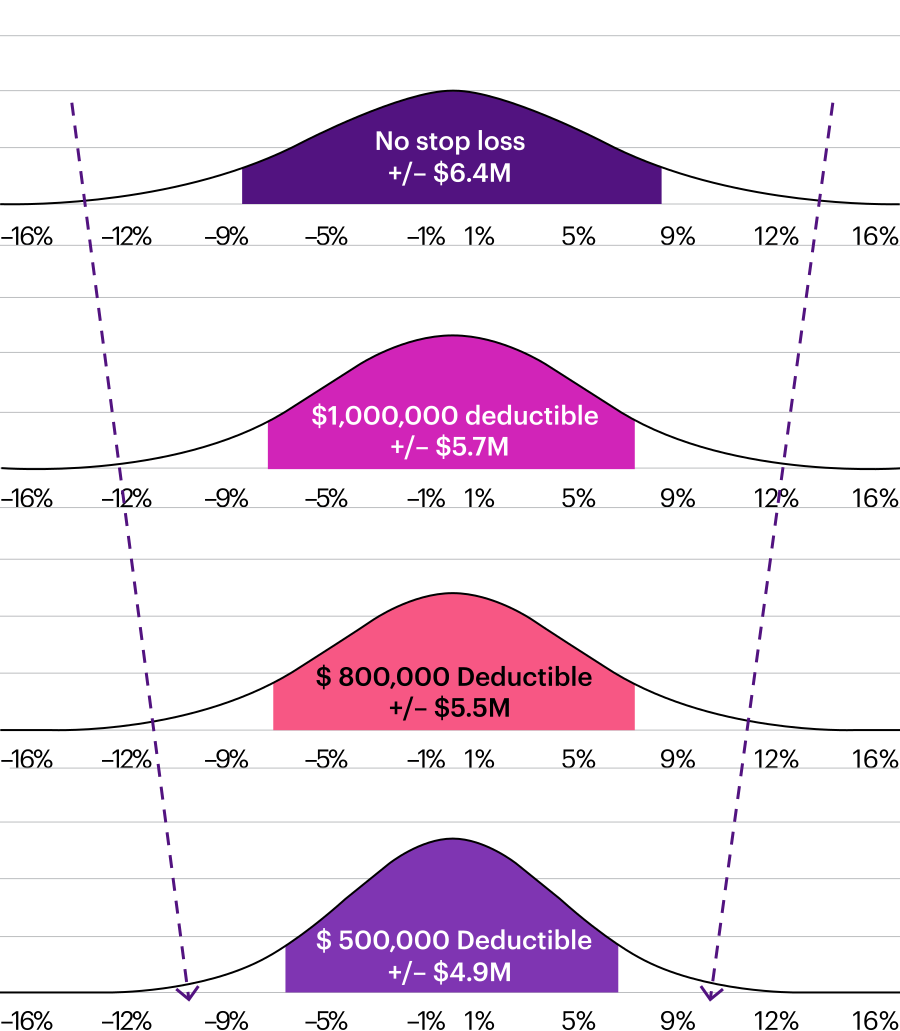
Range of outcomes vs projected
Self-funded plans must embrace a data-driven approach to risk management. This means moving beyond basic claims reporting to sophisticated analytics that provide actional insights.
- Predictive analytics for high-cost claims forecasting: Advanced analytics like our ACT solution use models to predict high-cost claims, allowing you to budget and intervene before the claims happen.
- Specialty drug pipeline exposure analysis: Data is paramount in taming specialty drug spend. Our specialty drug pipeline report allows plans to get visibility into current and future pharmacy spend. It estimates the financial impact of new drugs on your budget.
- Legislative financial impact analysis: Analytics to model the potential financial impact of regulatory changes on plan design, administrative costs and claims liability. For example, our tariff impact analysis looks at the specific components of medical supplies or pharmaceuticals that might be subject to new tariffs.
- High-cost claim risk transfer optimization: Make smarter decisions about stop loss policies or explore alternative strategies like captives using advanced data analytics. By projecting future risk and using our stop loss benchmarking data, clients can obtain adequate protection without overpaying for coverage.
The Future of Self-Funding: Informed decision-making
In the current healthcare environment, risk is a constant factor. For self-funded employers, the issue isn't whether uncertainty will occur, but how prepared they are to handle it. By turning data into actionable insights, it’s possible to anticipate volatility, measure exposure and make informed decisions that safeguard both budgets and employees.
Ultimately, the future belongs to those who treat risk management as a proactive discipline — one powered by data, guided by insight and aligned with long-term resilience.
FAQ – Frequently asked questions
As with any risk, the typical risk management steps for a health plan include:
- Risk identification: What are major risks plans are facing in today’s uncertain and fast-changing world?
- Risk assessment and quantification: What advanced analytics are available to help you quantify your risk factors?
- Implementing controls and mitigation strategies: When it comes to healthcare spend, there are cost categories that can be managed through clinical intervention, utilization review and population health programs, and then there are true catastrophic costs that are high severity but low frequency that should be mitigated through a mechanism like stop loss insurance, captives or Individual Coverage Health Reimbursement Arrangement (ICHRA).
- Allocating resources and budget: Optimizing expenditure by investing in high return on investment areas.
- Ongoing monitoring, review and reporting: Establishing key performance indicators and measurement strategies to ensure continuous oversight and provide timely, actionable insights.
Employers can adopt several strategies:
- Use budget variability modeling to understand potential cost ranges and their likelihood.
- Implement predictive analytics to forecast high-cost claims and intervene early.
- Conduct specialty drug pipeline exposure analysis to anticipate future pharmacy spend.
- Perform legislative financial impact analysis to prepare for regulatory changes.
- Improve high-cost claim risk transfer through smarter stop loss policies or alternative strategies like captives.
Authors