


In music, artists like Prince, Taylor Swift and Beyoncé have changed the rules. They combine different styles to create something special and meaningful. These artists refuse to be confined by traditional labels, just as the Total Portfolio Approach (TPA) challenges the conventional constraints of Strategic Asset Allocation (SAA).
TPA applies this same principle to portfolio construction — prioritizing objectives, risks, and outcomes over predefined asset class labels. By focusing on the portfolio objectives, TPA opens the door to investments that investors might otherwise overlook.
Total portfolio approach in practice: Real world case studies
In 2019, Australia’s Future Fund used TPA to identify rising interest rates as a key risk, prompting a reduction in portfolio duration by trimming exposure to long-dated assets like late-stage venture capital. This included selling over AU$6 billion in private equity across 2019–2020, avoiding steep discounts and adding an estimated AU$2 billion in value as rates later climbed and valuations fell. While the COVID-19 onset briefly reversed rate trends, the fund’s conviction and long-term orientation ultimately led to a positive outcome.
Crucially, this move reflects a core TPA insight: interest rate sensitivity extends beyond fixed income. Equities, especially growth-oriented or long-duration assets, are also exposed to rate changes through valuation effects. The Future Fund’s ability to act on this cross-asset opportunity highlights how TPA enables more holistic, dynamic risk management than traditional siloed approaches.
WTW investment case studies
Infrastructure debt case study – investing beyond traditional asset class boundaries
A few years ago, we found a unique infrastructure debt strategy, which we considered an attractive addition to clients’ portfolios. Due to the nature of the strategy, it didn't fit neatly into an SAA defined asset class because it overlaps both real assets and private credit. However, it offered unique exposure to a thematic renewable energy trend.
In a traditional SAA framework, this opportunity would likely have been excluded for the following reasons:
- Rigid asset class definitions: In an SAA framework, asset allocations are strictly defined so this investment doesn't clearly fit into a single category
- Siloed coverage teams: Competing asset class teams may limit collaboration, making it difficult to pursue idiosyncratic overlapping opportunities
- Narrow portfolio focus: SAA focuses on predefined asset classes, often ignoring the potential contribution of unique opportunities to overall portfolio outcomes
In contrast, TPA’s collaborative and integrated structure enabled the real assets and credit teams to jointly conduct due diligence. As a result, the opportunity was added to clients’ portfolios, improving diversification and capturing thematic tailwinds.
Impact example: The introduction of the strategy improved many of the top-level factors we consider when managing portfolios, further illustrating the benefits of TPA. The radar chart below highlights several of these factors, including improved risk-adjusted return figures, albeit at the cost of liquidity.
How TPA improves portfolio outcomes
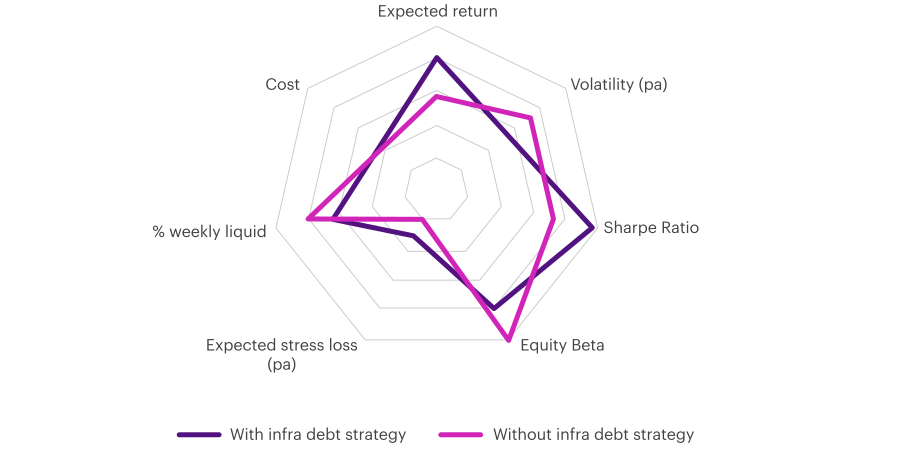
Chart is illustrative to show the changes of adding the infrastructure debt strategy to the real assets strategy solution.
Fallen angels case study — capturing credit opportunities between investment grade and high yield
Fallen angels are bonds that the credit rating agencies (S&P, Moody’s, Fitch) once rated investment grade, but were later downgraded to high yield, often because the issuer’s financial health declined. When this happens, prices often drop sharply. As selling pressure fades and companies work to regain their investment grade status, prices typically rebound to fair-market value and can often result in positive returns for investors that buy early. This is known as the “Fallen Angel effect,” which can create a unique investment opportunity for two main reasons:
- Market overreaction: Investors often oversell in response to downgrade news, pushing prices below fair value.
- Forced selling: Investment policy statements or investment guidelines require many institutional investors to sell bonds that fall out of the investment grade universe, adding further downward pressure on bond prices.
In 2020, amid the market volatility caused by the COVID-19 pandemic, the BBB corporate bond segment (bonds with the lowest investment grade rating) had grown substantially and companies were borrowing more than before the pandemic — both tailwinds for a strategy that capitalizes on the fallen angel effect.
Given these tailwinds, we partnered with an investment manager to design a strategy that captured the fallen angel premium. Our investment thesis played out as expected: a wave of downgrades occurred in mid-2020, followed by a market recovery that benefited this strategy. Over the first 12 months of investment, the fallen angels index outperformed the high-yield index by 4.3% — highlighted in the chart below.
This strategy works best in a TPA framework, but it's an unlikely strategy under an SAA framework for the following reasons:
- Dynamism: TPA allows us to adjust allocations based on evolving market conditions and act on timely opportunities as they arise. In this case, it enabled us to deploy capital into a niche but attractive opportunity, something a fixed SAA framework wouldn't accommodate.
- Rigid asset class definitions: Similar to the infrastructure debt example, under SAA, corporate credit is typically divided into strict buckets: investment grade and high yield. Fallen angels sit between these categories, meaning they don't neatly fit into either. As a result, investors using SAA would likely overlook or entirely exclude fallen angels.
Catastrophe bonds case study — diversification through uncorrelated risk
Catastrophe bonds, commonly referred to as “cat bonds,” are structured financial instruments that allow insurers to transfer specific risks associated with natural or man-made disasters, such as hurricanes or earthquakes, to investors in the capital markets. By purchasing these bonds, investors assume the risk of catastrophic events in exchange for potentially higher returns. The popularity of cat bonds is growing because of:
- The increasing frequency and severity of catastrophic events
- The insurance industry’s need for more efficient risk management solutions
As weather and disasters are not correlated to or dictated by markets or economics, catastrophe bonds provide strong diversification benefits relative to traditional asset classes, making them appealing in multi-asset portfolios. Looking ahead, the opportunity is supported by cyclical dynamics: after major loss events, demand for protection rises while supply decreases push premiums higher.
Cat bonds don’t fit well in an SAA approach because of their uncorrelated nature, lack of a benchmark fit and their deviation from conventional debt instruments. However, TPA’s flexible framework allows for their inclusion. They were incorporated as part of a broader strategy aimed at enhancing the portfolio’s return distribution and portfolio diversification given their uncorrelated returns relative to traditional asset classes.
TPA vs SAA: Key takeaways
- TPA shifts portfolio construction away from rigid asset class labels and toward investment objectives, risk factors and overall portfolio outcomes
- SAA frameworks can miss opportunities and risks that cut across asset classes, particularly in complex or increasingly interconnected markets
- By assessing investments on their contribution to the total fund, TPA expands the opportunity set to include strategies that may sit between traditional categories
- Real‑world examples, from infrastructure debt and fallen angels to catastrophe bonds, illustrate how TPA enables dynamic, cross‑asset decision‑making.
- TPA improves portfolio resilience by finding hidden risk exposures and enhancing diversification, even when individual positions are relatively small
- For asset owners with multiple objectives, private market exposure or evolving risk environments, a TPA framework provides a more flexible and forward‑looking portfolio than traditional SAA
When a total portfolio approach makes sense
Just as genre-bending music invites listeners to experience sound in a more fluid and expressive way, TPA empowers asset owners to invest with greater creativity, responsiveness and alignment to their goals. Investments like infrastructure debt, fallen angels and catastrophe bonds may not find a home in traditional SAA frameworks. But under TPA, investors can evaluate them on merit and contribution to the total fund's objective. In a world where markets are increasingly complex and interconnected, embracing TPA is like discovering a new musical language, one that harmonizes innovation with intention and performance with purpose.
Disclaimer
Towers Watson Australia Pty Ltd (ABN 45 002 415 349 AFSL 229921) (“WTW”) has prepared this material for general information purposes only and it should not be considered a substitute for specific professional advice. In particular, its contents are not intended by WTW to be construed as the provision of investment, legal, accounting, tax or other professional advice or recommendations of any kind, or to form the basis of any decision to do or to refrain from doing anything. As such, this material should not be relied upon for investment or other financial decisions and no such decisions should be taken based on its contents without seeking specific advice.
This material is based on information available to WTW at the date of this material and takes no account of developments after that date. In preparing this material we have relied upon data supplied to us or our affiliates by third parties. Whilst reasonable care has been taken to gauge the reliability of this data, we provide no guarantee as to the accuracy or completeness of this data and WTW and its affiliates and their respective directors, officers and employees accept no responsibility and will not be liable for any errors, omissions or misrepresentations by any third party in respect of such data.
This material may not be reproduced or distributed to any other party, whether in whole or in part, without WTW’s prior written permission, except as may be required by law. In the absence of our express written agreement to the contrary, WTW and its affiliates and their respective directors, officers and employees accept no responsibility and will not be liable for any consequences howsoever arising from any use of or reliance on this material or any of its contents.
WTW may enter into transactions with, and use the services of, any of our related bodies corporate. Such arrangements will be based on arm's length commercial terms.
Authors
Contact

For wholesale investors only