
The private equity industry has finally stepped onto the unstoppable train that is the sustainability movement. There is rarely any debate nowadays as to whether environmental, social and governance (ESG) considerations can be powerful drivers of value creation. The key challenge lies in execution.
In this white paper, we shed light on how sustainability practices of private equity managers are evaluated using our assessment framework. In addition, we hope this paper can be a useful resource for private equity managers who have only recently embarked on their own sustainability journey and are now looking for guidance. We are doing this not only because we believe the influence of the private equity industry, which has enjoyed tremendous growth in the past decades, can be channelled into addressing systemic challenges facing global communities.
We are also a firm believer that properly incorporating ESG considerations ultimately delivers strong financial returns for investors, in a long-term sustainable manner.
Sustainability is now mainstream in the private equity industry
In a survey of 117 private equity managers, 100% of respondents believe that sustainability is relevant to investment decision-making (Figure 1)1. In another 2020 survey of over 50 private equity managers, over nine in 10 respondents (93%) believe that focusing on ESG themes will generate good investment opportunities2.
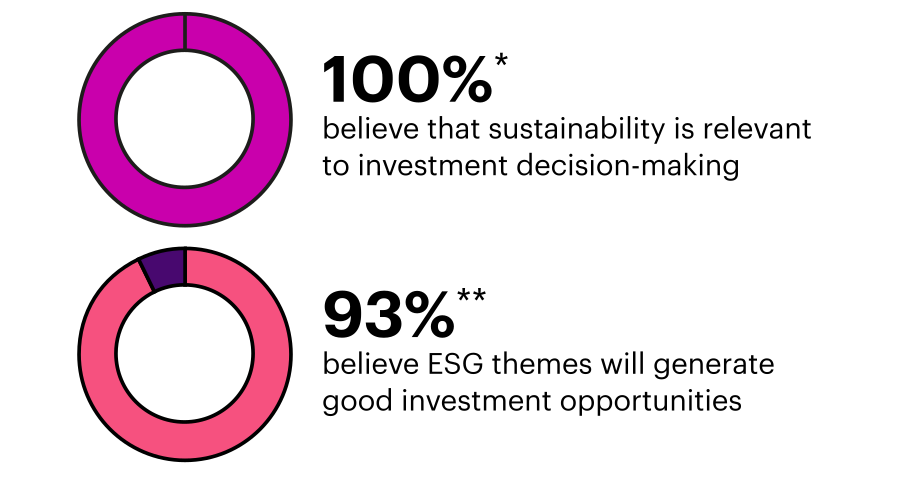
Sustainability is now mainstream
Private equity is well-positioned to take the lead in sustainability
- Long investment horizon
While private equity is far from immune from short-termism, the average holding period for portfolio companies is around five to six years3. That allows private-equity-owned companies to operate on a longer time horizon than most publicly traded companies, whose executives often feel compelled to manage the business to meet quarterly guidance. An adequately long time frame is often required to realize ESG objectives such as reducing greenhouse gas emissions and for the benefits of successful sustainability initiatives to be reflected in the financial value of the business. - Control-oriented approach and greater access to information
Private equity firms are often well-placed to exert significant influence, if not outright control, over their portfolio companies. This can include encouraging for stronger sustainability practices. The information advantage, coupled with its control-oriented ownership model, can put private equity firms in a powerful position to drive changes in corporate behaviours.
Despite a tepid pace of adoption until recently, we believe the private equity model offers a couple of critical advantages in advancing sustainability
WTW private equity sustainability assessment and engagement framework
At WTW we believe that properly incorporating sustainability considerations, including both risks and opportunities, is central to successful long-term investment outcomes. This foundational belief spurred the development of a structured and disciplined process for integrating ESG considerations into our manager research decisions.
In evaluating the sustainability practices of a private equity manager, we use a six-dimensional framework to assess the overall commitment to sustainability and the sophistication of ESG integration (Figure 3). The key is to pinpoint clear evidence that ESG integration has gained collective buy-in and become institutionalised, supported by a clearly defined governance structure and a fit-for-purpose resourcing model.
Footnotes
1 “ESG and the SDGs: Insights from private equity managers”, LGT Capital Partners, 2020.
2 “Eyes on the prize: unlocking the ESG premium in private markets, ERM, 2020”.
3 “Prolonged Private Equity Holding Periods: Six Years Is the New Normal”, Joenvaara et al, The Journal of Alternative Investments Summer 2022
Notice for UK persons accessing this page
This page contains links to certain historical documents which were issued by Willis Towers Watson (WTW) as at the date specified on each linked document, in relation to the products offered by WTW. WTW believes that it is useful to investors to retain these documents on our website, for your information and reference purposes. Each such document was assessed as being compliant with prevailing regulatory requirements as at its date of issue, including that its contents are fair, clear and not misleading. Given that these documents were issued as at a specific point in time, WTW does not believe it would be appropriate to retrospectively amend those documents. As a result such documents have not been reviewed in light of any subsequent regulatory guidance or market practice including the FCA’s anti-greenwashing guidance (FG24/3). Any persons accessing this page, and the documents made available on this page, should not seek to rely on such documents and should use them only for information or reference purposes. Any investment decision should be based exclusively on the formal offer and subscription documents for the relevant investment product, and not these historical documents.
For the full report and analysis, download the paper below.
Download
| Title | File Type | File Size |
|---|---|---|
| Sustainability in private equityPDF | 1.8MB |
Contact