Choose your location
Select the location and the language that you prefer


main content, press tab to continue
What is ECA? How does it affect my MPF?
ECA stands for 'Employee Choice Arrangement'. If you are an employee, from November 1, 2012 ECA will allow you to do the following things:
- Transfer your accrued benefits (i.e. the accumulated contributions and investment returns) from the employee mandatory contributions made during your current employment to a personal account* with an MPF trustee and in an MPF scheme of your own choice, once every calendar year (January1 to December31).
- Transfer any accrued benefits from previous employment or self-employment that have been transferred to your current contribution account to either a personal account or another contribution account with an MPF Trustee and in an MPF scheme of your own choice, at any time.
Notes:
- You must transfer your accrued benefits as a single lump sum. Partial transfer is not allowed.
- You can only transfer accrued benefits derived from your voluntary contributions if the rules of your individual MPF scheme and provider allow it.
As an MPF member, what you need to know about ECA includes:
- Which portion(s) of your contribution account of current employment can be transferred
- When and how often can you make the transfer
To help you understand the composition of current contribution account and their transferability easier, we have prepared the following case study as illustration:
Case study
Name: Mr. Chan, an MPF member since 2001.
- From 2001 to 2005 Mr. Chan worked at company A, which used trustee A; in 2006 he changed to company B, which used trustee B.
- After changing his employment, Chan consolidated all his MPF accrued benefits with trustee A to his current contribution account, under trustee B.
As a result, Mr. Chan's contribution account under trustee B looks like this:
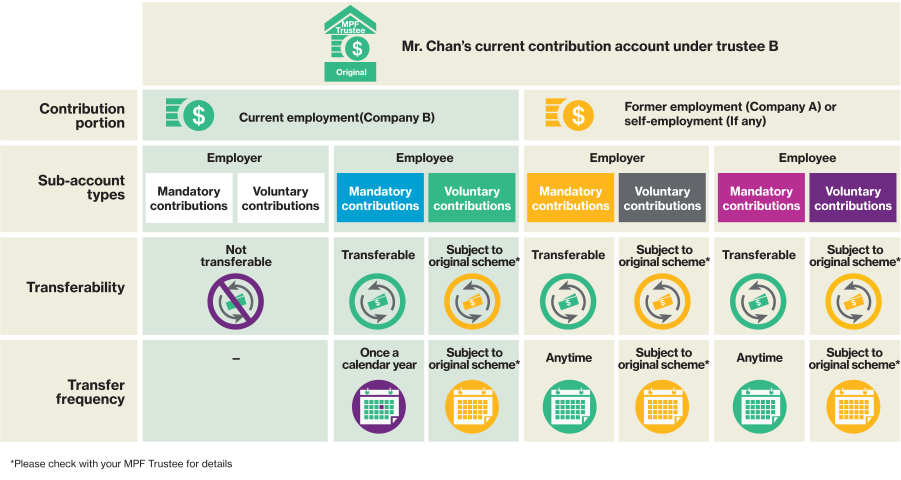
Mr. Chan's contribution account under trustee B
Current employment (company B):
- Employer mandatory contributions
The mandatory contributions from current employer cannot be transferred. -
Employer voluntary contributions
The voluntary contributions from current employer cannot be transferred. -
Employee mandatory contributions
The accrued benefits from the employee's portion of mandatory contributions during current employment can be transferred to an MPF scheme and trustee of the employee's choice. Transfers are allowed once each year (i.e. from 1 January to 31 December), and the accrued benefits must be transferred as a lump sum each time. -
Employee voluntary contributions
The transfer arrangement for the voluntary contributions from current employment is subject to the governing rules of the original scheme. You may enquire trustee of the original scheme for details.
Former employment (company A) or self-employed (if any):
- Employer mandatory contributions
If the mandatory contributions from former employment (including employer's and employee's portions) have been transferred to the Contribution Account of current employment, these accrued benefits can be transferred to an MPF scheme and trustee of employee's choice, at any time and as a lump sum. -
Employer voluntary contributions
The transfer arrangement for the voluntary contributions from former employment is subject to the governing rules of the original scheme. You may enquire trustee of the original scheme for details. -
Employee mandatory contributions
If the mandatory contributions from former employment (including employer's and employee's portions) have been transferred to the Contribution Account of current employment, these accrued benefits can be transferred to an MPF scheme and trustee of employee's choice, at any time and as a lump sum. -
Employee voluntary contributions
The transfer arrangement for the voluntary contributions from former employment is subject to the governing rules of the original scheme. You may enquire trustee of the original scheme for details.
The new arrangement is expected to promote market competition, creating demands such that trustees will have to further enhance service standards and lower fee level(s). For MPF members, the change means more say and greater freedom of choice, and it is worth spending more time and effort to proactively manage your MPF account. To make a wise and informed decision, compare MPF schemes by making use of various information resources and comparative platforms available. Remember, you snooze, you lose!
Will transferring the accrued benefits out of the original trustee affect my future contributions?
Even after you transfer your employee mandatory contributions (and also during the transfer process), your employer will continue to make employer and employee mandatory (and voluntary) contributions into their chosen employer's scheme, rather than into the scheme you have selected. In Mr. Chan's case, even though he can transfer the accrued benefits of his own mandatory contributions once every calendar year from trustee B to the provider of his choice, company B will continue to submit contributions to the employer's scheme – ie: the contributions will continue to go to trustee B.
About MPFexpress

Related Newsletter
MPFexpress
A quarterly publication providing comprehensive information on the Mandatory Provident Fund.
What benefits will ECA bring me? And what are potential risks associated?
The good news
- Market competition should increase with ECA. ECA is expected to boost market efficiency, which should result in reduced fees, enhanced product features, and improved service offerings.
- As an employee, you will have greater control over your own MPF investment, and will be able to select MPF trustees and schemes based on your specific personal needs and circumstances.
- Along with increased control, you will gain a greater level of ownership of your MPF accounts. This should help make you be more aware of your retirement needs, and prompt you to manage your MPF accounts more effectively.
Things to watch
Transferring accrued benefits involves buying and selling funds, which brings risks:
‘Out of market’ risk
This is the time lag between when your accrued benefits are cashed out (i.e. redeemed) by the original trustee and when they are settled (i.e. subscribed) by the new trustee. Be aware that the whole transfer process could take around two to three weeks to complete. Prices fluctuate in line with the market. In the sense of a bull market, there is a chance that you will end up buying in at a higher price than when your accrued benefits were cashed out, thereby creating a realised loss as a result of the ECA transfer.
‘Forward pricing’
Fund execution (e.g. selling and buying of funds) is carried out on a ’forward pricing’ basis. This means the execution prices of funds are calculated on the basis of their net asset value after the market closes on the relevant trading day. Unlike stock trading, MPF funds adopt the same ’forward pricing‘ arrangement as general retail funds. MPF members cannot therefore specify the dealing date and price of funds when buying or selling.
Potential loss on guaranteed return
A transfer of accrued benefits may violate certain guarantee conditions, such as minimum investment periods, which may disqualify you from entitlement to a guaranteed return.
Other potential costs
These are the extra costs you might incur if you select MPF Trustees and schemes without a careful analysis of the market players, including your original trustee, and a clear consideration of your personal needs. For instance, MPF trustees commonly offer preferential fee arrangements or grant periodic rebates to participating members, especially those who work for large employers. However, when joining an MPF scheme as an individual you may not enjoy similar privileges, which means you may end up paying higher management fees after the ECA transfer. This is why MPF members need to understand the scheme features and offerings of both their existing and any new schemes before they change.
How to make a transfer? How long will the transfer last?
While stock trading and money transfer can be executed in no time nowadays, fund trading involves a relatively complicated process which can be time consuming. As MPF funds are traded within a tightly monitored system, you can expect protracted process when transferring accrued benefits from the original trustee to the new trustee.
When filling in the Employee Choice Arrangement – Transfer Election Form (MPF(S)-P(P)) form requesting for a transfer, you will notice that there are several remarks in the attached guide and notes reiterating that it may take 2 to 3 weeks to complete the whole transfer process. It implies that you may be exposed to the risk brought about by market fluctuation during the transfer.
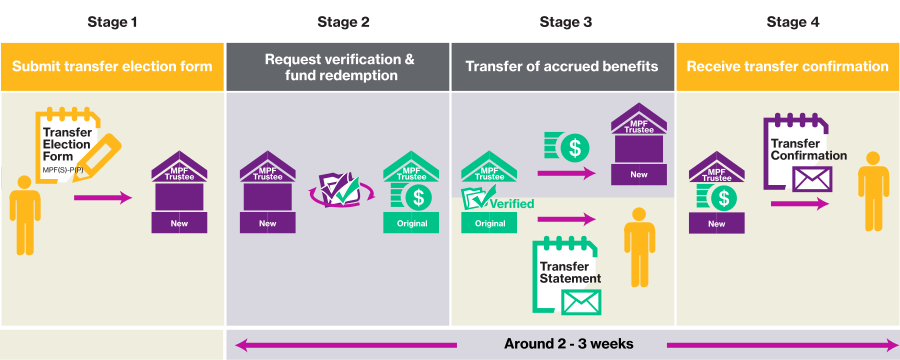
Using the case study mentioned earlier, the different stages of the transfer process are shown below.
|
Mr. Chan will first have to go to the new trustee (Trustee C) he has selected , open personal account (if it doesn’t exist already) and submit an ’Employee Choice Arrangement – Transfer Election Form’ (Form MPF (S)-P(P)) (Transfer Election Form). |
Trustee C will then verify the information with Mr. Chan’s original trustee (trustee B). |
Once both parties have verified the information, trustee B will sell the fund units in Mr. Chan’s current contribution account, send the ‘transfer statement’ letter to Mr. Chan and send a cheque to trustee C. |
‘Transfer confirmation’ from the new trustee, confirming that the accrued benefits have been transferred to the new trustee. Employees should check the contents of the documents to ensure the accuracy of the transferred amount and the details of account. |
Reminder!
Download the Employee Choice Arrangement – Transfer Election Form from MPFA website.
Make sure you pass your completed transfer election form to the new trustee, and get all the relevant documents back from both the new and original trustees once the transfer is completed.