
Defined benefit (DB) pension plans continue to cause financial volatility, which is not yet at a comfortable level for many multinational companies, despite widespread moves toward defined contribution (DC) plans. The financial risks of DB plans can be reduced by headquarters (HQ) adopting a systematic multi-local approach with central guidance and oversight, to identify de-risking opportunities, lay the groundwork up front and stay on top of volatile financial markets — changing practices, legislation and trends.
DB obligations are a complex form of debt. This debt is the underlying cause of financial volatility, with the potential to impact the company’s covenants and hamper business operations — and create unexpected cash calls, large expenses to be recognized in profit and loss (P&L), or big liabilities on the balance sheet.
For most multinationals, their DB plans around the world have different levels of funding. The risks outlined above are starkest in unfunded and underfunded arrangements, but even plans with assets greater than their obligations may create significant challenges.
At the same time, DB plans represent a significant administrative and operational commitment, especially if they are funded, so there is also a financing vehicle to operate. This is a significant consideration for multinational companies that are looking to simplify their operating models globally.
In this article, we outline the common techniques multinational organizations have deployed to manage pension risk as well as provide insights on optimizing global pension debt management and de-risking decisions using a systematic approach that addresses all aspects of the risk, including the impact to employees.
Common techniques
A desire to reduce risk from DB plans is not new. A common starting point to control risk is to close DB plans to new entrants and, increasingly, to future accrual. This article focuses on steps beyond these, which bear down on the DB legacy that is left behind as the future state moves toward DC. Common techniques to reduce the legacy risks include:
- Funding and investment strategy:
- Set funds aside to help mitigate the impact from the debt, typically in a trust-based structure (e.g., a pension fund) or an insurance-based structure. These take various forms around the world — including stand-alone, multi-employer, multi-local and cross-border.
- Invest these funds in assets that more closely track liabilities to neutralize volatility in the P&L statement or balance sheet. As the size of the underlying obligation (debt) moves with market conditions, so do the assets. This liability-driven investment approach has become much more sophisticated over the years, taking advantage of new financial instruments and incorporating dynamic investment allocation strategies.
- Transfer the risk to an insurer, which makes payments directly to employees, thus taking the responsibility away from the employer. This option is not available in all countries, however, as there may not be any providers interested in taking on such business where it is not already commonplace.
- Offer members a different form of benefit to replace all or some of their existing entitlement. Growing significantly in importance in the past decade, such offers come in various forms around the world. The simplest and most common is a lump sum offer (i.e., a one-time payment to the member or to a DC pension plan) in place of defined benefits.
Within and around these common techniques, a raft of variations and adaptations have emerged over recent years — and continue to emerge — as companies and providers seek and find ways to address different circumstances and constraints in different jurisdictions.
These de-risking techniques require a significant investment of time and effort. Even in countries where such techniques are relatively common, building agreement within the organization to take actions can prove quite cumbersome. If an approach is more novel, the time required to gain traction can increase exponentially. What’s more, headquarters and local company management may lack direct control of key decisions, particularly in countries such as the Netherlands, Switzerland and the U.K., where trustee-like bodies exert significant control over various aspects of plan operation, including options for employees or how assets are invested.
Looking at opportunities with a global perspective
Given vast differences in “the art of the possible” between countries, a centrally established approach to managing DB risk achieves the best outcomes for a multinational company. All too often, however, companies take a country-by-country approach to determining the path forward. In doing so, they miss the big picture — and often better opportunities. Put simply, a single-country viewpoint may identify that de-risking option A is more efficient than option B. However, what a single-country focus fails to uncover is that, just across the border, there may be a third option that is a better use of time and capital than either A or B.
With limited financial resources and time available to spend on de-risking, organizations would benefit from utilizing a systematic approach to assess their significant DB risks across the globe to determine which approach(es) will truly have the biggest overall impact to address their specific pain points. And it is important to recognize that what causes “pain” does vary industry by industry and even company by company. Some companies and industries are most focused on P&L considerations, others on balance sheet (and in the case of financial services companies, capital adequacy) considerations, and still others on cash flow.
Understanding what risks matter and how much it is worth to the business to mitigate or remove them allows prioritization between the available potential opportunities. It is seldom the case that the optimal set of opportunities will all be sufficiently attractive to be actioned immediately, but there may well be a number that are “bubbling under” and should be monitored, discussed more below.
Equally important to monitor are legislative or quasi-legislative changes happening in a multinational’s key DB countries. To take a couple of examples:
- Conventional wisdom in the U.S. held that a lump sum offer could not be extended to someone once a pension was in payment. Several years ago, Ford and General Motors challenged that convention and began offering lump sum payouts to pensioners. Shortly afterward, the IRS announced it would no longer approve such payments, only to reverse that decision in 2019.
- In the U.K., a similar evolution of regulatory views has occurred on what is permissible and appropriate to offer employees upon transfer of their entitlements out of DB plans.
Tracking such legislative and regulatory changes and interpretations helps identify triggers for action or further investigation, thus enabling the full range of significant opportunities to be considered.
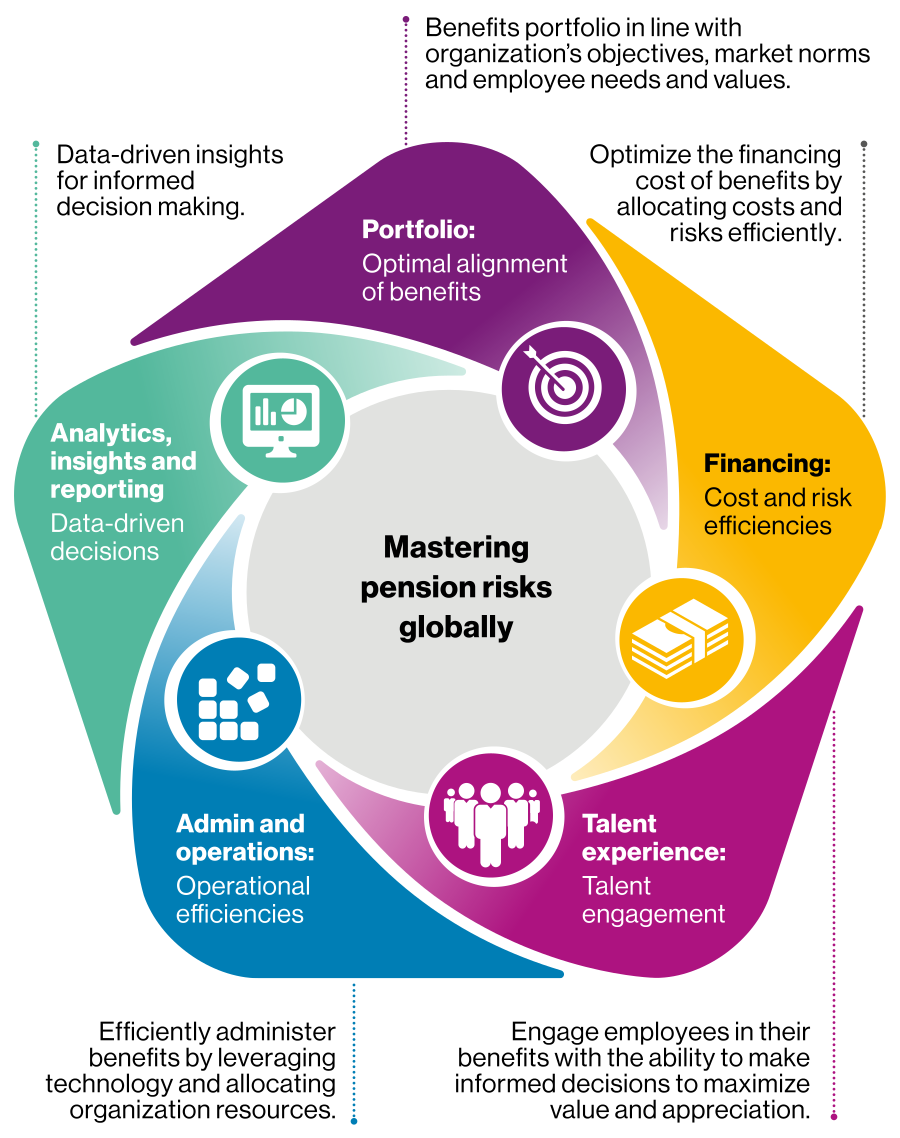
Partnering with an experienced global pension risk management specialist will enable an organization to more effectively identify, assess and prioritize the best opportunities for their context and circumstances. At Willis Towers Watson, we consider de-risking opportunities using five to ensure a systematic approach and consistent assessment of all the implications of any potential de-risking action, and how this fits into a multinational’s wider employee benefit and business strategy.