Hailstorms rank among the costliest natural catastrophes in Europe and have become a growing concern for insurers and society alike, with record-breaking events, such as the July 2023 storms in Northern Italy, causing over $3 billion in damage.[1],[2]
While the global rise in hail-related insured losses is primarily driven by increasing exposure and economic growth,[3] the severity and frequency of recent events have amplified concerns about how climate change may be influencing hail risk. Some studies suggest that hailstorms may produce larger hail more frequently in a warming climate, but the science remains far from settled.
A global review by Raupach et al. (2021)[4] summarized the state of knowledge: while small hail may become less common due to increased melting, large hail is expected to become more frequent, driven by stronger updrafts and greater atmospheric moisture. However, Raupach also highlighted that the trends are highly uncertain because changes in other factors influencing hail potential were less understood, such as storm types, storm frequencies, and aerosol concentrations.
This article explains what we currently know about hail trends in Europe under climate change, the important uncertainties that remain, and highlights three key insights that help guide our understanding.
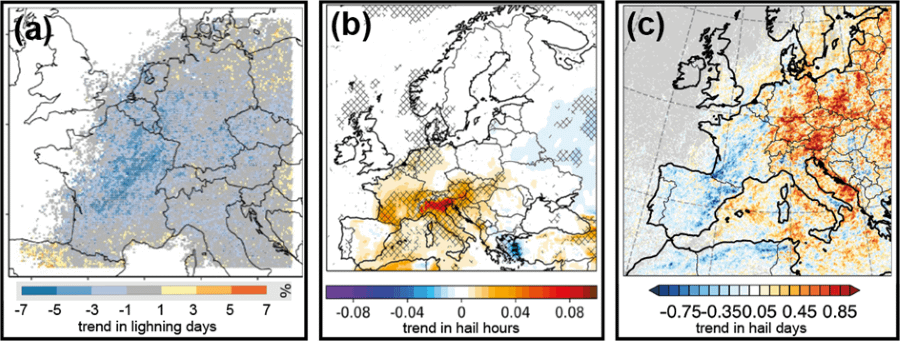
Figure 1: Three different views of hail risk. Trend in (a) observed lightning days 2001-2021 in Augenstein et al. (2024),[5] (b) hail hours (>2 cm) based on atmospheric environments from 1950-2021 in Battaglioli et al. (2023),[6] and (c) hail days (>1.25 cm) in convection-permitting simulations by Thurnherr et al. (2025).[7] All trends are per decade and averaged over the respective analysis period.
…a warmer atmosphere holds more moisture and generates stronger convective updrafts, both favoring larger hailstone formation.
The development of models with horizontal resolution of a few kilometers enables simulations of individual thunderstorm updrafts, a major step forward in hail research. However, this “convection-permitting” resolution is not yet fine enough to fully resolve the complex structure of storms, which is important because the shape and peak intensities of thunderstorm updrafts are critical for large hail formation.[14] In addition, most models do not simulate the detailed microphysical processes involved in hailstone growth and evolution.
…for Europe’s hail hotspots, evidence points toward a rising and persistent threat.
Three key insights for understanding hail risk and their implications for risk modeling
Despite differences in methods, study periods, and proxy indicators, three broad insights are supported by recent research:
- Large hail is likely to become more common in individual thunderstorms, consistent with the thermodynamic relationships identified in Raupach et al. (2021).
- High-resolution climate models broadly support an increase in hailstorm severity, although regional trends diverge.
- Some regions, especially hail-prone areas like Northern Italy, Switzerland, and Austria, are likely to face an increasing threat, although decreases in storm frequency or increasing melting could offset trends elsewhere.

Related content
While confidence has grown, caution remains essential. Each research approach, whether observational, environmental, or modeling, carries important limitations, and none provide a complete picture on their own. Conclusions based on single studies or narrow time periods should be interpreted carefully.
The impact of hail trends will also depend on how hazard changes interact with exposure and vulnerability. Even if storms become less frequent overall, increased severity or economic growth can still drive higher insured losses. Therefore, the growing potential for more severe hail in already high-risk regions highlights the importance evaluating natural catastrophe models, insurance pricing, capital allocations and exposure aggregations to ensure they are fit for purpose, particularly in vulnerable markets like Northern Italy and Central Europe.
Collaboration between academia and industry, as was the basis for this article, remains crucial to closing knowledge gaps and has led to significant advances over the last decade. Research initiatives such as ICECHIP,[15] the first large field campaign on hail in over 40 years beginning in 2025, and the continued development of convection permitting models, are important steps toward building a clearer, more actionable picture of future hail hazard and vulnerability for risk managers.
References
- WTW. Gargantuan hail in northern Italy: Natural climate variability or climate change? (2024). Return to article
- De Martin, F., et al. Dynamic and statistical analysis of giant hail environments in northeast Italy. Quarterly Journal of the Royal Meteorological Society, e4945. (2025). Return to article
- WTW. Analyzing the aftermath of 2023's severe weather in the U.S. (2023). Return to article
- Raupach, T. H., et al. The effects of climate change on hailstorms. Nature Reviews Earth and Environment, 32–36. (2021). Return to article
- Augenstein, M., et al. Influence of the North Atlantic Oscillation on annual spatio-temporal lightning clusters in western and central Europe. EGUsphere. (2021). Return to article
- Battaglioli, F., et al. Modeled Multidecadal Trends of Lightning and (Very) Large Hail in Europe and NorthAmerica (1950–2021). J. Appl. Meteor. Climatol., 62, 1627–1653. (2023). Return to article
- Thurnherr, I., et al. The effect of 3°C global warming on hail over Europe. Authorea [preprint]. (2025). Return to article
- Manzato, A., et al. Hailstone Characteristics in Northeast Italy from 29 Years of Hailpad Data. J. Appl. Meteor. Climatol., 61, 1779–1795. (2022). Return to article
- Peters, J. M., et al. Cumulonimbus Clouds Convert a Smaller Fraction of CAPE into Kinetic Energy in a Warmer Atmosphere. J. Atmos. Sci., 81, 1943–1961. (2024). Return to article
- Mallinson, H., et al. Hailfall in a Possible Future Climate Using a Pseudo–Global Warming Approach: Hail Characteristics and Mesoscale Influences. J. Climate, 37, 527–549. (2023). Return to article
- Martín, M. L., et al. Major Role of Marine Heatwave and Anthropogenic Climate Change on a Giant Hail Event in Spain. Geophysical Research Letters, 51(6). (2024). Return to article
- Brennan, K. P., et al. Insights from hailstorm track analysis in European climate change simulations, EGUsphere [preprint]. (2025). Return to article
- Gensini, V.A., et al. Hailstone size dichotomy in a warming climate. Clim Atmos Sci 7, 185. (2024). Return to article
- Fischer, J., et al. Hail Trajectories in a broad Spectrum of Supercell-like Updrafts. J. Atmos. Sci., in press. (2025). Return to article
- In-situ Collaborative Experiment for Collection of Hail In the Plains (ICECHIP). Return to article
Authors

Contacts


Conclusions based on single studies or narrow time periods should be interpreted carefully.