The upstream energy insurance market has continued to soften since the April Energy Market Review (EMR).
Softening market conditions have accelerated
Market softening has accelerated since our last update, and this has resulted in a majority of insurers falling short of their budgets so far. While some markets have been able to rebase their budgets to take account of the changing rating environment, many remain committed to hitting existing budget targets. This has led to further acceleration in the market softening:
Competition to retain and win substantial placements with premium exceeding $10 million is fierce, but insurers with less aggressive premium income targets are more disciplined in their approach
Insurers are reporting average book reductions of 5%-10%, but this is not consistent across the portfolio
Some placements that have not been tested in the last few years are being quoted at reductions of 30-40%
A clear dichotomy is emerging. Markets not subject to these budget pressures are quoting less competitively
Underwriters are managing softening market conditions with increased credits and long-term agreements to maintain business
“Latin America is showing a significant downward trend in pricing, with recent tenders reflecting discounts of over 40%. In some countries such as Argentina, hybrid structures featuring substantial retentions have led to major premium reductions and elsewhere, such as Peru, competitive conditions endure across programs.” Ana María Gómez, Regional Leader, Willis Natural Resources, Latin America
“
Latin America is showing a significant downward trend in pricing, with recent tenders reflecting discounts of over 40%. In some countries such as Argentina, hybrid structures featuring substantial retentions have led to major premium reductions and elsewhere, such as Peru, competitive conditions endure across programs.”
Ana María Gómez | Regional Leader, Natural Resources, Latin America
The tightrope of rating adequacy
Until rates fall below a critical threshold, profitability remains viable, and underwriters are willing to compete for increased market share on profitable business. But management are keeping a watchful eye on this activity, which may become unsustainable as markets continue to soften: a trend to watch next year.
Underwriters are getting strategic
“In Q3 2025, some insurers were reporting 6-8% reductions on their upstream book. But these figures need to be assessed critically as reductions don't take into account the new business or increased premiums on loss-making accounts. The double-digit reductions achieved on the largest accounts are removing vast amounts of capital from insurers’ premium pools, and underwriters are using high single-digit reductions on small-medium size businesses as a strategic tool to signal an effort to steady the softening across the entire portfolio. It’s likely that the larger accounts will pay dividends when the insurance market cycle hardens, and pressure to retain these accounts is significant. Absorbing reductions on these big accounts is unavoidable until market dynamics change”, Paul Braddock, Head of Upstream G.B., Willis Natural Resources.
“
It’s likely that the larger accounts will pay dividends when the insurance market cycle hardens, and pressure to retain these accounts is significant. Absorbing reductions on these big accounts is unavoidable until market dynamics change”
Paul Braddock | Head of Upstream G.B., Natural Resources
The true picture of the rating environment likely lies somewhere between the extremes of ‘broker talk’ and ‘underwriter talk’ and reflects the differing rating microcosms in the upstream energy market.
As ever, the scale of rating movements across the market varies considerably. Insurers report overall book movement of –5% to –10%. Large, clean operating accounts with a premium spend in excess of $10 million have achieved in excess of 40% reductions when leadership has been challenged, with reductions more modest for most. At the other end of the scale, accounts with a poor loss record are likely to attract rate rises or require deductible/retention increases to offset the rate increase.
Insurer-insured relationships remain critical.
Long-term relationships with lead markets are being rewarded with incumbent leaders reevaluating their pricing when challenged to retain renewal business. “Negotiating larger reductions is more accessible when incumbent leaders with longstanding relationships with clients are challenged through alternative quotes at renewal”, Richard Burge, Head of Offshore Broking, Chief Broking Officer, Willis Natural Resources
“In response to these compelling market conditions, buyer behavior often reflects a preference for long-term strategic partnerships so clients can capitalize on the soft rate environment available currently. Clients are aligning with insurers who demonstrate consistency and flexibility—these partnerships are helping clients secure better terms, broader coverage, and more stable relationships, especially as insurers prioritize retention of clean, well-managed risks.” Charlotte Watts, Head of Energy and Mining, Willis Natural Resources, Asia
“
Clients are aligning with insurers who demonstrate consistency and flexibility—these partnerships are helping clients secure better terms, broader coverage, and more stable relationships, especially as insurers prioritize retention of clean, well-managed risks.”
Charlotte Watts | Head of Energy and Mining, Natural Resources, Asia
A new baseline of low loss activity
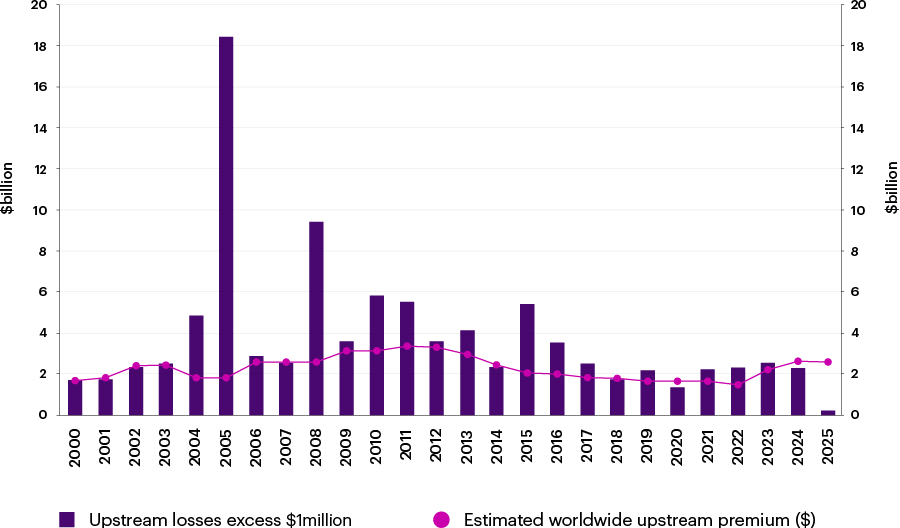
Despite an increase in activity, it has now been nearly a decade without a market loss exceeding $1 billion. This may indicate a new lower baseline of loss activity driven by improved risk management and asset quality, as well as a move away from riskier frontier territories. If this is indeed the case, the soft rating environment driven by benign loss activity may stay for a while longer. In a world where loss activity is predominantly attritional, big players will be more likely to weather the storm due to the breadth of their portfolios.
The upstream energy market continues to deliver profitability for insurers
The upstream energy market continues to deliver profitability for insurers
the expected for 2025 is over $2 billion
The upstream energy market continues to deliver profitability for insurers, the graph shows losses exceeding $1 million, the expected global premium for 2025 is over $2 billion
Construction risks’ new premium can come at a cost
Construction remains a unifying concern across upstream markets. The long-tail risks remain a perennial challenge, but underwriters are more accommodating of these less favored risks where an operational relationship already exists. Leaning on operational relationships to bolster a construction placement is becoming a key broking strategy: a trend to watch in 2026.
There’s a hard line on subsea construction
Meanwhile, capacity remains restricted for subsea construction, creating a micro hard market. In a soft market where winning new business is a key focus, some markets are considering small amounts of subsea construction to boost much-needed premium income. However, if incorrectly priced, construction placements can take months to complete, leaving clients with a significant degree of uncertainty on coverage and cost.
The outlook is bright
“Signs are that the market could be reaching an inflexion point, but reinsurance reductions could prop up profitability margins to keep the softening trend as we head to 2026”, George Richardson, Upstream Energy Broker, Willis Natural Resources.
Download the full article to find out how to prepare for 2026 and optimize your renewal strategy in a softening market.