
The Asia Pacific salary landscape enters 2026 in a state of stable yet significant transition. While median salary increases were steady at 4.9%, the 75th percentile for salary increase has dropped to 5.2% (Figure 1). This indicates a narrowing gap between the market median and the upper quartile. It can also be a sign that the differences across industries and companies are beginning to compress, reflecting more disciplined and converging salary increase strategies.
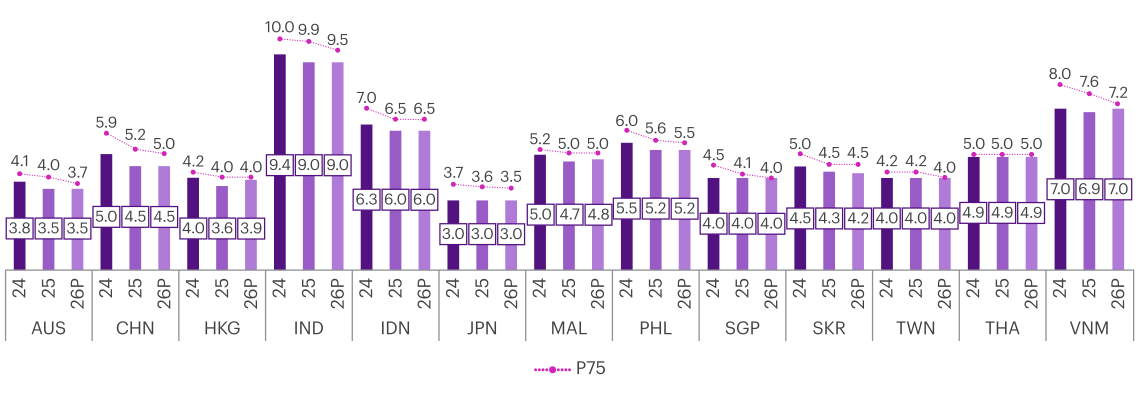
Source: 2024-2025 December WTW Salary Budget Planning Report, APAC
The exception to this trend is Hong Kong, where a higher salary increase rate is expected in 2026, driven primarily by the financial services sector. This momentum can be largely credited to investment banking, supported by a strong initial public offering market in 2025.
The resurgence of AI-driven demand has triggered another round of competition for technology talent, driving leading organisations to increase salary budgets to retain critical skills. The financial services sector, for example, has a growing competition for tech talent, thereby leading to salary increase rates for fintech jobs, particularly in India and in Indonesia.
The tight market for critical talent has fueled the move toward value-differentiated rewards across the region. Today, Asia Pacific organisations concentrate their investments where they matter most, as the top 10% of performers now receive about 20% of the total salary increase budget. In contrast, average-rated performers that comprise 65% of the employee population must share 50% of the total increase budget with their peers (Figure 2).
Source: 2024-2025 Dec WTW Salary Budget Planning Report, APAC
This strategic allocation allows companies to retain their most critical talent without increasing overall payroll costs, reflecting continued cost discipline, sharper scrutiny on return on reward investment, and a focused need to protect essential capabilities in an uncertain macro environment.
This trend is particularly evident in several markets:
In addition to strategic allocation, talent attrition should also be considered when looking at salary budget trends. Across Asia Pacific, voluntary attrition stabilised at 10% while involuntary turnover rose from 4% to 4.8% (Figure 3).
Source: 2024-2025 December WTW Salary Budget Planning Report, APAC
In some countries, shifts in attrition rates can be attributed to industry-specific changes, such as normalisation in the financial services sector in Indonesia after hiring freezes and workforce adjustments. In Malaysia, involuntary attrition rates rose to 4.2% due to industry consolidation, downsizing and workforce restructuring. Demographic and behavioural shifts also contribute to attrition rates, like in Japan where attrition rates had an uptick due to an aging workforce and increased mid-career mobility among young professionals. In Taiwan, 88% of organisations report difficulties retaining talent, particularly those from semiconductor and AI infrastructure sectors. This has led organisations to use variable pay, bonuses and retention incentives to maximise cost while retaining critical talent.
These developments suggest that organisations across the region are taking a calculated approach in their salary budgets to better retain critical talent in a competitive environment.
While compensation strategies become more refined, the rising cost of healthcare emerges as a secondary pressure point. Medical inflation in Asia Pacific is projected to soar in 2026, outpacing the global average by about 3%. For certain markets, the projections are striking, with Singapore (16.9%), Taiwan (16.7%) and the Philippines (16.1%) facing some of the highest rates in the region.
Several factors are driving these costs, from advancements in pharmaceuticals (such as the increased use of GLP-1) to systemic issues like fraud, waste and abuse — which ranked among the top three cost drivers, especially in China, India and Hong Kong, according to the 2026 WTW Global Medical Trends survey (Figure 4). Moreover, most (84%) of insurers are expecting international trade policies and tariffs to increase healthcare costs, with 69% anticipating moderate increases and 15% predicting significant increases.
Source: 2026 WTW Global Medical Trends Survey
Since limited cost sharing has emerged as a major cost driver, it is also reported as the secondmost effective way to manage rising medical and pharmacy costs. With limited cost sharing practices contributing to higher expenses across Asia Pacific, markets are seeing growing attention on costsharing approaches as employers and insurers look for more sustainable benefit models. With the growing need to ensure the sustainability of benefit programmes, employers should consider proactive healthcare strategies:
As the region navigates the twin pressures of tightening salary budgets and rising medical costs, it becomes more crucial for organisations to be more effective in building structural foundations that enable workforce investment to be more consistent, equitable and scalable. AI can help HR teams achieve this and establish foundations quickly and at scale without the need to expand budgets.
HR teams can now use AI to build a "single source of truth" for jobs, levels and skills, underpinning everything from pay governance to internal mobility. With these key areas of adoption in mind, here are some areas where AI can play a critical part in establishing structural foundations within the workforce:
These foundations directly strengthen organisational decision making. They bring discipline to pay and rewards through consistent leveling, fair ranges, clearer merit guidelines, and smarter budgeting. They also unlock internal mobility, using job groupings and skills mapping to open new career paths and reduce reliance on external hires. With sharper visibility into skills, organisations can target reskilling, align people to roles faster, and invest in learning more effectively. And by unifying skills data across the workforce, they can plan with greater confidence—anticipating skill gaps, strengthening succession pipelines, and identifying truly critical roles.
The year ahead promises to be truly transformative. As global markets evolve and technology accelerates, there is a greater need for strategic clarity.
However, we view these challenges as significant opportunities. By moving beyond the data and integrating AI-driven insights with a human-centric approach to rewards and wellbeing, Asia Pacific organisations can build a more resilient workforce.
The goal is not just to keep up with the market, but to build the foundations that let our people and businesses thrive in an increasingly digital and volatile world.