

Japanese non-executive director (NED or outside director) compensation is increasing, but still lags when compared to the U.S. and European markets.
An annual analysis on non-executive director pay (which complements similar research on CEO pay) found that median outside director pay in Japan increased 4.0%, compared with increases of 4.8% and 0.4% in the U.S. and Germany, respectively, and a decrease of 5.6% and 0.7% in the U.K., and France. This research is based on publicly available data for over 500 companies in Japan, France, Germany, the U.K. and the U.S.
The key findings include:
The total outside director pay in Japan (cash and stock compensation) has increased from JPY 17.2 million to reach JPY 17.9 million in FY2024 (Figure 1). This represents a 4.0% year-over-year increase.
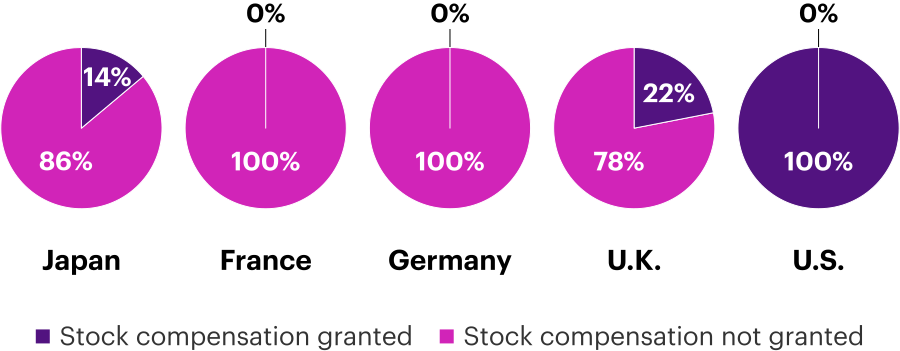
The proportion of Japanese companies that make grants of stock to NEDs as a part of their compensation program increased to 12 (approximately 14.5%) which represents the highest uptake of stock compensation for outside directors in Japan to date (Figure 2b). Total compensation for outside directors in the top 10% of the Japanese market has reached approximately JPY 30.5M (approx. 24% increase year-over-year). The significant increase in pay levels amongst the most highly remunerated outside directors in Japan is reflective of a bifurcation in NED compensation practice amongst domestic companies.
Grants of stock to NEDs is an effective approach to expanding NED compensation levels. There is a trend of large Japanese companies revising their NED pay structures to include stock compensation as part of their push to globalize operations. The use of stock compensation is seen to be particularly useful by many Japanese companies as it can increase alignment with shareholder interests, and is also an effective way to attract outside directors from the global talent market. Going forward, as Japanese companies continue to globalize their operations and seek to appoint NEDs from overseas markets, it will be beneficial for companies to reference U.S. practice in using both cash and stock (Figure 2) to compensate their directors.
However, a significant gap between Japan and the Western markets remains evident when it comes to differentiating compensation for NEDs that hold leadership positions. In the U.S. and Europe, it is considered best practice for independent outside directors to be appointed as chair of the Board, lead director and committee chairs, to ensure independence of oversight. Moreover, it is common practice to compensate outside directors with leadership positions higher than a regular outside director to best reflect the higher degree of responsibilities and increased time spent on meeting role expectations (Figure 3). Considering the rise in shareholder activism promoting improved corporate governance and strengthening corporate value in Japan, it is likely that shareholders will increasingly encourage companies to implement Western governance models which may include the appointment of external directors as the chair of the Board. To make this type of governance structure possible, designing outside director pay to reflect the increased responsibility of leadership positions will be an important step for Japanese companies to take going forward.
Outside director pay data was compiled by the WTW Global Executive Compensation Analysis team using public disclosures. Details of the analysis and basis of representation are as follows:
Source note: Outside director analysis reflects individual pay for Outside Directors in the U.S. market and Non-Executive Directors in the U.K., German and French markets in addition to fee policies of each company under analysis. For outside directors that are not lead independent director or chair or the board, the average compensation for all applicable directors is used to calculate median (1 data point per company). Chair of the Board data represents the total pay to the relevant director for each company. Japanese data points calculated by taking the average compensation payable on an individual basis by dividing the total number of outside directors by the total compensation paid to all outside directors.