On April 5, 2024, a Mw4.8 earthquake struck about 40 miles west of New York City, with the epicenter located near Tewksbury, New Jersey (Figure 1). The event produced widespread reports of low-to-moderate shaking across the region, including in New York City, northern New Jersey, and eastern Pennsylvania. However, there were no major injuries or significant damage to buildings recorded.
While this earthquake was not a notable event in itself, it serves as a timely reminder of the seismic risk present in the Northeastern U.S., which often gets overshadowed by the higher risk in other parts of the country such as California. Although relatively rare, damaging earthquakes can occur; Boston experienced a Mw6.0 event in 1755, and a Mw5.8 earthquake occurred in northern New York State in 1944. There have also been two significant events within the Greater New York City area, with magnitudes of Mw5.1 in 1737 and Mw5.3 in 1884.
While a damaging earthquake in New York City is considered unlikely, it is not an impossibility. Today, the city's high population density, valuable infrastructure, and large number of older, vulnerable buildings combine to create a high-risk environment for even moderate (Mw5.0 - 5.5) seismic events. In this Insight article, we use downward counterfactual analysis to ask the question “what if the April 2024 earthquake had been worse for New York City?”.
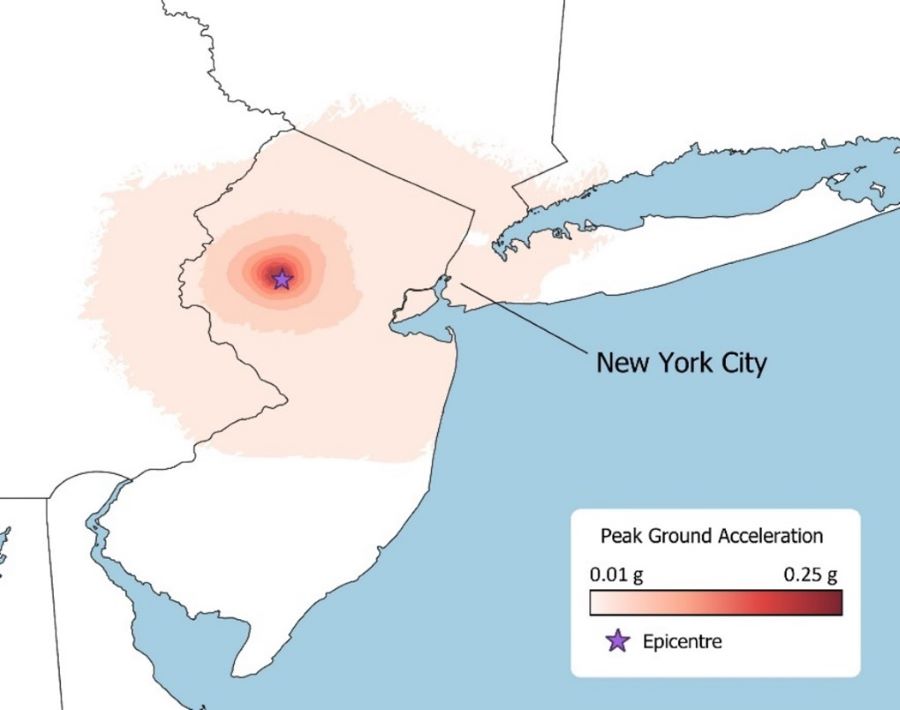
Figure 1 Peak Ground Acceleration for the 2024 Mw4.8 earthquake and location of the epicentre.
Data source: USGS.
Downward counterfactual analysis
Humans often react to major disasters by engaging in upward counterfactual thinking, in which we analyze past decisions and their outcomes using hindsight to identify what could have been done better. However, an equally important but often overlooked strategy is to apply downward counterfactual thinking, which involves imagining worse scenarios than those that occurred period.[1] Downward counterfactual analysis is a type of lateral thinking exercise that helps to identify vulnerabilities and enhance risk management by considering how a situation could have deteriorated.
In the (re)insurance industry, for example, downward counterfactual analysis is increasingly being used to examine near-miss events, like a hurricane narrowly avoiding a major city period.[2] Such scenarios are designed to help answer questions like "How could the financial loss have been worse?" and "What business actions should be implemented to prepare for such an event in the future?". This type of analysis not only helps (re)insurers plan for similar future events, but also strengthens overall risk management.
Given New York City's status as a major population and economic center, it is important to explore downward counterfactuals of the April 2024 earthquake. What if the event had been stronger or closer to New York City? How might this have affected the city's residents, businesses, and economy? These questions help in understanding potential impacts and enhancing preparedness for future seismic events.
Imagining worse outcomes for the 2024 earthquake
History is only a single realization from an enormous pool of possibilities, so searching for alternative “what-if” scenarios can be a time-consuming exercise. However, the process can be streamlined using natural catastrophe models,[3] which simulate thousands of physically plausible events that have not been observed in history.
Using a U.S. earthquake catastrophe model, we analyzed hypothetical earthquakes affecting New York State that fall within the historically observed magnitude range of Mw4.5 to Mw5.5. Catastrophe models include stronger earthquake scenarios above Mw6 in New York State, but such events are deemed very rare, with return periods exceeding 500 years, and so are excluded from our analysis. Instead, we focus on understanding how small, plausible perturbations to the recent earthquake could have led to larger financial losses and worse outcomes.

Related content
Figure 2 shows the locations of these modeled events and demonstrates how even slight changes in the location and magnitude of the April 2024 earthquake could have resulted in substantial losses. There is a concentration of potential events causing high insured losses in the vicinity of New York City, with some scenarios producing damages exceeding $100 billion. This high potential for loss reflects the city's vulnerability, exacerbated by many older buildings constructed from unreinforced masonry before modern seismic design codes were introduced in 1995.[4] Note that the size of the loss depends not only on the rupture location but also on the rupture depth, with shallower depths causing more intense ground shaking. This detail, however, is not depicted in Figure 2.
Supporting these findings, a 2003 study by the New York City Area Consortium for Earthquake Loss Mitigation (NYCEM) used probabilistic earthquake hazard modeling to estimate potential economic losses from a seismic event in the city. NYCEM projected that a Mw5.0 event could cause around $8 billion in damages (2024 USD), while a Mw6.0 event might result in losses of approximately $67 billion (2024 USD). These estimates have been adjusted for inflation since 2003; losses would be even higher if adjusted further for increased exposure over time.
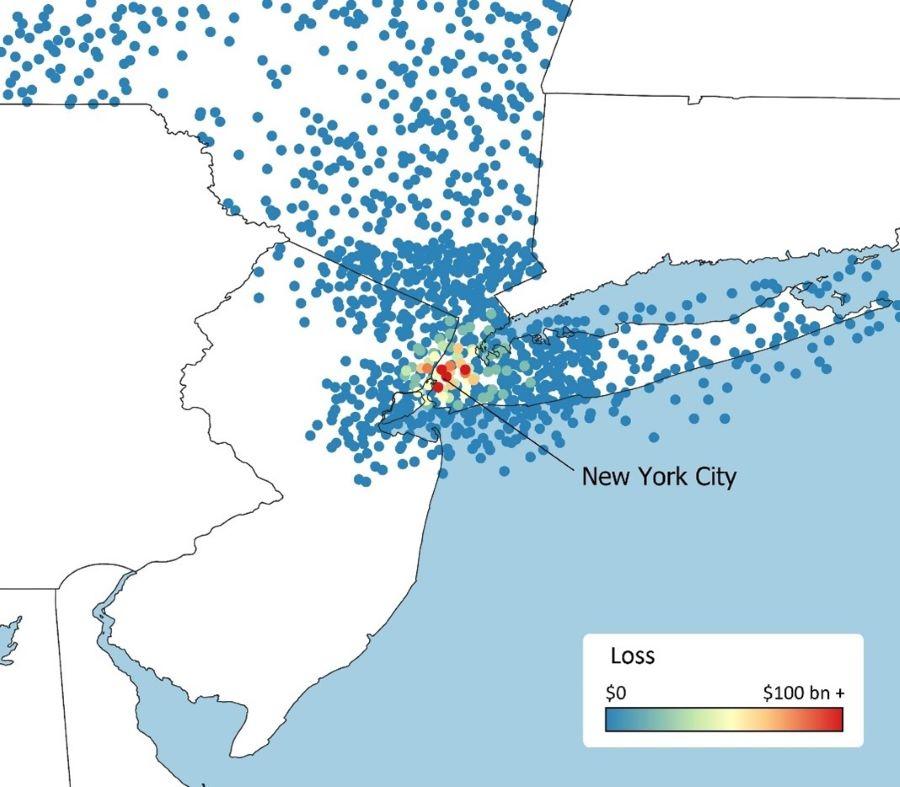
Figure 2 Insurance industry gross losses from Mw4.5– Mw5.5 earthquakes affecting New York State in the Moody’s RMS U.S. earthquake model. Each point represents the centroid of the rupture in the model. Only centroids in New Jersey and New York State have been included in the analysis.
Data source: Moody’s RMS.
Beyond catastrophe models
It is important to recognize that historical events can deteriorate in ways beyond just increasing property damage, which is the primary focus of catastrophe models. Therefore, when creating counterfactual scenarios that explore potentially worse outcomes, it's essential not to depend solely on these models. Including other sources of information and analysis is crucial to ensure a comprehensive risk assessment, especially in globally significant metropolitan areas like New York City.
For example, a severe earthquake in New York City could disrupt critical infrastructure, impacting transportation systems like subways, bridges, and tunnels with possible collapses and structural damages. Essential utilities such as water, gas, sewage, communication systems, and the electricity grid might be damaged, increasing the risk of fires and complicating rescue and recovery efforts. The disruption would extend to healthcare facilities, straining emergency services, and the overall response capability.
The economic repercussions could be profound. A significant earthquake could trigger widespread business interruption, with substantial insurance claims. On Wall Street, an earthquake could induce significant market volatility, driven by uncertainty and fear, potentially affecting global markets. Nonetheless, the adaptability shown during the COVID-19 pandemic suggests that many core business functions will be able to continue remotely, albeit with some disruption and displacement of employees.
Preparedness and resilience
As we have seen, even a moderate earthquake could severely impact New York City's infrastructure and economy. This possibility highlights the broader need for preparedness and resilience in the face of natural disasters—a challenge the Northeastern U.S. is already familiar with.
Hurricane Sandy is a prime example of an unexpected event that caused substantial damage to infrastructure, particularly in coastal areas. Similarly, severe flash flooding in September 2023 raised questions about disaster preparedness and the city’s resilience in a changing climate.[5] These events have created a more challenging property market, with the need for up-to-date property valuations becoming more prevalent. Insurers are now more frequently conducting on-site property visits.
Additionally, in 2023, Canadian wildfires caught authorities off-guard across the Midwest and Northeast U.S. The Air Quality Index reached a record-breaking high of 405ppm in New York City due to the smoke, highlighting the need to develop plans to protect residents during such events. This is an issue that U.S. Environmental Protection Agency has been tackling in recent years with their “smoke-ready” toolbox for wildfires.[6]
Although earthquakes impacting New York City are significantly less likely than storms, floods or wildfires, the potential consequences cannot be ignored. The insights gained from downward counterfactual analysis of the recent Mw4.8 event can inform ongoing efforts to enhance the city's resilience. By learning from past near-misses, risk managers, business owners, and residents can be better prepared for the future.
Footnotes
- Woo G, Maynard T, Seria J (2017),Reimagining history: counterfactual risk analysis Return to article
- Rye, C.J. and Boyd, J.A. (2022), Downward Counterfactual Analysis in Insurance Tropical Cyclone Models: A Miami Case Study Hurricane Risk in a Changing Climate. Return to article
- Mitchell-Wallace, K. et al. (2017), Natural catastrophe risk management and modelling: a practitioner’s guide, John Wiley & Sons. Return to article
- NYC Hazard Mitigation Plan Return to article
- WTW Natural Catastrophe Review July - December 2023. Return to article
- U.S. Environmental Protection Agency Smoke-Ready Toolbox for Wildfires. Return to article
Authors


There is a concentration of potential events causing high insured losses in the vicinity of New York City, with some scenarios producing damages exceeding $100 billion.