An annual analysis of CEO pay based on publicly available data from over 500 companies in Japan, France, Germany, the U.K., and the U.S, found that Japanese pay is on the rise. More companies are adopting frameworks that place a focus on at-risk pay, with long-term incentives now exceeding base salaries (at median). However, overall pay levels and the portion of pay linked to performance still lags compared to Western companies.
The key findings include:
- Median CEO pay in the U.S., U.K. and Germany increased year-over-year on a local currency basis due to an increase in all compensation components (base salary, annual incentive and long-term incentive) in the U.S. and increases in long-term incentive levels in the U.K. and Germany.
- Total CEO pay in France remained steady year-over-year on a local currency basis with a slight decrease in bonus levels impacting total pay.
- Median CEO pay in Japan increased by 7.2% with variable compensation comprising two-thirds of total pay and long-term incentives exceeding base salaries at median.
- ROE (at median) of Japanese companies remains subdued compared to the U.S. and the three European markets.
Compensation level and mix trends
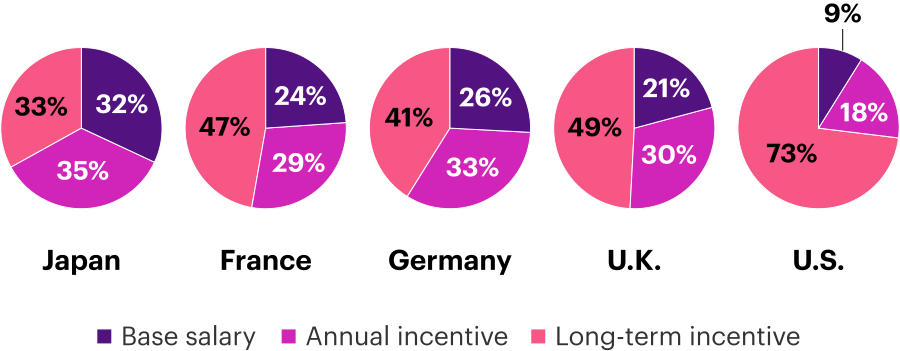
CEO compensation increased year-over-year in all markets, apart from France where pay levels did not see a significant change from the prior year in local currency terms (Figure 1). The upward trend was primarily driven by significant increases in long-term incentives which were up 17.8% in Japan and 7.5~10.0% in the U.S., Germany and France. The most remarkable growth of long-term incentives was observed in the U.K., where LTI was 33.2% higher than the prior year.
In addition to the continuing trend of compensation levels increasing in Japan, the results of the study appear to reflect a wider trend of European companies reviewing executive compensation programs to be more competitive with the U.S. as they aim to strengthen their ability to attract talent from global markets (Figure 2). As with prior years, financial performance reflects wider compensation trends whereby Japanese ROE levels remain weaker than in the U.S. and Europe (Figure 3).
Figure 3. Median ROE data
Median ROE dataSource: S&P Capital IQ
|
2024 ROE |
2025 ROE (Median values) |
| U.S. |
16.64% |
15.33% |
| EU (average) |
11.35% |
13.05% |
| U.K. |
11.63% |
16.16% |
| Germany |
9.51% |
11.10% |
| France |
12.90% |
11.88% |
| Japan |
9.85% |
9.66% |
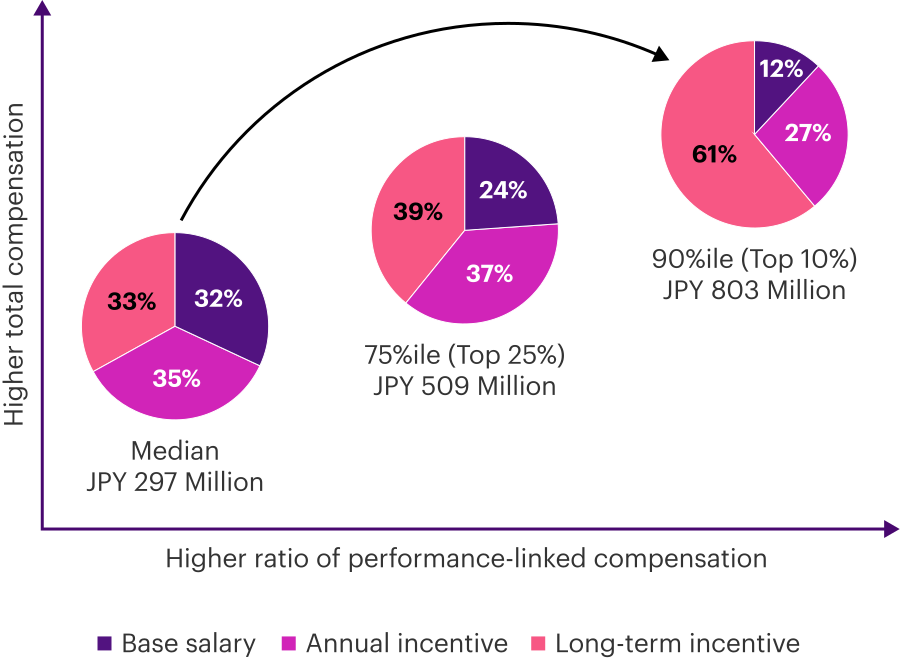
In Japan, median total compensation for CEOs reached JPY 297 million (representing a 7.2% increase from JPY 277 million in the prior year). At median, two-thirds of total compensation was comprised of variable pay (bonuses and long-term incentives) and long-term incentives exceeded base pay for the first time, reflecting the trajectory of expanding variable pay levels in Japan.
Furthermore, variable compensation makes up nearly 90% of CEO pay mix for companies that report total CEO compensation above JPY 803 million (representing the top 10% of the market; Figure 4) and is becoming competitive with European practice.
Figure 4. Compensation level and mix trends for Japanese companies
To date, there was a tendency for Japanese companies looking to globalize pay to set total compensation by loosely considering pay levels in the European region. However, a trend is emerging whereby European companies are increasing pay to match U.S. levels, citing the need to strengthen their ability to attract global talent. This means that simply referencing the entire European market rather than defining a competitive peer group may no longer be a sufficient rationale for Japanese companies to increase CEO pay levels.
If Japanese companies wish to globalize their compensation structures with a view to attract global talent, it will be necessary to go back to basics and define clear parameters for selecting a compensation peer group that includes companies that are key competitors for business and talent.
Moreover, as companies look to increase CEO compensation in Japan, it will become critical to explain how compensation was considered and set as a part of annual disclosures. In the U.S., and European markets, it is common practice to disclose the companies selected for the compensation peer group to demonstrate why the proposed pay structures are appropriate. If Japanese companies expand executive compensation offerings to mirror Western markets, there will also be an expectation that comparator companies are disclosed to gain understanding and support for proposed pay frameworks from the relevant stakeholders.
Finally, if companies cite a need to secure talent and improve competitiveness as a rationale for increasing compensation levels, it will also be necessary to clearly define the roles and responsibilities of executive positions that have global scope (such as the CEO). In tandem, the development of governance structures that allow the Board to flexibly replace executives if they are not meeting role expectations (succession planning and performance assessments), will also become an essential consideration going forward.
Footnotes