
In today’s volatile insurance market, a proactive approach to managing portfolios is becoming a critical differentiator. Many insurers have invested heavily in predictive analytics – building sophisticated pricing and risk models – but still operate in a largely reactive mode. The industry is now recognizing a gap in sophistication around portfolio management and the need for automated, advanced tools to close that gap.
In our opinion, those that embrace active portfolio management (APM) – continuously monitoring performance and adjusting strategy – are seeing markedly better results than those that don’t. Insurers with effective portfolio management achieve significantly better profitability with performance coming from actively steering the portfolio, rather than predicting outcomes and hoping for the best.
In this article, we explore what APM means in practice, and how Radar Vision – a new AI-driven tool – can help insurers adopt this approach.
What is active portfolio management?
With APM, an insurer proactively manages its book of business to meet strategic goals, rather than relying on static annual plans. It is a continuous, feedback-driven process that combines pricing, underwriting, claims, and strategic decision-making, enabling:
- Validation of assumptions in real time
- Monitoring performance through dynamic KPIs
- Detecting deviations between expected and actual performance
- Understanding and capitalizing on competitive advantages
- Adjusting strategy proactively based on emerging insights.
The alternative is a passive or purely predictive strategy, where companies might build excellent models but lack a feedback loop to respond when reality deviates from expectation.
Done well, APM is an ongoing cycle of insight–action–feedback that continually tunes the portfolio. The program will have plans for each portfolio segment, often tested with scenarios and backed by analytical techniques and robust monitoring in place. As a result, any deviation from the business plan can be identified and addressed quickly, keeping the company on course to meet its goals.
This proactive loop ensures no part of the book is left “untended.” Instead of waiting a full year to see results, the insurer is constantly monitoring and tuning its approach. Over time, this can yield a powerful cumulative benefit: issues are caught early (limiting losses), and profitable opportunities are capitalized on before competitors react. It’s the difference between steering a ship in real-time versus plotting a course at the start of a voyage and hoping the winds and tides and weather don’t change along the way.
A portfolio management framework
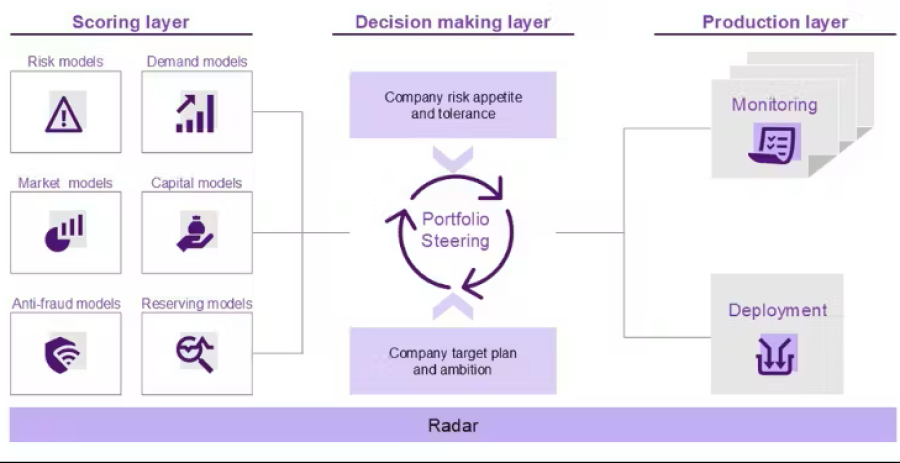
There exists a wide range of portfolio management frameworks, some more sophisticated and effective. But all have three distinct ‘layers’: a scoring layer; a decision-making layer; and a production layer. See Figure 1.
Scoring layer
The scoring layer enables predictive models to be evaluated on the in-force portfolio by scoring and ranking risks, segments, or decisions against predefined criteria. Insurers should fully leverage predictive modelling to support effective portfolio steering. This includes the core components of the pricing framework: risk models to predict expected future costs; demand models (e.g., conversion and retention) to capture customer behavior; and market models, where available, to benchmark competitiveness.
To gain a more holistic view of future profitability, these models should be integrated with capital models to reflect solvency and return constraints; reserving models to ensure technical adequacy; and anti-fraud models to anticipate claims leakage.
The interaction between these models enables a forward-looking, multi-dimensional view of expected costs and risks.
Decision-making layer
Once the models are applied, insurers must make strategic decisions within the boundaries defined by their risk appetite and tolerance, and by target business plans and ambitions.
This layer is where portfolio steering happens identifying which segments to grow, reduce, or reshape, based on profitability, growth potential, and alignment with strategic goals.
Production layer
After defining the strategy and setting commercial rates, insurers must ensure fast deployment through live rating engines and robust KPI monitoring to track performance in real time.
The essence of APM lies in the continuous feedback loop: continuous assessment of portfolio performance across its components, integrating insights into decision-making cycles. A dynamic monitoring system is key to seek out the unexpected: identifying emerging patterns, anomalies, and opportunities that may not fit traditional assumptions, and turning these into actionable insights.
This dynamic cycle is what transforms static planning into agile, data-driven portfolio management.
All too often we see an insurer’s pricing team build state-of-the-art risk and behavioral models and set rates accordingly at renewal time. But once the model outputs are deployed, the monitoring of performance may lag. Perhaps quarterly reports are generated to compare expected vs. actual results, but by the time an issue is evident, weeks or months have passed. This is essentially “predictive analytics on autopilot.” It assumes the predictions will hold true, with only periodic check-ins.
However, insurers with a strong technical discipline regularly monitor forward-looking KPIs—on a weekly or monthly basis—to track proactively performance, using metrics such as leakage or AP/TP.
Once underperforming profiles are identified, significant effort is dedicated to root cause analysis. Often, the drivers of loss can be traced back to non-technical pricing decisions, such as discretionary discounts or mispricing of specific segments.
Understanding performance patterns across profiles is essential to inform corrective actions and strategic steering. Even more critically, evaluating the impact of model changes through both statistical and financial KPIs enables timely and effective responses.
However, these activities require time, expertise, and resources, leaving many insurers to have to choose between sophistication and speed to market.
“Predict-and-act” analytics
What’s needed instead is a shift towards “predict-and-act” analytics – the ability to detect emerging changes quickly and respond in near-real-time. For example, if claims inflation starts accelerating due to a new social trend, or because a competitor radically changes their pricing, an insurer practicing active management would catch the deviation early (via monitoring metrics) and adjust course within weeks or even days. Yet, many insurers today lack this immediacy in their processes. And, as noted above, truly active, AI-driven portfolio monitoring has not yet been widely adopted across some markets. But those who are at the leading edge are seeing material business benefits.
It’s important to clarify the operational enablers that make APM truly effective. APM is not just about having the right models—it’s about embedding them into a system that is:
- Automated: data flows and analytical processes must be fully automated to reduce manual effort, lower costs, and ensure scalability.
- Fast: the system must support near real-time monitoring and decision-making, enabling insurers to react to deviations or opportunities within days—not months.
- Actionable: insights must be translated into clear, targeted recommendations, so that senior leaders can focus their attention where it matters most.
This is where advanced tools come into play.
We explicitly identified this shortfall, clients often had excellent models but needed automated and advanced tools for monitoring and management.
AI-powered monitoring in Radar
Radar Vision was built to complement the existing Radar pricing software, but with a new focus: continuous model monitoring and insight generation. The premise is to harness AI to do what humans cannot do continuously or quickly enough – comb through vast amounts of live data and flag the important changes as soon as they occur. As Pardeep Bassi, WTW’s Global Proposition Lead for Data Science, explains:
“Radar Vision cuts through complexity to deliver monitoring that discovers actionable insights faster, offering a competitive edge and driving business performance.”
Pardeep Bassi | Global Proposition Leader - Data Science, Insurance Consulting and Technology
“Insurers in today’s market deploy and maintain large, expansive predictive model estates. Radar Vision cuts through this complexity to deliver monitoring that discovers actionable insights faster, offering a competitive edge and driving business performance.”
In other words, Radar Vision is designed to watch an insurer’s portfolio like a hawk, automatically crunching up-to-date data and alerting teams to emerging trends or anomalies. It leverages AI algorithms to spot patterns that would be hard to catch with static reports. Crucially, it doesn’t just raise flags – it provides insight into what is happening (e.g. “claims frequency in Segment X is 15% above expected in the last 2 weeks”) and indicate why (e.g. “this increase appears driven by a spike in theft claims, possibly linked to recent economic changes”).
Some key capabilities and benefits of Radar Vision
With these capabilities, AI-driven monitoring tools like Radar Vision enable true APM at scale. They act as the always-on eyes and ears of the portfolio, freeing up human experts to focus on strategy and decision-making. Rather than replacing human judgment, such tools augment it: the analytics “engine” works continuously in the background, and the underwriting or pricing leaders can then apply their expertise to the insights generated. This aligns perfectly with the APM cycle described earlier; Radar Vision essentially turbocharges the APM cycle whilst providing a safety net. If something unexpected starts occurring, the tool will catch it even if analysts are busy with other tasks.
Many insurers have been slow to adopt these practices, with the focus traditionally on model building (predictive analytics) rather than model monitoring. The launch of Radar Vision signals a shift: a step-change in how insurers manage their business post-model-deployment. In the words of WTW’s announcement, it: “signals a step change in business performance and profitable growth” for insurers.
Don’t get left behind!
In an environment where insurance landscape is evolving rapidly, with economic shifts, competitive pressures, and new risks constantly emerging, sticking with a static or purely predictive approach is a liability. Active portfolio management, especially when powered by cutting-edge AI tools, is quickly becoming a must-have capability. It allows insurers to navigate volatility with agility and to turn data into decisions in a continuous loop.
“Active portfolio management, especially when powered by cutting-edge AI tools, is quickly becoming a must-have capability.”
Dr. Massimo Cavadini | Head of Product, Pricing, Claims and Underwriting for Continental Europe, Insurance Consulting and Technology
Radar Vision’s introduction is timely. It provides a practical means for insurers to embrace this active approach without having to build all the infrastructure themselves. But technology alone won’t transform an organization; commitment from leadership and a willingness to change processes are equally necessary.
In summary, insurers should seize this moment to evolve. Those who shift their focus from just predicting risk to actively managing it – leveraging automation and AI for constant vigilance – will be better equipped to profit and grow in the years ahead. The gap in adoption, is an opportunity: a chance for forward-thinking insurers to leap ahead of their peers.
The time for “predict and forget” is over.
Authors