Integrating wellbeing strategies with human capital goals fosters a sustainable culture and drives business success.
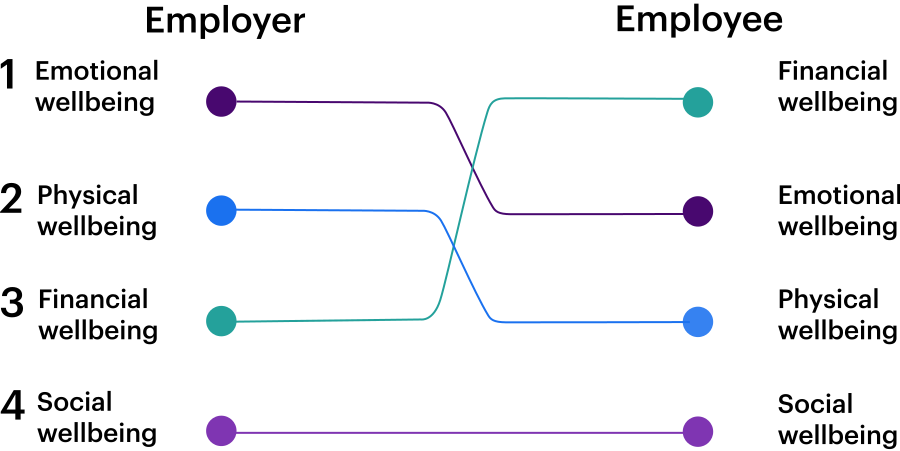
Today, India is considered as one of the world's fastest-growing economies, thanks to rapid economic expansion, technological advancement and demographic transformation. Many feel that the country is also leading the way in many sectors, particularly in the global capability centre (GCC), financial services, hi-tech, pharmaceutical and manufacturing. Employees in India are eager to be part of this rapid growth and over 70% agree – their benefits package is a major reason for joining or staying with an employer, as highlighted in our 2024 Global Benefit Attitudes Survey – India. However, the survey results also show a notable gap in the wellbeing priorities of employers versus employees (Figure 1).
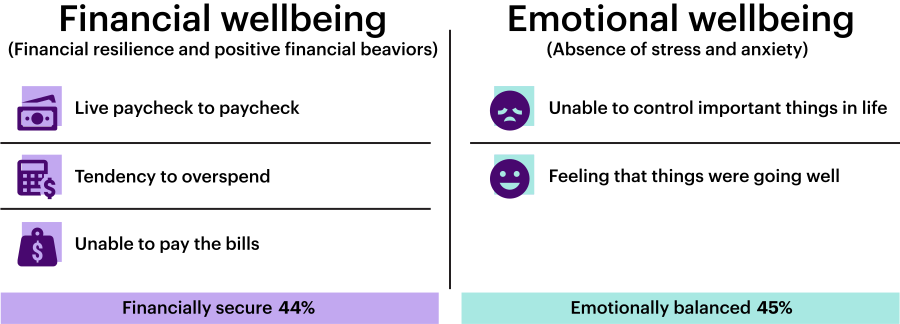
Most employers in India believe that emotional wellbeing is a top priority, followed closely by physical wellbeing. This is clearly demonstrated through the focus on provisions for health and insurance benefit offerings alongside mental health support. While employees appreciate their employers’ support for their emotional and physical health, most of them placed greater importance on financial wellbeing – with a majority citing job security and the higher cost-of-living as key drivers for this need. Less than half of workers in India feel financially secure enough to not live pay check to pay check (Figure 2). The 2024 Global Benefit Attitudes Survey – India reported that, employees who feel financially vulnerable are three times more likely to get a short-term loan for expenses and almost seven times more likely to miss a medical appointment due to money issues.
Figure 1 – Employer priorities are misaligned with employee needs
Employees in India are increasingly relying on their employers to help them get better deals and selections for their benefits package. This presents a huge opportunity for organisations to make wellbeing an essential part of their human capital strategy for attraction and retention. By moving beyond traditional wellness initiatives and adopting a holistic approach, employers in India can bring forth a new workplace reality.
Figure 2 – Less than half of employees in India feel financially and emotionally secure
Future focus areas for employers
Here are four crucial actions for organisations to take, as they transition from traditional wellness initiatives to a more holistic wellbeing strategy.
01
Prioritise ‘high risk’ employees
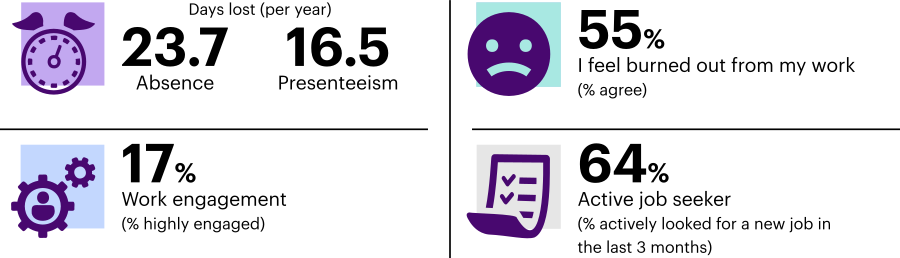
One in every 10 employees in India is at a ‘high risk’ of experiencing detrimental outcomes to their wellbeing. They are financially vulnerable, suffer from poor health and may be emotionally unbalanced. According to the 2024 Global Benefit Attitudes Survey – India, such employees are active job seekers, have low engagement at work, report being burned out and have high absenteeism and presenteeism (Figure 3).
Figure 3 – ‘High risk’ employees are struggling with being present, healthy and engaged at work
Clearly, traditional approaches will not be sufficient to make a palpable impact. Instead, focus on a ‘value on investment’ approach that looks across the core pillars of employee wellbeing, in order to create a truly supportive plan for ‘high risk’ employees.
02
Use employee listening strategies and data analytics
Our 2024 Global Benefit Attitudes Survey – India found that, employees who are more satisfied with their overall wellbeing support, have observed that their employers have a high awareness of their views and challenges at work. Leveraging an effective method for employee listening and wellbeing diagnostic tools, can help organisations to realise the correlation of people analytics with employee behaviours and wellbeing strategies. This can uncover insights and root causes of wellbeing issues. For example, targeted and measurable actions to address the needs of ‘high risk’ employees.
Findings from the 2024 Global Benefit Attitudes Survey – India show that, employers’ high awareness and communication efforts have encouraged employees to maximise their benefits and to trust the tools and services provided by their employer. All these inevitably leads to a significant level of wellbeing – and employers could even gain the desirable byproduct of employees becoming more loyal to their employer, thus happily recommending their workplace to other jobseekers.
03
Develop a multi-year roadmap that aligns wellbeing investments with broader business goals
Traditional approaches involved looking at market benchmarks, focusing on return on investment and measuring the effectiveness of wellness activities against healthcare costs. However, there is a stronger case to be made nowadays on the measurable correlation between positive employee behaviours and business outcomes.
For instance, burnout can be linked to symptoms such as disengagement at work and days lost to presenteeism. By collecting ‘intangible’ metrics, such as reviewing the frequency of sick leaves vis-à-vis overtime applications, organisations could correlate wellbeing investments with behavioural patterns, including retention rate, engagement and productivity.
04
Leverage a mix of high-tech and high-touch solutions for a personalised wellbeing experience
With the abundance of intuitive and customisable technologies for delivering wellbeing resources in a personalised and engaging way, many employers are probably facing ‘option paralysis’. Employers may be struggling to formulate a digital approach that is effective, flexible and affordable.
Before shopping for a digital solution, it’s crucial to ensure a strong alignment between wellness and human capital strategies. Identify key business goals and the appropriate employee data to measure value on investment. And then design a wellness ecosystem that fully supports these objectives.
By integrating wellbeing strategies with human capital goals, employers can more effectively bridge gaps and address what matters more to their workforce. More importantly, they would nurture a holistic and sustainable culture of wellbeing among employees, leading to long-term business growth and success.
Please fill the form on the webpage to download the complete whitepaper for more information on insights from our latest surveys.