Choose your location
Select the location and the language that you prefer


main content, press tab to continue
Infographic
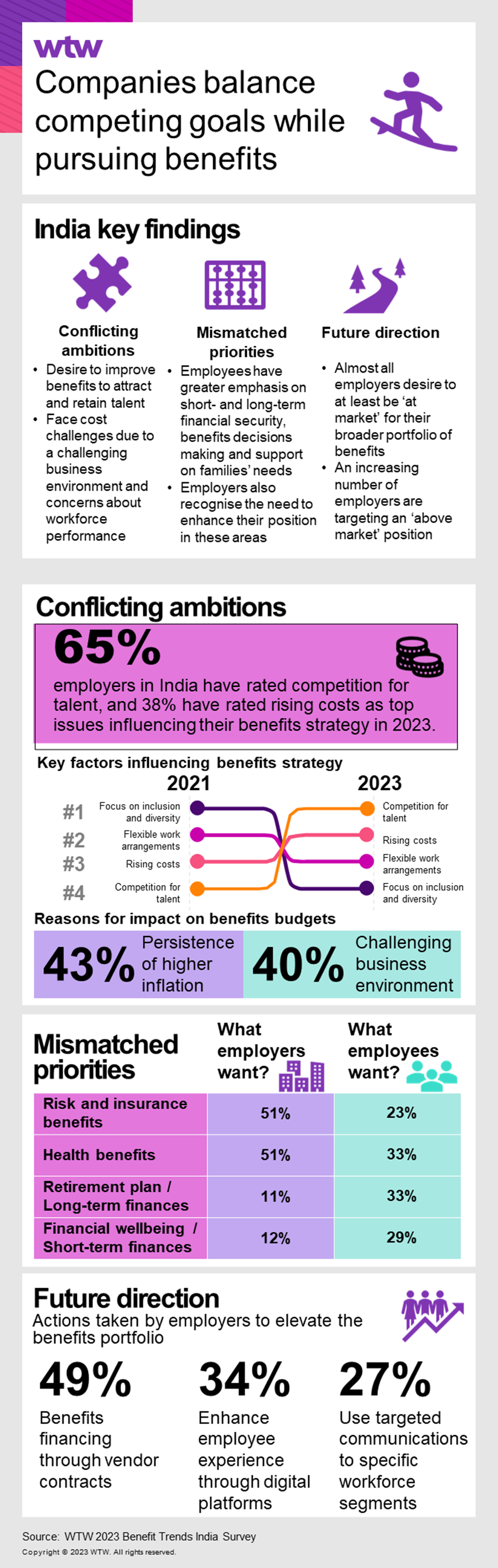
Infographic: 2023 Benefit Trends Survey India Highlights
Snapshot of 2023 Benefits Trends India Survey India findings that reflect responses from 364 companies.
Conflicting ambitions
- Desire to improve benefits to attract and retain talent
- Face cost challenges due to a challenging business environment and concerns about workforce performance
Mismatched priorities
- Employees have greater emphasis on short- and long-term financial security, benefits decisions making and support on families’ needs
- Employers also recognise the need to enhance their position in these areas
Future direction
- Almost all employers desire to at least be ‘at market’ for their broader portfolio of benefits
- An increasing number of employers are targeting an ‘above market’ position
Conflicting ambitions
- 65% employers in India have rated competition for talent, and 38% have rated rising costs as top issues influencing their benefits strategy in 2023.
Key factors influencing benefits strategy
| 2021 | 2023 | |
|---|---|---|
| 1 | Focus on inclusion and diversity | Competition for talent |
| 2 | Flexible work arrangements | Rising costs |
| 3 | Rising costs | Flexible work arrangements |
| 4 | Competion for talent | Focus on inclusion and diversity |
Reasons for impact on benefits budgets
- 43% Persistence of higher inflation
- 40% Challenging business environment
Mismatched priorities
| What employers want? | What employees want? | |
|---|---|---|
| Risk and insurance benefits | 51% | 23% |
| Health benefits | 51% | 33% |
| Retirement plan / Long-term finances | 11% | 33% |
| Financial wellbeing / Short-term finances | 12% | 29% |
Future direction
Actions taken by employers to elevate the benefits portfolio
- 49% benefits financing through vendor contracts
- 34% enhance employee experience through digital platforms
- 27% use targeted communications to specific workforce segments
Source: WTW 2023 Benefit Trends Survey India Findings
Download
| Title | File Type | File Size |
|---|---|---|
| Companies balance competing goals while pursuing benefits | .1 MB |

