
With listings in London having declined by 40% since 2008, there has been recent debate on the attractiveness of London as a destination for organisations to access capital. It appears that the Financial Conduct Authority (FCA) are prepared to act having recently opened consultation on proposals to streamline the listing rules. These proposals notably include replacing the existing ‘standard’ and ‘premium’ listing segments and a simplification of the admissions process which the FCA hope will attract more organisations to London and boost economic growth.
In recent months we have also observed influential stakeholders adding to this discourse on UK competitiveness through the lens of executive pay. There has been active discussion in the UK press on the role and influence of proxy advisors and the difference in pay levels between the UK and US with the latter being the subject of a recent research publication by the Financial Reporting Council.
There has been active discussion…on the role and influence of proxy advisors and…pay levels between the UK and US
We have seen the discussion play out during the 2023 AGM season with several FTSE 100 organisations who have significantly increased pay levels citing the need to be competitive against the US market. At the other end of the debate are those that cite growing income inequality and the current cost of living crisis as reasons why executive pay should not increase.
This was the topic of our recent webcast where we were joined by Andrew Ninian, Director, Stewardship, Risk and Tax at the Investment Association, and Matthew Roberts, Associate Director, Stewardship at Fidelity International, for a panel discussion. If you missed this discussion then you can access a recording on the right.
In this edition of Executive Pay Memo, we take a deeper dive on some of the key issues of the debate so far.
Proxy voting agencies
Summary of differences between regional ISS and Glass Lewis voting policies
One of the areas that has received particular attention is the role and influence of proxy advisors in the UK. We conducted an analysis of ISS and Glass Lewis’s executive pay voting policies across three major regions - UK and Ireland, Continental Europe, and North America:
| Highly prescriptive | ||
 |
United Kingdom |
|
|---|---|---|
  |
|
|
| Less prescriptive | ||
 |
United States |
|
https://www.issgovernance.com/file/policy/active/emea/UK-and-Ireland-Voting-Guidelines.pdf
https://www.glasslewis.com/wp-content/uploads/2021/11/UK-Voting-Guidelines-GL-2022.pdf
At one end of the spectrum is the prescriptive UK and Ireland framework where there is an overt emphasis on pay fairness (and restraint) relative to the wider workforce. At the other end of the spectrum is the US voting framework which is materially less prescriptive and there is a greater focus on pay for performance and alignment of executive pay with the shareholder, rather than the wider stakeholder, experience. Whilst this contrast in philosophies is driven by the underlying governance environments, it does acutely highlight the broader set of considerations that UK Remuneration Committees must typically consider when determining executive pay outcomes.
Share plan dilution limits are another area of contrast. From a UK and Ireland perspective, dilution limits have long been set in relation to the Investment Association’s guidance, leaving companies with limited flexibility to increase dilution based on company-specific factors (e.g., lifecycle or industry). By comparison, in the European and US contexts investors and proxies tend to take a more holistic view on what constitutes acceptable dilution based on peer practice. Interestingly, this AGM season we have observed a FTSE 250 BioTech organisation adopt dilution limits more aligned to US practice citing the need to compete with US peers – the proposals received overwhelming shareholder support.
Whilst there are clear differences in the voting policies – how do ISS and Glass Lewis voting recommendations, shareholder voting outcomes and voting alignment with ISS and Glass Lewis recommendations compare between the US and UK?
We analysed ISS and Glass Lewis recommendations for the FTSE 100 and S&P 500. Whilst it is certainly the case that the voting policies differ, interestingly the proportion of ‘Against’ recommendations in both regions is very similar, with a slightly higher prevalence of ‘Against’ recommendations in the S&P 500 compared with the FTSE 100:
| Proxy adviser recommendations | 2022 remuneration / say on pay resolutions | ||
|---|---|---|---|
| FTSE 100* | S&P 500* | ||
| ISS | For | 89% | 88% |
| Against | 11% | 12% | |
| Glass Lewis | For | 89% | 86% |
| Against | 11% | 14% | |
Information sourced from:
ISS Proxy Analysis & Benchmark Policy Voting Recommendation reports; Insightia.
It is a similar picture in terms of shareholder voting outcomes, with a slightly higher prevalence of failures in the S&P 500 compared with the FTSE 100:
| Voting outcomes | 2022 remuneration / say on pay resolutions | |
|---|---|---|
| FTSE 100* | S&P 500* | |
| Average support | 91% | 88% |
| Median support | 94% | 93% |
| Failures | 1% | 4% |
Information sourced from:
ISS Proxy Analysis & Benchmark Policy Voting Recommendation reports; Insightia.
We also analysed the alignment of ISS and Glass Lewis recommendations and shareholder voting outcomes between 2018-2022 from some of the largest institutional investors who combined have assets under management of approximately $45bn:
| 2022 remuneration / say on pay resolutions | ||||
|---|---|---|---|---|
| FTSE 100* | S&P 500* | |||
| Investor | ISS Match (%) | GL Match (%) | ISS Match (%) | GL Match (%) |
| Lower Quartile | 90.3 | 87.7 | 80.1 | 79.9 |
| Median | 91.9 | 90.3 | 88.1 | 87.1 |
| Average | 92.1 | 89.1 | 84.5 | 82.5 |
| Upper Quartile | 96.7 | 91.7 | 90.2 | 89.5 |
The data tells us that shareholder voting outcomes are better aligned with ISS and Glass Lewis recommendations for the FTSE 100 rather than the S&P 500 by the order of 3-4 percentage points at median. Note that whilst there are a high number of variables underpinning the numbers, we can at least tentatively conclude that ISS are more influential from a voting perspective in the UK than in the US.
UK and US executive pay levels and structure
As highlighted during the webcast, whilst executive pay levels in the US are materially higher than the UK, it should not be overlooked that US businesses are typically significantly larger than UK businesses:
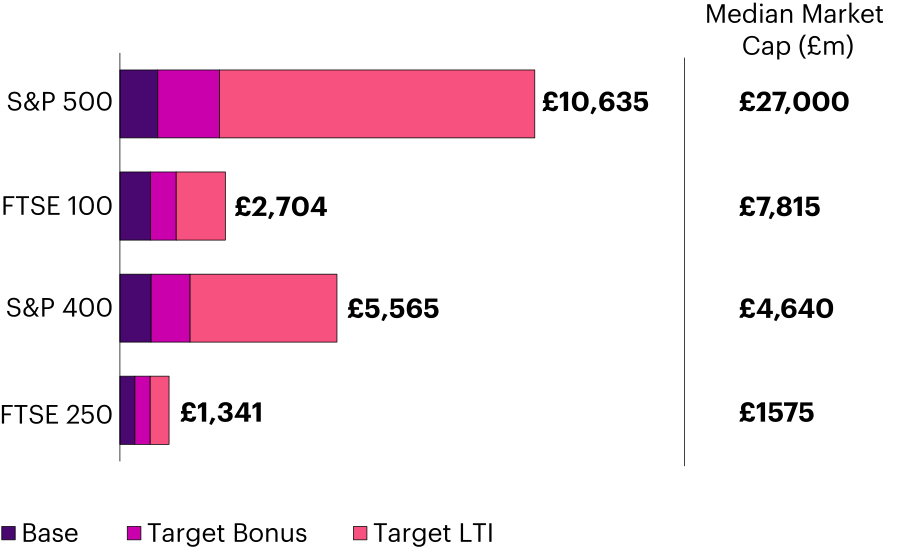
Note that LTI represents a ‘target’ / expected value due to US equity including performance and time-vested components
In the US this is the disclosed accounting value of awards during the year
In the UK this is an estimated target based on a 60% adjustment factor for performance-based awards
Notwithstanding the above, from discussions we are observing at Board level, there does appear to be growing sentiment within some FTSE 50 organisations genuinely exposed to the global talent market that pay levels need to be increased to compete with US and other global peers, as well as competitors outside the listed company space. In some organisations we have observed cases where US-based candidates are hired at executive committee level and whose pay levels compress the pay structure in relation to the executive directors.
US businesses are typically significantly larger than UK businesses
The results indicate that the executive talent market is truly global with 38% of respondents indicating that it is highly likely and 45% indicating it is a possibility.
80% of respondents rated the UK’s approach restrictive, or very restrictive. Whilst the focus of the debate has so far centred on pay levels versus the US, we highlighted during the webinar the structural differences in pay between the UK and US driven by the corporate governance environments. These include shareholding and post-cessation guidelines, mandatory bonus deferral, and long-term incentive holding periods, some of which were government interventions in response to high-profile corporate failures.
Perhaps unsurprisingly, quantum is highlighted as the biggest challenge, followed by investor / proxy views.
Nearly a third of respondents indicated that they would be prepared to do something contrary to UK norms and accept the potential voting implications. This aligns with what we are hearing from Boards who are now, more than ever, generally prepared to accept a lower vote in return for increased pay opportunities and more tailored pay arrangements, provided there is a clear business case for doing so.
What next?
Where an organisation chooses to list is driven by a multitude of factors including the anticipated investor base, tax, legal, accounting, and regulatory considerations. Executive pay, although high profile and emotive, is unlikely to be a determining factor in this decision.
Nevertheless, the general sentiment we heard in our recent webcast is that, whilst executive pay in the UK is far from broken, the prescriptive nature of proxy and shareholder guidance has led to inflexibility in pay structures and a reduction in the perceived value of executive pay. The issue of pay levels versus the US or other global talent competitors does not affect all FTSE companies but is a concrete challenge in certain industries/company types. The combination of inflexibility and uncompetitive pay levels is causing genuine concern in some UK-listed companies that they are not competitive in the global executive talent market and that this positioning is a material risk to organisational success. This AGM season we have seen Boards prepared to act on quantum and we expect this trend to grow in future, and perhaps even to spill over into issues of reward design.
Whilst executive pay in the UK is far from broken, the prescriptive nature of proxy and shareholder guidance has led to inflexibility in pay structures
Authors



2023 Remuneration Committee webcast
We cover the latest trends and insights for boards.