
Introduction
Ensuring that buildings adhere to national building codes is often a labor-intensive, error-prone, and time-consuming process. This task becomes even more daunting when considering the numerous versions of building codes within a country, especially for older structures that may have been compliant with outdated regulations but no longer meet newer standards. Identifying discrepancies between building codes and actual fire safety in buildings poses a significant challenge for fire risk managers and building owners.
In response to these challenges, a recently published[1] study led by a team of researchers from Loughborough University, supported by the WTW Research Network, has addressed these issues by developing an innovative method for automated fire risk compliance checking with building codes. This study utilizes Artificial Intelligence (AI) to directly interpret raw building blueprints. By leveraging computer vision and deep generative models, the research offers a comprehensive, flexible, and highly efficient approach to managing building fire risks.
The method has been validated using sections of the UK Building Regulations, demonstrating the feasibility of the proposed approach. The promising results suggest that this system could potentially be expanded to include worldwide building codes, significantly changing how we today are controlling whether buildings are compliant with the building code.
AI blueprint interpretation and risk assessment
A fundamental aspect of this research is the development of an AI system capable of accurately interpreting building blueprints to assess non-compliant fire risks. This system leverages advanced computer vision techniques to process both paper-based and digital blueprints, extracting critical information and evaluating the building’s compliance with building regulations. The goal is to automate the traditionally labor-intensive and error-prone process of blueprint analysis, providing a quicker method for identifying potential fire hazards.
How is this done?
To achieve this, a series of advanced image processing and machine learning techniques are employed:
Step 1: Blueprint standardization and interpretation
The first step involves preprocessing the raw blueprints to create a uniform format suitable for further analysis. This process begins with resizing the blueprints to a standard dimension, ensuring consistency across different types of blueprints. Following this, denoising techniques are applied to remove any unwanted visual artifacts, which enhances the clarity of the blueprints. The next step, binarization, converts the images to black and white, simplifying the task of distinguishing between different elements of the blueprint. Finally, morphological processing techniques, such as erosion and dilation, are employed to refine the image features, making structural elements like walls and doors more prominent and easier to identify.
Step 2: Layout extraction and room classification
Once the blueprints have been standardized, the AI system utilizes computer vision algorithms to interpret them. This involves several key tasks. Firstly, contour detection algorithms identify the outlines of rooms and other structural elements by detecting edges within the image. Next, color detection is used to recognize different colors in the blueprint, which often denote various features or materials. Following this, Optical Character Recognition (OCR) technology extracts textual information such as room labels and dimensions. This helps in classifying each room based on its intended use, such as a bedroom, kitchen, or hallway. By segmenting the blueprint into distinct areas and understanding the layout, the AI system can build a comprehensive map of the building’s interior.
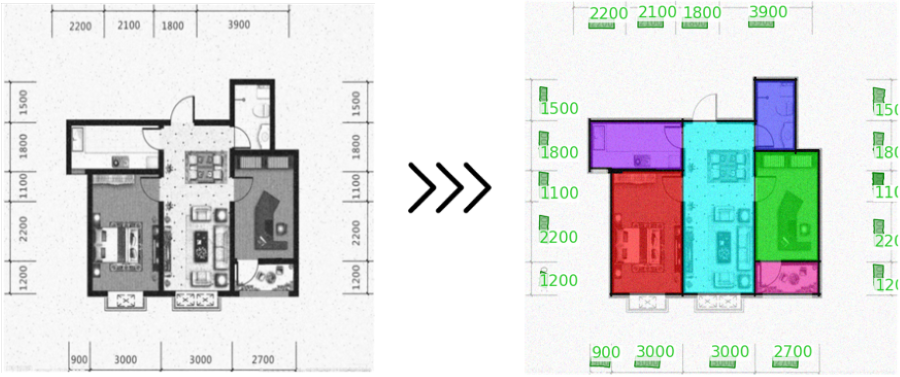
Images of contour detection algorithms identifying outlines of structural elements followed by OCR extracting textual & colour information of room names and dimensions.
Step 3: Fire risk compliance checking
With the extracted layout from interpreted blueprints in hand, the system proceeds to evaluate the fire risks. This involves analyzing the building's layout for compliance with building regulations using a knowledge-based algorithm. A key aspect of this assessment is determining the Maximum Travel Distance (MTD), which is the furthest distance a person must travel to reach an exit in case of a fire.
- Room Connectivity Graph: The AI creates a graph representing the connectivity of rooms and exits, using nodes (rooms) and edges (connections like doors).
- MTD Calculation: Based on the Room Connectivity Graph, the system calculates the MTD for each room, ensuring that all travel distances meet regulation standards.
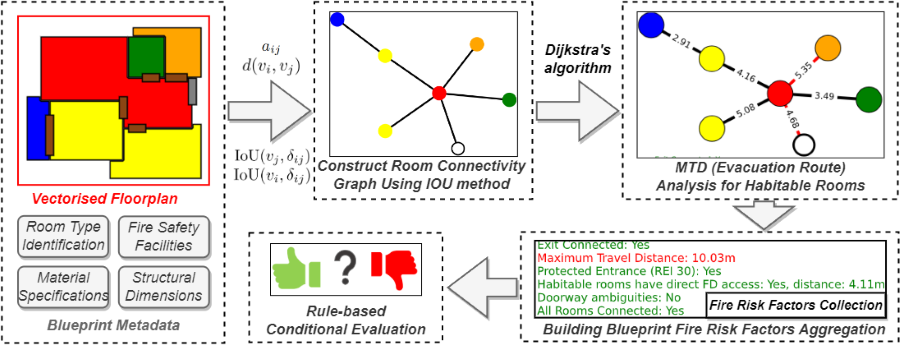
Drawing of AI designed blueprint which continues to refine itself.
Risk mitigation by generative AI
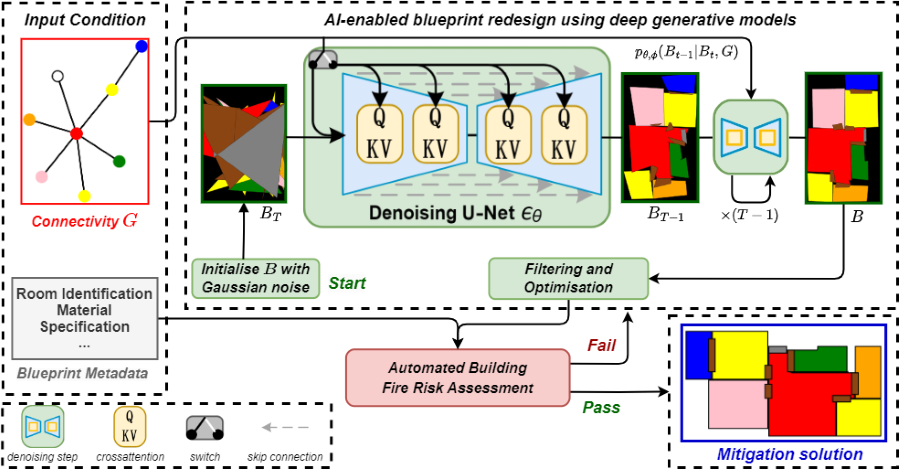
A crucial component of this research is the use of generative AI models to mitigate non-compliant fire risks identified in building blueprints. Once potential fire hazards are detected through the automated assessment process, the AI system steps in to redesign the floor plans, ensuring they comply with the adopted regulations.
How is this done?
To achieve effective risk mitigation, the research utilizes deep generative models, specifically diffusion models, to redesign building layouts:
Step 1: Generative model training
The deep generative model is trained on a large dataset of building floor plans. This training involves learning the patterns and structures that constitute safe and compliant building designs.
- Data Collection: A comprehensive dataset of floor plans is gathered. This includes various types of buildings to ensure the model can generalize across different architectural styles and layouts.
- Model Training: The model learns to generate new floor plans by analyzing the dataset. It uses techniques like neural networks to understand the relationships between different elements in a floor plan.
Step 2: AI-based blueprint redesign
Once the model is trained, it is used to redesign blueprints that have been identified as non-compliant or hazardous during the risk assessment and compliance checking phase.
- Identifying Non-Compliant Areas: The AI system highlights areas in the blueprint that do not meet regulatory standards. This includes issues like excessive Maximum Travel Distances (MTD) and inadequate exit placements.
- Generating New Designs: The generative model proposes new designs that address these issues. It modifies the layout to reduce MTD, improve exit placements, and enhance overall compliance.
Step 3: Iterative refinement
The redesign process is iterative, meaning the model continuously refines the proposed blueprint until it meets all fire risk standards.
- Feedback Loop: Each new design is evaluated for compliance. If it still has issues, the model receives feedback and makes further adjustments.
- Convergence: The process continues until the design is fully compliant with building regulations. This ensures a high level of reliability in the final blueprint.
Graph created by AI representing the connectivity of rooms and exits, using nodes (rooms) and edges (connections like doors).
This new approach bypasses the need for in-depth knowledge of national building codes and BIM data, simply utilizing raw building blueprints instead. Not only does this broaden the applicability of fire risk assessments, but it also significantly reduces the time and cost associated with these processes, making it feasible to assess more buildings than is currently possible.
By incorporating advanced computer vision techniques, this method can automatically process both paper-based and digital blueprints, extracting critical building information and evaluating compliance with building codes. The inclusion of a deep generative model to redesign unqualified blueprints further provides architects and engineers with a tool that not only identifies risks but also suggests actionable design modifications. This dual capability streamlines the entire process from assessment to mitigation, making it a valuable asset for building owners, and fire risk managers.
This technology has far-reaching applications. Firstly, it aids building inspectors by swiftly and accurately assessing compliance with regulatory standards, eliminating the need for manual inspections of every detail. During construction, project managers utilize the tool to ensure adherence to building codes, thereby minimizing errors and delays. In real estate transactions, buyers and sellers leverage the tool to verify compliance as part of due diligence, preempting potential issues before finalizing deals. Architects and engineers rely on its capabilities during renovation and retrofitting projects, ensuring proposed changes comply with codes, thus expediting the design process. Furthermore, in urban planning, city planners harness the tool's insights to evaluate proposed developments, fostering safer and more sustainable communities by ensuring compliance with zoning and building regulations.
Footnote
Authors