The phrase "tipping point" was first popularized in 2000 by the author Malcolm Gladwell, who wrote about how seemingly minor changes in a system can accumulate to create a “moment of critical mass” that has a major impact[1]. Gladwell primarily discussed tipping points caused by social contagion, which is when behaviors and attitudes spread through social interactions, such as trends in fashion, music, or crime. But tipping points also exist in many natural systems, including the Earth’s climate.
Traditionally, climate tipping points have been best understood as a transition from one base state to another.
The Intergovernmental Panel on Climate Change defines a tipping point as a critical threshold beyond which a system re-organizes, often abruptly and/or irreversibly[2]. Traditionally, climate tipping points have been best understood as a transition from one base state to another (also known as bifurcation-induced tipping). The transition is usually associated with a gradual change in a variable – such as global mean temperature – to the point where it passes a critical threshold, beyond which bifurcation takes place and the system tips into a different state. Scientists have identified at least 15 potential climate tipping points, including rainforest dieback, ice sheet melting, and the thawing of permafrost[3].
Climate tipping points increase economic risk globally[4], and as a result, there have been recent warnings that if insurers do not account for these thresholds in their scenarios, they will be underestimating their climate change exposures[5], [6]. However, there is a less obvious but equally important risk that insurers are overlooking: if the rate of change in a variable is too fast, it can lead to sudden changes in a system without a bifurcation point being crossed.
Rate-induced risks

A recent review paper led by Paul Ritchie from the University of Exeter argues that when it comes to generating tipping points in natural and human systems, the rate of change in external forcing is often more important than the absolute change[7]. This is because when an external forcing is applied to a system, it usually responds by adjusting to find a new equilibrium. But if the rate of change of the forcing is too rapid, the normal balancing forces that keep a system in check cannot keep up. As a result, the system becomes unstable and tips before reaching a bifurcation threshold. This behavior is known as rate-induced tipping.
Inflation is a recent example that many of us will be familiar with. Over the past two years, countries around the world have seen above-target inflation, prompting central banks to respond by raising interest rates. The goal is usually to increase interest rates until a critical threshold is reached, which reduces spending in the economy and, as a result, prices, and inflation. However, raising interest rates too quickly can overwhelm an economy’s ability to deal with the change. This generates a rate-induced tipping point before the planned threshold is realized, resulting in financial instability and a more severe slowdown than intended.
The same thinking can be applied when it comes to climate change. As the global mean temperature increases, the Earth’s system (and subsystems) adjusts to achieve a new equilibrium. However, if the temperature changes too quickly and causes the system to deviate significantly from the equilibrium, rate-induced tipping can occur. In other words, increasing temperatures too quickly can cause climate instability, similar to how increasing interest rates too quickly can cause economic instability.
Insurance markets are…vulnerable to rate-induced tipping because they are at the forefront of dealing with the impacts and uncertainty of climate change.
An example from the climate system is the Atlantic Meridional Overturning Circulation (AMOC), which plays a crucial role in redistributing heat and salinity across the Atlantic Ocean. Paleo records have long indicated that an increase in the amount of freshwater flowing into the North Atlantic – such as from melting glaciers – can lead to a bifurcation threshold being crossed that causes an abrupt slowdown of the AMOC. This would have significant consequences for regional temperature, wind, and precipitation patterns. However, recent research suggests that the rate of freshwater increase also matters; if it's too fast, the AMOC could destabilize and collapse even before a bifurcation point is reached[8].
Insurance market tipping points
However,... if the rate of change in a variable is too fast, it can lead to sudden changes... without a bifurcation point being crossed.
Insurance markets are particularly vulnerable to rate-induced tipping because they are at the forefront of dealing with the impacts and uncertainty of climate change. If the costs of extreme weather claims increase, it will often not take long for these expenses to be reflected in the price and availability of insurance. If the change is gradual, then insurers and consumers can easily adjust over time. But if the change is too fast, there is a risk of market dislocation. Rapidly rising premiums, for example, will limit the affordability of policies for consumers and reinsurance for insurers. This situation will likely translate into reduced premium income and increased capital requirements (for firms unable to secure adequate outwards reinsurance), threatening the viability of current portfolios and business models.
Despite this risk, most insurers are not yet considering rate-induced market tipping in their climate change scenarios. This oversight could be because it is frequently assumed that the annual policy cycle can be used to gradually reprice and rebalance portfolios over time as climate change progresses. The problem with this strategy is that it implicitly assumes that the rate of change will be manageable and that traditional strategies used to adjust exposures – such as limiting risk, increasing premiums, and transferring risk – will be available and sufficient to restore balance.
But some warning signs are already starting to emerge. Insurance costs have been increasing rapidly in recent years due to a number of expensive disasters, growing concerns about climate change, and above-average reconstruction inflation. This has created a particularly challenging market for primary insurers, who have been struggling to secure sufficient reinsurance for their riskiest exposures. These factors have contributed, in part, to some firms withdrawing cover from high-risk areas such as Florida and California. Given these recent trends, it is not difficult to envision a situation in which the rate of change causes significant market dislocation that cannot easily be addressed as part of the annual policy cycle.
This scenario is made all the more challenging by uncertainty. Where there is ambiguity in the magnitude of the contribution of climate change to increasing claims (e.g., due to the lack of enough historical data to detect a statistically significant trend), insurance markets are susceptible to contagion. Similar to the social contagion Malcolm Gladwell wrote about, small behavioral changes could accumulate until there is a moment of critical mass. In other words, if the concerns about the future impacts of climate change grow large enough, rapid changes in insurance markets could happen over a short period of time, inducing tipping points before the actual impacts are fully realized.
Trend risk scenarios
The real question for insurance companies is how to assess the risks from rate-induced tipping points. Physical climate risk scenarios currently used by insurers are usually designed as instantaneous shocks, whereby a future climate state is applied to present-day market conditions, exposures, and business models (Figure 1a). While this approach is valuable for exploring a range of hypothetical futures, it does not easily allow us to consider the pace at which climatic or market variables will evolve over time.
To explicitly examine the rate of change, one option is to use trend risk scenarios[9] (Figure 1b). Trend scenarios were first pioneered by Pierre Wack in the 1970s, who led the scenario analysis team at Royal Dutch Shell to analyze how the rate of change in a variable, such as market volatility, influences business outcomes. The same approach could be used by insurers to explore the implications of rate-based changes in weather-related claims, and potential thresholds at which market dislocation could occur.
To be useful for decision-making, these scenarios should focus on individual insurers’ exposures, business models, and objectives. One way to conduct such an exercise is via a normative (or reverse stress test) approach, which would allow an insurer to first specify an undesirable rate of change that is relevant for their business, before then exploring the different ways in which that change may materialise[10].
Incorporating rates of change into insurance decision-making has the potential to revolutionize the way that many firms think about, analyze, and manage climate change risks. As a result, it is vital that insurers begin to explore the potential risks posed by rate-induced tipping in both physical systems and insurance markets.
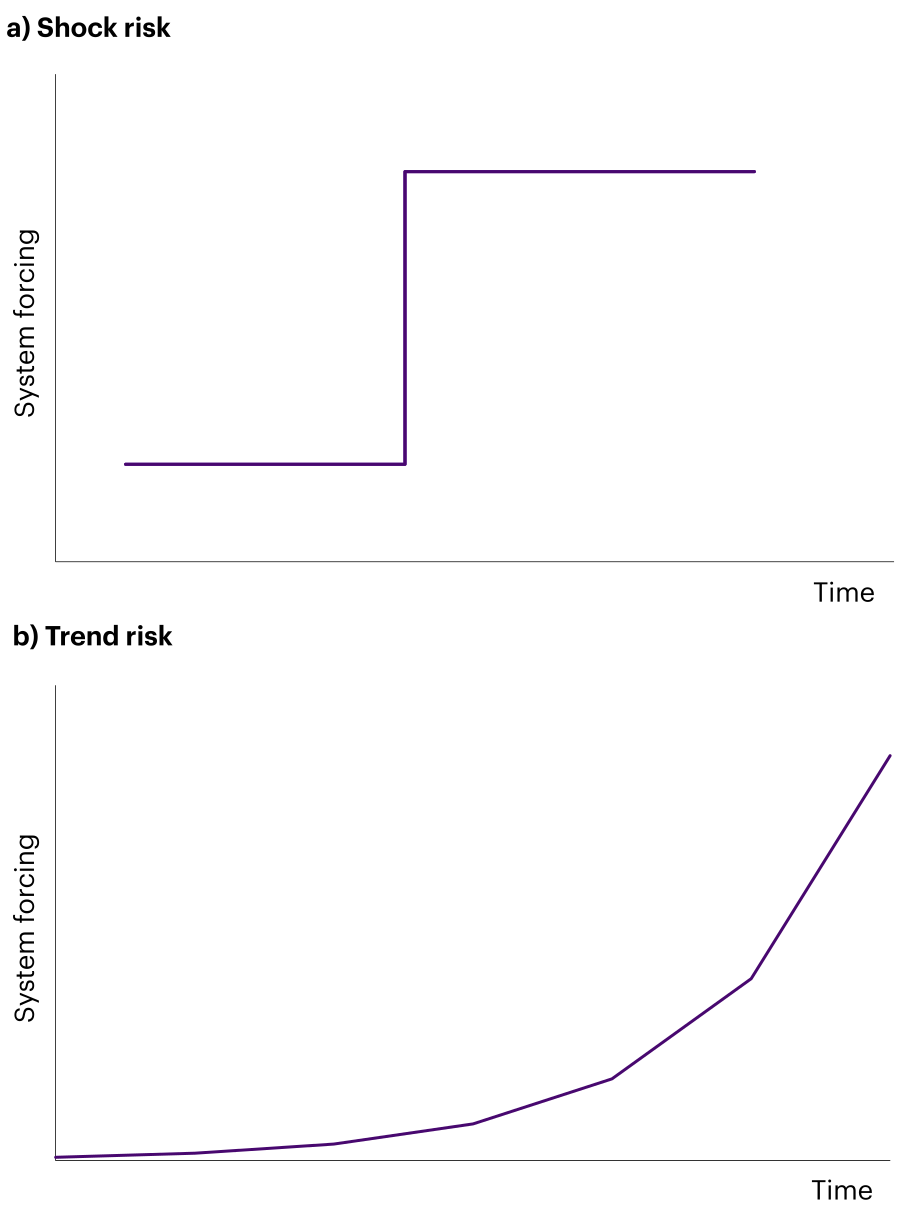
Figure 1: A schematic diagram showing shock risk (a) and trend risk (b) scenarios. The y-axis represents the forcing that is applied to the system. In a shock scenario, an instantaneous forcing is applied at a point in time, whereas in a trend scenario the forcing is applied in a more realistic way over time and takes into account the rate of change.
Footnotes
- Gladwell, M. The Tipping Point: How Little Things Can Make a Big Difference (Abacus, 2002). Return to article
- IPCC. Annex VII: Glossary. Climate Change 2021: The Physical Science Basis, Contribution of Working Group I to the Sixth Assessment Report of the Intergovernmental Panel on Climate Change (2021). Return to article
- Armstrong McKay, D. I. et al. Exceeding 1.5°C global warming could trigger multiple climate tipping points. Science 377, eabn7950 (2022). Return to article
- Dietz, S., Rising, J., Stoerk, T. & Wagner, G. Economic impacts of tipping points in the climate system. Proc Natl Acad Sci U S A 118, e2103081118 (2021). Return to article
- Trust, S., Joshi, S., Lenton, T., Oliver, J. The Emperor’s New Climate Scenarios. Institute and Faculty of Actuaries (2023). Return to article
- Rye, C. J. Why relying on frequency-severity adjustments could underestimate your tail risk from climate change. Why relying on frequency-severity adjustments could underestimate your tail risk from climate change Return to article
- Ritchie, P. D. L., Alkhayuon, H., Cox, P. M. & Wieczorek, S. Rate-induced tipping in natural and human systems. Earth System Dynamics 14, 669–683 (2023). Return to article
- Lohmann, J. & Ditlevsen, P. D. Risk of tipping the overturning circulation due to increasing rates of ice melt. Proceedings of the National Academy of Sciences 118, e2017989118 (2021). Return to article
- Strong, K., Carpenter, O., Ralph, D. Developing Scenarios for the Insurance Industry. Cambridge Centre for Risk Studies at the University of Cambridge Judge Business School and Lighthill Risk Network (2020). Return to article
- Rye, C. J., Boyd, J. A. & Mitchell, A. Normative approach to risk management for insurers Nat. Clim. Chang. 11, 460–463 (2021). Return to article
Despite this risk, most insurers are not yet considering rate-induced market tipping in their climate change scenarios.