
For those working in listed markets, this title might come across a little strange. The fact is that most investment transactions are secondary in nature. Fundamentally, investments involve acquiring a right to access a series of future, in most cases uncertain, cash flows. As investors, we very rarely exit our investments by waiting patiently to receive these cash flows[1]. We trade these ownership rights with each other and that creates a vibrant secondary market and, most importantly, liquidity for all of us.
In comparison, a typical private equity fund investment is rather an outlier in the world of investing. To receive all the cash distributions, investors normally need to wait a decade, if not longer. Yet, a fund interest is nothing more than a claim to a series of future uncertain cash flows[2] and an appropriate clearing price, at least in theory, can match a willing seller with a willing buyer. In this sense, the development of a secondary market for private equity is both desirable and, maybe, inevitable. Having grown at a rate of over 20% per year over the last two decades (Figure 1), the private market secondaries have reached the critical mass that, we believe, should represent a valuable portfolio management tool for all private equity investors.
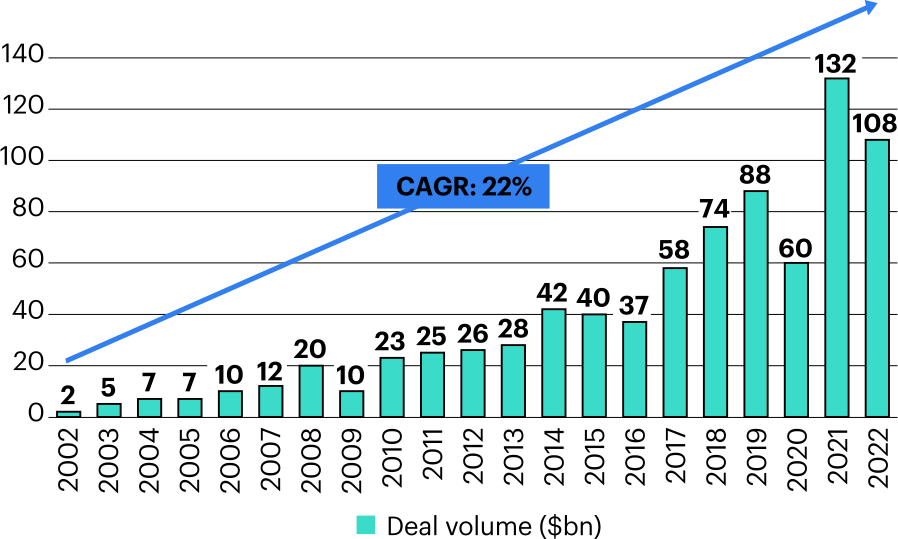
Figure 1: Global private market secondaries transaction volume ($bn)
Various types of secondaries — the “what”
Traditionally, the most common type of private equity secondary transaction, also most relevant to asset owners, is the so-called LP-led secondaries. In this transaction, an LP (limited partner, i.e., the investor in the private equity fund) sells its fund interest (or LP interest) to a buyer, which can be another existing investor in the fund, some other private equity investor, or increasingly commonly, a private equity fund established for the purpose of buying LP or other types of secondary interests (i.e., a secondary fund).
While the focus of this article is on LP-led secondaries, it is worth pointing out that as the secondary market develops, in recent years we have witnessed the growing importance and varieties of GP-led secondaries (GP is the general partner of the fund and manages the fund). A continuation fund is a typical GP-led secondary deal, created by the GP to facilitate the transfer of a portion of the exiting fund’s portfolio (single or multiple assets) to a new vehicle. It provides LPs of the existing fund an option to cash out of their investments or roll over their interest, in addition to bringing in new LPs. This is sometimes used as a way for those investors able to take a long-term view to continue to maintain exposure to the biggest winners in a fund’s portfolio.
Financial engineering, however, doesn’t stop here, as the industry observed the emergence of many new creative ways of structuring a secondary deal such as preferred equity secondaries, direct secondaries, strip sales or tail-end solutions, just to name a few.
What is in it for me? — the “why”
Any transaction has two sides, a buyer and a seller. Each side comes in with its own specific context, objectives and motivations. A deal is only possible when both sides walk away with something that they value.
Liquidity and portfolio rebalancing are among the most common reasons for asset owners who are seeking to sell in the secondary market. “Denominator effect” has been one of the most mentioned buzz words in the private equity community over the last two years. When public markets plummeted, private market holdings, which for various reasons did not decrease in value as much, ended up representing a larger proportion of the entire portfolio. This phenomenon has seen many asset owners over allocate to private equity, relative to their pre-determined targets. One of the tools available to asset owners to address overallocation is to sell private equity fund interests in the secondary market and many have chosen this path — around 50% of the sellers in 2022 were first-time sellers which is a significant step-up compared to the 25% in 2021[3].
Asset owners could also be driven by other portfolio management considerations, for example to adjust the geographical or sectoral exposures, or in some rare cases a key leadership change, such as a new CIO looking to “shake things up”. Occasionally, changes in laws or regulations can force asset owners to sell. For example, the Basel III banking framework introduced after the 2007-09 Global Financial Crisis led many banks to pare back their private equity portfolios.
How about buyers? Their motivations are also severalfold
Many buyers are driven by the opportunities to acquire undervalued assets to generate an attractive risk-adjusted return, particularly in the cases where sellers are, for whatever reasons, forced to sell and hence are less sensitive to price.
Private equity is known for its “blind pool” risk. When an LP commits to a private equity fund, it takes a leap of faith that the GP will deploy capital to the best of its ability to generate returns while managing risks.
There is, however, little visibility on what actual investments will be. A secondary interest in a fund that has already completed the investment period can perfectly mitigate this risk as all investments are known to the buyer.
Relatedly, secondary assets are particularly appealing to asset owners who are new to the asset class and seeking to ramp up the exposure to its desired allocation target quickly. This includes private wealth investors that represent a growing proportion of the capital being allocated to private equity, because of a desire for diversification, increasing accessibility and regulatory shifts.
What also comes with a fund that is partially or fully invested is that distributions should come sooner, effectively shortening the holding period. There is a rather technical term describing the impact of secondaries on the return profiles of a private equity fund investment — J-Curve mitigation — as the secondary buyers are less likely to experience negative returns in the early years of their investment, unlike a typical new primary fund investor.
Practical considerations for asset owners — the “how”
When contemplating engaging in private equity secondaries, there are several key considerations for asset owners to keep in mind.
Starting at the top, asset owners need to assure that a secondary transaction, whether selling or buying, is aligned with its own investment objectives and strategy and compatible with the agreed risk tolerance level. As an example, when facing the impact of the “denominator effect”, risk tolerance level can be the difference between having to liquidate, in some cases good quality, assets and widening target allocation ranges to avoid being a forced seller.
Underwriting a secondary transaction involves evaluating both the underlying GP and the existing assets in the fund. The manager underwriting part isn’t vastly different than underwriting a primary fund, covering many aspects in the areas of business, strategy, capability, people and process[4]. Understandably, when it comes to a secondary interest in a post-investment period fund, the manager’s ability to source new deals becomes less relevant than assessing the quality of the existing portfolio, including their growth and exit prospects, industry dynamics, and any potential risks or liabilities. The GP’s value-creation credential should be a primary focus of the underwriting process as it is vital for return generation post-transaction.
For buyers, understanding the seller’s motivation to sell is also valuable. A seller may offer a lower price, but in the world of asymmetric information it is important to weigh that against the risk of acquiring a struggling asset.
It is worth bearing in mind that the buyer not only inherits ownership rights of the existing assets, but it is also responsible for all future capital calls, in addition to being entitled to all future distributions. Understanding and stress testing the incremental liquidity impact is imperative to seamlessly incorporate the newly acquired secondary interest in the overall private equity program.
There are also legal and regulatory considerations. Asset owners need to understand the terms and conditions of the secondary transaction, including the fund’s partnership agreement, subscription agreement, governance rights, reporting requirements, and any potential restriction on transferring and exiting the investment.
Then there is the pricing and valuation. Private equity fund secondaries are normally priced as a percentage of the net asset value (“NAV”) of the fund interest being sold. Understanding the pricing methodology used by the GP and forming a judgment on whether the price accurately reflects the underlying value of the assets is a prerequisite for a successful transaction. And that provides a perfect segue to the next session where we move our focus to recent market dynamics.
Latest developments in the secondary market
Pricing pressure turns secondaries into a buyer’s market
Pricing in the secondary market deteriorated during 2022 across both buyout and venture strategies (Figure 2). Average pricing for buyout declined from 97% of NAV to 81% of NAV and pricing for venture capital dropped from 77% of NAV to 60% of NAV. Bid-ask spreads have continued to widen throughout the year driven by factors such as (i) a decline in the global macroeconomic outlook (ii) a disconnect between the correction in public market valuations and resilience of private equity NAVs and (iii) a more challenging exit environment, resulting in delayed exits and lower liquidity for LPs. Although there are some early indications that pricing has picked up during the first half of 2023, we believe buyers will remain highly selective and conservative in their underwriting over the short term
Secondary market welcomes first-time sellers and insurance buyouts
Even though the private equity secondary market has been around for decades, a lot of LPs are new to the space and have only recently explored its benefits as a portfolio management tool. As mentioned earlier, one key driver that has brought sellers to market during 2022 is the denominator effect. In addition, the rise in interest rates has also sparked a trend amongst corporate defined benefit pension plans to secure an insurance buyout, particularly in the UK. As interest rates moved up and the funding levels of schemes increased, so has the appetite for de-risking which consequently involves selling private equity and other illiquid holdings, typically deemed as risky assets. Whether you are a secondary veteran or first-time seller, we recommend seeking expert advice to navigate the, oftentimes untransparent, secondary landscape.
In today’s market, the whole is worth less than the sum of its parts
Secondaries capital overhang, which is the ratio of available capital to secondary deal volumes, increased to 2.1x by the end of 2022[5]. What it indicates is there is some pressure amongst buyers to deploy capital and work on the next fundraising. However, buyers are currently very selective on the portfolios they want to acquire and tend to favor countercyclical and resilient assets (e.g., US buyout) over strategies that are more sensitive to the macroeconomic and geopolitical environment (e.g., China) or strategies and sectors with more valuation uncertainty (e.g., venture capital). As a result, pricing can vary widely amongst different managers and funds. However, it must be noted that different buyers have different strategies and will price portfolios differently. Therefore, it is in a seller’s best interest to go to market through a well-organized competitive auction and instruct buyers to submit bids across strategies and sub-portfolios to reveal line-by-line pricing and buyer preferences. Packaging the most compelling individual offers will offer the seller a better overall price compared to buyers offering a total portfolio solution at a steeper discount.
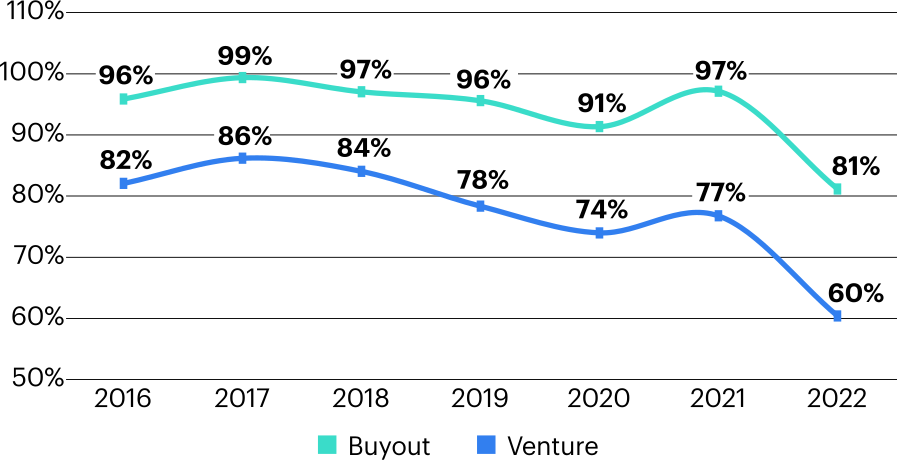
Figure 2: Secondaries pricing (% of NAV)
How WTW’s private equity team can help you
In conclusion, we believe that the development of the private equity secondary market is nothing but a natural evolution of this asset class. We expect this segment of the market to continue to mature, and become more sophisticated still, offering asset owners an important additional lever to pull to manage their overall private equity exposure. Not to mention the massive upside potentially released by the transformative power of blockchain and tokenization.[6]
Regardless of the development of the market infrastructure, partnering with a seasoned and expert team will always be key to unlock the value in private equity secondaries.
At WTW our team is equipped with the skills to help you on your private equity journey utilizing the secondary market to help you achieve your objectives. Whether you are building a private equity portfolio for the first time and believe now is the right time to ramp-up exposure more quickly. Or, you would like to use the current market environment to evolve or shrink an existing program. WTW has the experience necessary to partner with you, having transacted over US$1.5bn on the secondary market for our clients in the past five years.
Disclaimer
The information included in this publication is intended for general educational purposes only and should not be relied upon without further review with your WTW consultant. The information included in this presentation is not based on the particular investment situation or requirements of any specific trust, plan, fiduciary, plan participant or beneficiary, endowment, or any other fund; any examples or illustrations used in this presentation are hypothetical. As such, this presentation should not be relied upon for investment or other financial decisions, and no such decisions should be taken on the basis of its contents without seeking specific advice. WTW does not intend for anything in this presentation to constitute “investment advice” within the meaning of 29 C.F.R. § 2510.3-21 to any employee benefit plan subject to the Employee Retirement Income Security Act and/or section 4975 of the Internal Revenue Code.
Footnotes
- How many investors buy bonds on issuance and hold them to maturity? Not to mention stocks. Return to article
- Both negative cashflows as it relates to capital call liabilities during the investment period and positive cashflows associated with cash distributions during the post investment period. Return to article
- Global Secondary Market Review, Jefferies, January 2023. Return to article
- For more on WTW’s approach to private equity, please refer to our white paper Institutional allocation to private equity — A maturing industry calls for a differentiated approach. Return to article
- Global Secondary Market Review, Jefferies, January 2023. Return to article
- For interested readers, please refer to a Thinking Ahead Institute thought piece When securitisation meets blockchain, written by one of the co-authors of this article. Return to article
Download
| Title | File Type | File Size |
|---|---|---|
| The coming of age of private equity secondary investmentsPDF | 1.4MB |
Contacts