Physical AI is the convergence of artificial intelligence, robotics, sensors, autonomous systems, digital twins, and machine reasoning into machines that can perceive, decide, and act in the physical world. Unlike traditional AI, which largely operates in digital environments through software applications, physical AI extends intelligence into factories, warehouses, vehicles, infrastructure, healthcare systems, and eventually homes. A more detailed discussion on the insurability of physical AI is available in the companion article.
The concept has rapidly emerged as one of the most significant developments in artificial intelligence. NVIDIA CEO Jensen Huang has characterized physical AI as the next major wave of AI innovation, describing a future in which billions of robots and autonomous systems become part of the global economy. NVIDIA defines physical AI as end-to-end systems capable of perceiving, reasoning, interacting with, and navigating the physical world, moving beyond digital assistants and software agents into machines that perform real work[1].
For investors, operators, insurers, regulators, and risk managers, physical AI represents both a transformational opportunity and a profound challenge. It promises productivity gains comparable to earlier industrial revolutions while simultaneously introducing novel liability, governance, and insurance questions that existing frameworks were not designed to address.
Why Physical AI matters
The importance of physical AI stems from a simple reality: most economic activity occurs in the physical world. Factories produce goods, trucks move products, hospitals treat patients, utilities manage energy, and warehouses fulfill orders. While generative AI transformed knowledge work, physical AI aims to transform operational work.
Several technological breakthroughs have converged to make this possible. Large language models provide reasoning capabilities; computer vision enables perception; reinforcement learning supports adaptive decision-making; digital twins and simulation environments allow machines to train safely before deployment; and increasingly powerful edge computing platforms make real-time inference possible. IBM notes that advances in foundation models and generative AI have removed many of the bottlenecks that previously limited autonomous physical systems[2].
As adoption accelerates, exposures increase in both scale and frequency. When AI operates purely in software, failures typically result in financial loss, reputational damage or regulatory exposure. When AI is embodied in machines, failures can lead to bodily injury, property damage, operational disruption and systemic risk. This fundamentally changes the insurance challenge.
From Raspberry Pi to humanoids: how falling costs are expanding adoption and liability
| Layer | Then (2010s) | Now (2025–2026) | What’s changing |
|---|---|---|---|
| Low-cost compute (Raspberry Pi) |
$25–$35 programmable devices enabling early experimentation | Widely accessible compute platforms used in education, prototyping, and robotics | Entry barriers to building intelligent systems collapse |
| Industrial robots | High-cost, large-scale automation (~$40K+ typical units) | Costs falling toward <$11K in some forecasts; 4.28M robots operating globally (2023) | Automation expands beyond large manufacturers |
| Cobots (collaborative robots) |
Early-stage, limited adoption | $20K–$50K per unit; ~50K+ units already deployed by 2020 | Automation becomes viable for SMEs (subject matter experts) and flexible production |
| Humanoid robots | Prototype-stage, ~$90K+ early models (limited deployment) | Costs declining toward ~$30K–$150K range, with rapid iteration and early pilots | General-purpose robotics begins to move into real-world environments |
| Market scale (humanoids) |
N/A | $5T potential market; ~1 billion units projected by 2050 | Physical AI shifts from niche to systemic |
NVIDIA's physical AI architecture relies on what it calls a "three-computer" model: AI supercomputers for training, simulation environments for testing and digital twins, and edge computing systems for real-world deployment. This framework reflects a fundamental shift in how intelligent machines are developed and operated[3].
The broader significance is economic. Physical AI is not merely another software category; it is a technology capable of reshaping labor productivity, industrial efficiency, logistics, healthcare delivery, transportation, and infrastructure management.
Market size and economic opportunity
Although difficult to quantify precisely, the addressable market spans multiple trillion-dollar industries, including manufacturing, logistics, transportation, energy, construction, and healthcare.
Industry forecasts for humanoid robotics alone project a multitrillion-dollar market opportunity over the coming decades. Morgan Stanley, for example, has projected a potential $5 trillion market for humanoid robots by 2050, though substantial technical and economic barriers remain[4].
Humanoid robots are expected to become a $38 billion market by 2035
Forecast global humanoid robot market size ($ billion)
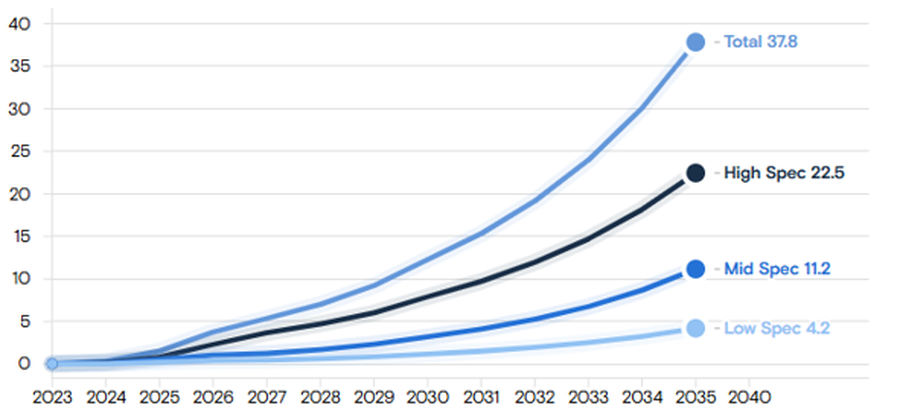
Source: Goldman Sachs Research. High, mid, and low spec refer to robot sophistication, from basic functionality to state of the art.
The market extends far beyond humanoids. NVIDIA's vision encompasses autonomous factories, robotic warehouses, industrial automation systems, autonomous vehicles, smart infrastructure, and AI-enabled production environments. Recent industry developments suggest that physical AI is transitioning from experimental deployments toward operational enterprise systems[5].
From an investment perspective, physical AI may ultimately prove more economically consequential than generative AI because it directly affects productivity in sectors responsible for the majority of global GDP.
Real-World use cases
Physical AI is already being deployed across multiple industries.
Manufacturing remains the most mature application. AI-enabled robotic systems perform assembly, welding, inspection, quality control, and material handling while adapting to changing conditions rather than following fixed scripts. AI-powered factories can optimize workflows, reduce downtime, and continuously improve operational efficiency[6].
Warehousing and logistics are rapidly adopting physical AI through autonomous mobile robots, inventory management systems, and intelligent fulfillment operations. These systems navigate dynamic environments, coordinate activities, and respond to changing operational conditions[7].
Transportation and autonomous vehicles represent another major use case. Physical AI enables vehicles to perceive environments, predict outcomes, and make real-time driving decisions. World models and simulation systems are increasingly being used to train these systems before deployment[8].
Healthcare applications include robotic surgery, patient monitoring, rehabilitation systems, and autonomous medical devices. These systems combine perception, reasoning, and action in highly regulated environments[9].
Agriculture is adopting AI-powered tractors, harvesters, and monitoring systems capable of autonomous operation and real-time adaptation to environmental conditions. Advanced edge AI systems now provide the computational power required for these applications[10].
Obstacles to adoption
Despite significant progress, physical AI faces substantial barriers.
First, the challenge of data collection remains severe. IBM notes that physical AI cannot rely solely on scraped digital data. Robots must interact with real environments, generating costly, time-consuming, and often imperfect datasets. Physical systems also experience wear, failure, and maintenance issues during training[11].
Second, physics remains unforgiving. Simulations are improving, but the "sim-to-real" gap persists. Systems that perform well in virtual environments often encounter unexpected failures in real-world conditions involving friction, weather, lighting, human behavior, and unpredictable events[12].
Third, economics matter. While robotics costs are declining, deployment, integration, maintenance, and safety certification remain expensive. Some analysts argue that purpose-built robots will achieve adoption faster than general-purpose humanoids because they deliver clearer returns on investment[13]. To contribute to the potential barrier to entry in high costs, Robot-as-a-Service was created as a subscription-based business model that allows users to rent robots rather than purchase them outright. Though this is still in early stages, it is already valued at $2 billion and is expected to grow at a CAGR of 17% in coming years. Also, it reduces the load on cost of wages. Robots in a RaaS model are charged $2-8 per hour, a much cheaper rate than humans.
Finally, public trust and regulatory acceptance remain uncertain. Organizations deploying physical AI must demonstrate safety, reliability, transparency, and accountability.
The Insurance, Liability, and Operational risk challenge
The most underappreciated aspect of physical AI is risk.
Traditional software failures create digital consequences. Physical AI failures create physical consequences.
An autonomous warehouse robot may collide with workers. A delivery robot may injure pedestrians. An AI-enabled medical device may contribute to patient harm. An autonomous industrial system may damage property or disrupt operations.
This creates a complex web of liability involving manufacturers, software developers, operators, component suppliers, data providers, and system integrators.
Insurance frameworks today generally separate risks into product liability, general liability, cyber liability, professional liability, workers' compensation, and property coverage. While AI has already begun to blur these boundaries, physical AI pushes them even further.
For example, if a robot injures a worker because of a flawed machine-learning model, is the liability attributable to hardware, software, data, operator supervision, or system design? Traditional insurance products were not built around adaptive systems that continuously learn and evolve after deployment.
Operational risk is equally significant. Organizations deploying fleets of autonomous systems face new exposures involving software drift, model degradation, cyber-physical attacks, sensor failures, and cascading operational disruptions.
Can insurance keep pace?
The insurance industry has historically adapted to technological change, from automobiles to aviation to cyber risk. Physical AI represents the next inflection point, as risk increasingly moves from digital systems into the real world.
Future underwriting will depend less on static engineering specifications and more on dynamic performance data. Insurers may evaluate simulation performance, real-world safety metrics, digital twin validation results, software update governance, and operational monitoring systems.
Continuous underwriting models may emerge in which risk assessments are updated based on live operational data rather than annual policy reviews.
Digital twins could become particularly important. Because many physical AI systems are trained and tested in simulated environments before deployment, insurers may eventually require evidence of simulation-based stress testing as part of underwriting processes. NVIDIA's emphasis on digital twin infrastructure suggests that simulation may become a foundational risk-management tool rather than merely a development tool[14].
The future of governance and underwriting
The future governance model for physical AI will likely resemble a hybrid of aviation safety, industrial safety engineering, and AI governance.
Organizations deploying physical AI systems will need robust controls around model development, validation, monitoring, cybersecurity, incident reporting, explainability, and human oversight.
Regulators will increasingly demand transparency regarding how autonomous decisions are made. Meanwhile, insurers will seek standardized measures of safety and reliability before providing coverage including measurable model performance informed by technical validation, accuracy thresholds, and reliability testing.
The winners in physical AI may not simply be those with the most advanced technology. They may be the organizations that best demonstrate trustworthiness, safety, auditability, and operational resilience.
Physical AI represents the transition of AI from software into infrastructure. As intelligent machines move from screens into factories, roads, hospitals, and public spaces, risk management will become as important as technical capability. The future market opportunity is enormous, but so is the responsibility. Organizations that treat governance, insurance, and liability as strategic priorities rather than compliance exercises will be best positioned to capture the value of the physical AI era.
Footnotes
- What Is NVIDIA’s Three-Computer Solution for Robotics? Return to article
- What is physical AI? Return to article
- What Is NVIDIA’s Three-Computer Solution for Robotics? Return to article
- Humanoid robots won’t be the future: purpose-built robots will Return to article
- NVIDIA GTC Showcases Virtual Worlds Powering the Physical AI Era | NVIDIA Blog Return to article
- What is physical AI? Return to article
- What Is NVIDIA’s Three-Computer Solution for Robotics? Return to article
- NVIDIA GTC Showcases Virtual Worlds Return to article
- Physical AI Agents: Integrating Cognitive Intelligence with Real-World Action Return to article
- Nvidia just built a brain that can power humanoid robots Return to article
- What is physical AI? Return to article
- What is physical AI? Return to article
- Humanoid robots won’t be the future: purpose-built robots will Return to article
- NVIDIA GTC Showcases Virtual Worlds Powering the Physical AI Era | NVIDIA Blog Return to article
Authors