As we observe Chronic Disease Awareness Day on 10 July 2026, the Asia Pacific region stands at a critical health juncture with rising obesity rates. The numbers tell a compelling story, with Asia Pacific now having the largest population of individuals living overweight or with obesity worldwide. Approximately one billion people, or two in every five adults, is currently affected.[1]
These concerning health statistics are driving a need for change in how employers, insurers, and policymakers approach health and benefits. For employers navigating the complex landscape of employee benefits in Asia Pacific, understanding this shift is essential.
The obesity epidemic in Asia Pacific
Across Asia Pacific, obesity is rising at a rapid pace, yet in most markets it remains viewed primarily as a lifestyle factor as opposed to a chronic disease requiring medical intervention. This perception has created many challenges. Most health insurance plans do not cover anti-obesity medications, treatments or surgeries, unless prescribed to address co-morbid conditions. There is limited public funding to prioritise obesity in national health strategies, and clinical inertia persists, with many healthcare providers trained to recommend diet and exercise, relegating medical treatment and medication to a last resort.
The data paints an ominous picture of how rapidly this challenge is escalating. Vietnam is experiencing a 37% increase in obesity rates, positioning it among Southeast Asian nations with the fastest-growing rates.[2] In higher-income Asia Pacific markets like Hong Kong, nearly one-fifth of adults is obese, while almost half are overweight.[3] Several Asia Pacific countries, including Australia and New Zealand, now report adult obesity rates exceeding 30%.[4] These numbers have profound implications for healthcare systems and workplace productivity.
The hidden cost driver in claims data
Here is where the issue becomes particularly relevant for employers and health and benefit teams. While insurers rarely pay claims for obesity, they do pay for the health conditions that are driven by metabolic conditions. The financial impact is substantial and far-reaching, manifesting not in the treatment costs of obesity, but in the cascade of chronic conditions and loss of productivity that follow.
People living with obesity face two to four times higher risk of developing Type 2 diabetes mellitus and cardiovascular diseases such as hypertension and dyslipidemia.[5] Beyond these well-known associations, obesity is also linked to sleep apnea, osteoarthritis, fatty liver disease, and several cancers.[6] These conditions don’t usually represent one-time medical events – they result in longer hospital stays, higher pharmaceutical use, and earlier onset of chronic claims in working-age populations. In practical terms, this means claims start earlier in employees' careers and last longer throughout their working lives.
This troubling story is illustrated in the latest MAXIS claims data, where the Asia Pacific region ranked second globally in 2025 for endocrine-related paid claims as a share of total spend (3.5%), with diabetes, a condition strongly linked to obesity, accounting for 39% of that spend.[7]
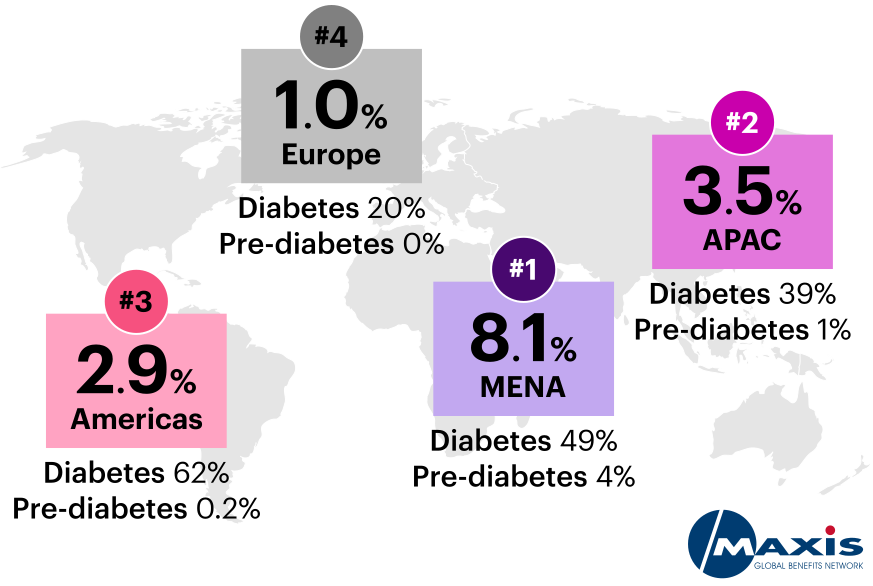
Regional ranking of endocrine diseases by paid claims cost in MAXIS data (2025)
Source: MAXIS GBN proprietary data (2025)
Complete this form to access the full article
Asia Pacific’s obesity growth is fastest among working-age adults, leading to critical implications for employers. Higher medical inflation driven by chronic disease treatment is becoming the norm. Cardiovascular disease, cancer, musculoskeletal conditions, and diabetes are currently the top drivers of claims by utilisation across Asia Pacific.[8] Beyond direct medical costs, employers face increased absenteeism and presenteeism, rising mental health comorbidities, and earlier transitions to high-cost claimant status among their workforce. In Indonesia, research shows obesity can lead to lower productivity and early retirement, with professional workers having a 2.7 times higher risk of obesity than labour workers.[9]
Dr Leena Johns, MAXIS GBN Chief Health & Wellness Officer says “Our claims data paints a unique picture of emerging health risks for the Asia Pacific region, beginning with an often-overlooked problem: Asian – and particularly South Asian – people are at risk of metabolic disease developing earlier and at lower body mass index (BMI) thresholds than their Western counterparts, driven in part by a greater propensity for abdominal visceral fat and insulin resistance.[10] Some studies have found that South Asian people are as much as nine times more likely to exhibit cardiometabolic risk factors at a ‘healthy’ BMI (of 18.5 to 24.9) than other ethnic groups.”[11]
Is there any silver lining? Clinical studies consistently demonstrate that achieving even modest health improvements and weight loss can make a meaningful difference. In individuals living with obesity, a 5-15% reduction in body weight can help prevent the development of future comorbidities, with some conditions requiring a 10% reduction or more for substantial risk reduction.[1] This evidence suggests that proactive intervention, as part of a medical-led holistic care plan, could fundamentally alter the trajectory of chronic disease in working populations.
Download the full article by completing the form on the top right of this page to learn more about the developing cost and coverage landscape, latest observations of GLP-1 usage, lessons from new claims data, and employer actions to consider.
Footnotes
- Yoong J et al., "Population-Level Impact of Weight Loss on Predicted Healthcare Spending and the Incidence of Obesity-Related Outcomes in the Asia-Pacific Region: A Modelling Study," BMC Global Public Health 2, no.1 (October 2024):68 Return to article
- “Obesity on the Rise in Việt Nam, Outpacing Regional Countries”, Vietnam News, June 25, 2025 Return to article
- "Nearly 1 in 2 Hongkongers Is Overweight or Obese, Study Shows," South China Morning Post, January 8, 2026 Return to article
- New Zealand Ministry of Health, “Obesity”; Australian Institute of Health and Welfare, “Overweight and Obesity” Return to article
- Dal Canto E et al., "Diabetes as a Cardiovascular Risk Factor: An Overview of Global Trends of Macro and Micro Vascular Complications," European Journal of Preventive Cardiology 26, no. 2 suppl. (December 2019): 25–32 Return to article
- “Strategies for the Management of Obesity in the Asia-Pacific Region”, Wiley (May 2025) Return to article
- MAXIS GBN proprietary data (2025) Return to article
- WTW 2026 Global Medical Trends Survey, Asia Pacific Return to article
- Pranoto RJ et al., "The Association of the Type of Occupation and Obesity among Indonesian Workers Based on the 2018 Indonesian Food Barometer (IFB) Data," World Nutrition Journal 8, S1 (October 2024) Return to article
- Balaji K et al., "Inflammation and Cardiometabolic Disease in South Asians: The Fire and Fire Tenders," Journal of Clinical Lipidology, 2025 Return to article
- Patel SA et al., "Is the 'South Asian Phenotype' Unique to South Asians? Comparing Cardiometabolic Risk Factors in the CARRS and NHANES Studies," Global Heart 11, no. 1 (March 2016): 89 Return to article
Authors



Asia Pacific's obesity growth is fastest among working-age adults, leading to critical implications for employers.