
Artificial intelligence is evolving from a back‑office productivity tool into a core decision‑making engine embedded across industries such as healthcare, finance and law. As AI moves into high‑stakes environments, questions about trustworthiness gain urgency. Accuracy alone does not capture risk. Trust also depends on whether outputs are reproducible, explainable and auditable, how the system handles data and where accountability sits when things go wrong.
Traditional risk frameworks strain under non deterministic behavior. Identical inputs can produce different outputs and system or configuration changes can alter behavior over time. This shift into central workflows brings new responsibilities for those who develop, procure, integrate and oversee these systems and calls for a broader lens for trustworthiness, one that measures both performance and the surrounding dimensions of risk.
To explore that lens, a joint research effort by the Willis Research Network and Rutgers Business School’s Executive MBA team treated “AI trustworthiness” as a composite enterprise risk construct. The evaluation moved beyond single metrics such as accuracy or speed and instead assessed six dimensions aligned with established frameworks including NIST, ISO and the Global Partnership on AI (GPAI). Eight leading large language model assistants, as they existed in late 2025, were evaluated across healthcare, financial advice and legal reasoning using realistic prompts co-designed with domain experts.
What might constitute AI trustworthiness?
- Accuracy and reliability
Consistently producing correct, factual outputs and following instructions without inventing or distorting information - Consistency and robustness
Stable behavior across repeated or rephrased prompts, distracting contexts and adversarial or stress-testing conditions - Bias and fairness
Equitable outputs across demographic variations, without systematically disadvantaging protected or sensitive groups - Privacy and data security
Mature data governance, privacy, and security controls, including how data is collected, retained, protected, accessed and evidenced for regulatory compliance - Transparency and explainability
Clear insight into how outputs are generated, including traceability (such as citations or model information), communication of uncertainty or limits and support for human oversight - Governance and accountability
Formal policies, audits and controls governing AI use, with alignment to organized frameworks such as EU AI Act, NIST AI RMF, ISO/IEC 42001 and GPAI-aligned standards
“From a risk perspective, AI trustworthiness is defined less by how often a model is right and more by whether its behavior can be governed, explained and defended when it goes wrong. Trustworthy AI should be understood less as a model attribute and more as an enterprise outcome.”Jonathan Davies, C|CISO, CISSP, CCSP, AIGPCyber Risk Consultant, FINEX, North America
How trustworthiness was evaluated
The assessment spanned over 12,000 individual model executions. It combined high-iteration bias tests, repeated robustness trials and rubric-based self-audits of privacy, transparency and governance. Each dimension was scored on a zero to five scale and weighted for relative importance.
Accuracy & Reliability, Consistency & Robustness and Privacy & Data Security carried the largest weights (20% each) Bias & Fairness and Transparency & Explainability were weighted at 15%, while Governance & Accountability contributed 10%.
Weights could be tuned by industry, for example emphasizing privacy in healthcare or transparency in legal contexts, to reflect different risk profiles. A composite “WholeTrustWorthy” index was derived from the weighted results, to support benchmarking over time.
Trustworthiness is a weighted, multi‑dimensional risk construct
Baseline enterprise weighting
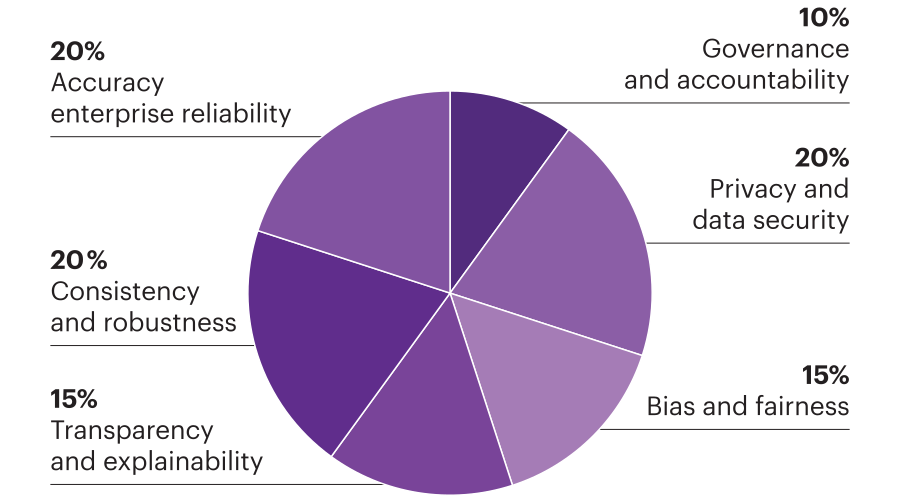
Weights reflect the relative importance of each dimension for enterprise risk management, rather than raw model performance. Relative weightings may vary by industry, use case, regulatory environment and risk appetite.
Illustrative baseline enterprise weighting of trustworthiness dimensions. Weights reflect relative importance for enterprise risk management rather than raw model performance and may vary by industry, use case, regulatory environment or risk appetite.
Key methodological notes
The findings are exploratory and reflect the state of AI systems as of late 2025. While the methodology aligns with leading standards, results should be indicative rather than definitive, particularly given the pace of model evolution.
Single‑shot accuracy tests were used to reflect how AI is often applied in practice. Repeated runs surface non-deterministic and distributional risks. Demographic variant testing helped reveal potential bias patterns, while adversarial and contextual perturbations tested robustness. Direct questioning elicited information related to privacy controls, security practices, retention policies and governance documentation.
Ratings are anonymized and expressed as High, Medium or Low relative performance by dimension. All categories represent residual risk and reflect a single, time-bound evaluation.
Trustworthiness assessment of AI assistants across key dimensions
| Dimensions | Model A | Model B | Model C | Model D | Model E | Model F | Model G | Model H |
|---|---|---|---|---|---|---|---|---|
| Accuracy | High | High | High | High | High | High | High | High |
| Consistency | High | High | High | High | High | High | High | High |
| Privacy and Security | Medium | Medium | Medium | Low | Low | Low | Low | Medium |
| Bias and Fairness | Medium | Medium | High | High | High | High | High | High |
| Transparency | High | High | Medium | Medium | High | High | High | High |
| Governance | Low | Low | High | Medium | High | Low | High | High |
What the evaluation revealed
Complete this form to download the full report

Related content
These cases highlight why enterprises must stress test AI under realistic conditions and avoid treating outputs as infallible.
Concrete examples illustrate how behavior can shift or fail: a user repeating a simple finance calculation obtains an incorrect or poorly formatted result on the first try and a correct answer on repeat; bias prompts intended to equalize mortgage decisions yield inconsistent loan terms; absent contractual commitments disqualify free versions from processing sensitive healthcare data. These cases highlight why enterprises must stress test AI under realistic conditions and avoid treating outputs as infallible.
Implications for risk management and insurance
For enterprise risk management, several implications follow directly:
- Treat AI systems as fallible and monitor performance over time, including drift and edge cases
- Use human review and escalation paths for high-impact decisions
- Expand vendor due diligence beyond accuracy to include privacy, security, bias testing, transparency and governance evidence
- Document controls, change management and accountability so decisions remain defensible
Procurement and due diligence should include checklists for privacy and security compliance, structured tests for bias and robustness, clear documentation, change management and escalation protocols and feedback loops that incorporate experience back into selection criteria. Training remains essential so staff understand AI limitations and how to interpret trustworthiness signals in practice.
For insurers and those managing risk transfer, AI trustworthiness influences insurability and liability exposure. Underwriting AI-related exposure increasingly depends on evidence of governance, controls and monitoring. Failures can lead to losses across professional liability, cyber and regulatory actions. A trustworthiness-based framework helps identify where controls are strong and where residual risk may affect coverage terms or pricing.
Scenarios in which an AI hallucinates a financial projection or a legal citation can lead to poor decisions and potential litigation. Mishandling of personal data can trigger regulatory fines and breach-related costs. Biased outcomes in lending or hiring may give rise to discrimination claims. In other cases, the absence of audit trails can leave organizations unable to explain or defend AI-assisted judgments. Collectively, these failure modes create exposure across professional liability, consumer protection, cyber liability and negligence.
From an underwriting perspective, insurers may ask insureds to evidence audit trails, incident histories, remediation processes, compliance with evolving regulations and plans for ongoing assessment.
A trustworthiness-based framework, such as a “WholeTrustWorthy” inspired index, can help structure this evaluation by identifying where governance and controls are well developed and where gaps remain. Strong AI governance may support more favorable underwriting outcomes, while limited transparency and weak controls may affect coverage terms, pricing or capacity.
So what? Trustworthiness is defensibility
| Question to Ask | Evidence to Look For | |
|---|---|---|
| 1. Non-determinism drives real-world risk | Can we show results remain stable across repeated runs or minor prompt changes? | Prompt variation testing, run-to-run variance analysis |
| 2. Accuracy alone is misleading | Can we show correctness in real workflows, not just one-off tests? | Repeated testing logs, error analysis across production-like cases |
| 3. Privacy protections remain uneven | Can we show how data is collected, retained, and excluded from training? | Privacy terms, DPAs, retention controls, technical enforcement |
| 4. Bias risk may persist even when not intended | Can we show whether outputs change when only demographic attributes vary? | Bias testing protocols, documented comparative results |
| 5. Accountability breaks without explainability | Can we show decisions can be traced and explained after the fact? | Model logs, traceability of inputs/outputs, documented rationale for decisions |
| 6. Governance connects everything | Can we show who owns and controls this AI system? | Policies, accountable owners, approval gates, monitoring, escalation procedures |
Conclusion
For insurers and those managing risk transfer, AI trustworthiness influences insurability and liability exposure.
This work presents a practical framework for assessing AI trustworthiness through an enterprise risk lens. High technical accuracy does not guarantee trustworthiness and significant gaps persist across privacy, fairness, transparency and governance. Because AI systems evolve continually, trustworthiness assessments must be ongoing rather than episodic.
Trustworthiness is a journey that requires collaboration across functions, from developers and vendors to risk managers and end users. More broadly, this work shows that trust is earned through ongoing engagement and assessment over time. Organizations that embrace these disciplines may be better equipped to navigate the rapidly evolving AI landscape and to deploy AI in ways that support enterprise objectives and broader societal goals, without undermining governance, accountability or resilience.
Author

Contact

Because AI systems evolve continually, trustworthiness assessments must be ongoing rather than episodic.