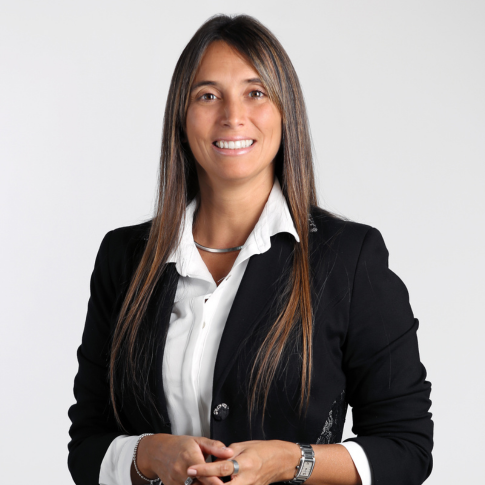
MAGDALENA RAMADA: And if I can build on that, the next step of that. Right now we're seeing the lower hanging fruit. You're describing a world where we have agents that are specialized in certain decision-making processes and are helping in those decision-making processes. And then the next step is when we have some maturity, we will be able to actually converge those decision-making processes in a way that we haven't before.
And so there will be technical function convergence. There will be a lot more talking between reserving and capital and pricing and underwriting and what we're seeing on the customer side and in risk evolution, and all of those decision-making cycles are going to be able to talk to each other in a more automated fashion. We will be generating data that is consistent and we will be able to converge in decision-making in granularity and timeliness.
I think that's the last evolution of how all of this impacts not only individual processes and the sophistication of decision-making cycles, but the target operating model as a whole.
MATT LAMBERT: Yeah, and I think that portfolio management function is probably one of the best embodiments of that, and potentially one of the really good places to start thinking about the true extent of how AI can support that, because as you say, you've got all of those feeder agents providing insights from the external environment, from other internal functions, and then allowing humans to synthesize that data and to make informed decisions about what they want to do with the portfolio.
One of the things I think that's crucial to think through, though, is how you drive the execution of that portfolio management. I'm still not sure that I see that being done through agents. I still see that being done by rules and predictive analytics that are then surfaced elsewhere, so that you've got that controllability.
MAGDALENA RAMADA: I think it will be a combination of all of the above. So the orchestration needs to include human and non-human agents. Some of them will be deterministic, others will be non-deterministic, others will be algorithms where you control the design, you know exactly what the accuracy of the algorithm looks like. So I think really the secret will be how do we orchestrate all of those elements. Some that will be more predictive than others, and some that will be more predictable than others.
And to which extent can we monitor very complex systems with multiple human agents, non-human agents, deterministic systems, tools, algorithms so that you can actually optimize their performance over time. And I think that's where the future is. And that is where a lot of the research right now is actually concentrating.
MATT LAMBERT: And one of the barriers at the moment, it feels, is that the tooling available is just slightly too general, and getting that level of specificity so that you're making portfolio management decisions about an insurer's risk appetite and how they want to run their business. It feels like that's maybe the place where we need to be going next.
MAGDALENA RAMADA: Yes. And there's very practical implications of that. Is it, do I train an agent with my last 50 underwriting decisions, or the last 100? What happens if my appetite changes? What happens if I'm dynamic? What type of knowledge in that agent becomes obsolete? How do I delete that type of obsolete knowledge? So essentially mimicking the way we make decisions is not that easy, and it needs a lot of process thinking.
And so it becomes very practical. And you hit the boundaries of the art of the possible very quickly. And I think that's probably where the differentiator will come and where we will have to learn how to embed our expertise, the expertise of experts like chief underwriters into those processes.
I think some practical advice is really: where do you add value? A lot of times, what we're seeing is clients and insurers are experimenting with different tools, with understanding how to use AI in certain areas. And they are not thinking about its scalability later on. And they are also not thinking about what the tool can do that it could not do five years ago, and where they bring value.
So a lot of the focus these days, and it is very technical and very practical, is how do you embed expertise into an agent. So you are talking about data liberation, data structuring. Those are things we are already seeing in the market and they are enabling us to have new data sources to turn unstructured data into structured data.
I think the next step is really to think about how do we architect our systems, how do we enable our tools to interact with AI agents, and how do we embed expertise into the orchestration of those agents, into their processes, into the way in which they are contextualized, but also in the way they think. And so we will have to augment many of these tools so that they become specific not only to insurance, but to very specific processes and develop a level of expertise that in the future might help them be autonomous.
So to me, practicality comes when you sit down and you think about what framework am I using. Do I control it? Can I generate learning? Is it self learning? Is it human based learning? And really the design of these agents and the control over that design is something that everyone that wants to embed expertise and differentiate from the rest of the market will need to think about.
MATT LAMBERT: One of the things I like to lean on when I start to think about how to get started, because I think it can be quite daunting when there is quite a lot of change and the technology landscape is evolving quickly, is to gravitate to a problem that I can relate to and have experience of. So I like to think of AI as a bit like having an army of 1,000 interns, because that is something I can relate to. I have hired, I have worked with interns, and I have had to check on them regularly to make sure they are doing the right thing.
And so I think that is a good mindset that can help. You need to do some training, some education, and start by giving tasks that are smaller and simpler, then build patterns and orchestration over time so that those agents begin to drive business value.
MAGDALENA RAMADA: Last year, I was telling people, start slow, but start now. I think in 2026, you really don’t have any excuses not to have started. And what the focus should be in 2026 is, you’ve learned a lot as an organisation. You have been understanding the art of the possible. That art of the possible is changing all of the time. You understand in which areas you will be generating increased productivity, or you’ll be quicker and better at doing some things.
And now you need to start thinking about, is that scaling, can it scale? Have I designed all of that in a way that it scales? So I think that’s the 2026 focus. It’s the focus where it is about impact and about all of the learnings. How do I translate that to take humans on that journey, to increase adoption, and to scale experimentation effectively.
MATT LAMBERT: So I don’t know about you, Magda, but key takeaways for me from the event were around, while AI is changing an awful lot, the game itself of insurance hasn’t changed. We’re still providing capital to transfer risk from companies, and we shouldn’t lose sight of the fact that a lot of the transformation journeys that we’ve been on as an industry are going to continue. And AI might augment that. It might slightly course correct some of that. But fundamentally, the value that we create for the economy isn’t going to change.
MAGDALENA RAMADA: And it is not only not going to change, you will still need some foundational elements that are not there across the industry and that still need to be developed. And so no, AI shouldn’t solve everything. And there are a number of things that you will need to have. Like, you know, we’ve been talking about digitisation for a very long time, about machine learning, unleashing a lot of the predictiveness that we need in the industry, and dealing with complexity and being able to monitor your model real estate.
So there’s a number of things in there that are not AI, at least not true AI as we understand it, that will still need to be used and developed. And those foundational capabilities are still under development. So to me, yes, there are some components that are new. The pace of transformation is certainly new, and the sense of urgency is new, but a lot of the foundational elements are the same. And the vision of where we’re going is also the same.
This is about closing the protection gap. It is about being able to assess new patterns and risk. It is about pricing more effectively. And so I think that rooting into where we want to go and what we do as an industry is the same. And that’s good.
MATT LAMBERT: Absolutely.