In July 2023, northern Italy witnessed two unprecedented European hailstone records: first, a 16 centimeter hailstone was found, followed by a 19 centimeter stone just five days later. These occurrences prompt questions about the influence of climate change on such extreme events and the potential for increased severity in the future.
Record-breaking hailstones in northern Italy
Northern Italy is no stranger to the damaging effects of enormous hailstones, but 2023 witnessed an alarming increase in the size of hailstones. The previous European hail size record of 15 centimeters was broken twice within one week in July 2023. On July 19, large hail with a maximum size of 16 centimeters fell in Carmignano di Brenta in northern Italy, province of Veneto (Figure 1).
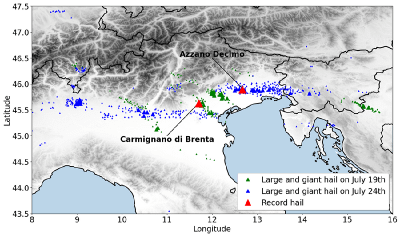
Figure 1: Hail reports in the European Severe Weather Database from July 19, 2023, and July 24, 2023.
Source: European Severe Weather Database
The hailstones had a typical spheroidal shape with long lobes (Figure 2, left). In contrast, the largest hailstone that shattered the record on July 24, near Azzano Decimo, FriuliVenezia Giulia, with a size of 19 centimeters, had a rather unusual shape (Figure 2, right) but was still accepted to be a genuine hailstone by experts of the European Severe Storms Laboratory (ESSL). Such large hailstones can severely damage buildings, cars and critical infrastructure (e.g., photovoltaic panels) and can completely destroy harvests.

Figure 2: Left: © Tornado in Italia – Floriana Record hail on July 19; Right: © Marilena Tonin Record hail on July 24 (dimensions given in centimeters)
Source: ESSL news
The record hail on both days was no isolated phenomenon but occurred within hail swaths covering large regions of northern Italy. On both days, the atmospheric conditions enabled several isolated, rotating thunderstorms, known as supercells, to persist for several hours. At least six tracks of long— lived supercells can be seen in the trail of reported hail of these days (Figure 1). Along these tracks, swaths of large and giant hail (greater than 10 centimeters) at least several kilometers wide and up to 200 kilometers long caused considerable damage in the region. At the time of writing, insured losses from the 2023 northern Italian hailstorms are expected to surpass US $3 billion. [1] After the severe flooding in May in the Emilia—Romagna region (see WTW’s H1 Natural Catastrophe Review), the thunderstorm-related summer loss was the second notable catastrophe event for Italy in 2023.
At the time of writing, insured losses from the 2023 northern Italian hailstorms are expected to surpass US $3 billion.
How can these extreme hailstorms be explained? It is well established that giant hail almost exclusively forms in supercell thunderstorms,[2],[3] which are characterized by a persistent, rotating updraft. These storms only form in atmospheric environments with sufficient instability and especially large wind shear (strongly varying wind speed and/or direction with height). However, not all supercells cause giant hail. In fact, less than 0.3% of all hail reports in Europe are of hail larger than 10 centimeters. Hence, for recordbreaking hail to occur, specific conditions must come together, both in the atmospheric environment and within the thunderstorm cloud.
These different factors, especially within the storm itself, can be very complex and difficult to observe. As a result, no definitive conclusions can be drawn about why these particular storms produced record-breaking hailstones. We know that the supercells on July 19 and 24 had very intense updrafts, as this can be estimated from satellite imagery.
Furthermore, the storms’ environments had abundant moisture for hail to grow efficiently, and the vertical temperature and wind profile supported wide and intense updrafts in the hail growth zone (which is between the 0°C height and 3 to 6 kilometers above ground). Recent research supports that these factors are especially important for hail.[4]
A warming climate and growing hailstones
Gargantuan hail has thus far been documented only for a few areas, such as the Midwest in the U.S. or Argentina[5] — where it is of course also very rare — but not in Europe. However, after the hailstone size record was broken twice in a week, our thoughts naturally turn to the cause. Are these hailstone records somehow linked to anthropogenic climate change? Or are they still in the range of natural climate variability?[6],,[7] Additionally, how does climate change, in general, affect both the frequency and intensity of hailstorms?

Related content
Natural Catastrophe Program 2024
Natural Catastrophe Review for January to June 2024, this session will delve into the significant natural catastrophe events that marked the first half of the year
Answering these questions proves challenging for several reasons. Homogeneous, long-term direct observations of hail are scarce, primarily because hail footprints usually span a limited area, often just a few square kilometers. Monitoring such localized events effectively would require a dense network of instruments. Currently, such networks, which utilize simple hailpads to measure hailstone sizes, exist only in limited regions, such as parts of France, northern Spain and northern Italy.[8],[9]Additionally, even state-of-the-art and highly resolved numerical weather prediction and climate models struggle to reliably predict hail due to the intricacies of the microphysics involved and the fact that hail is not a standard output parameter in these models. As an alternative, researchers have developed methods that relate hail occurrence to proxies, using remotely sensed observations from radar, satellite and lightning sensors. However, these indirect observations are not available for a sufficiently long-term period, a prerequisite for reliable trend estimations.
Regardless, climate change is anticipated to alter the environments in which hailstorms typically develop, particularly low-level moisture, vertical wind shear and melting level height, albeit with significant geographical variability.[10] These changes, which impact both convection organization and maximum hailstone sizes, can be reliably estimated from reanalysis data for the past and regional climate models for the future. Trends in environmental proxies computed from soundings or reanalysis in past decades exhibit moderate to strong trends toward a higher potential for convection across large parts of Europe.[11],[12].The largest increase in atmospheric instability and hail-related parameters is observed for northern Italy, aligning with the record hailstones discovered in that region. [13]
Similar trends, however, cannot be deduced from high-density hailpad networks installed in parts of France or northeastern Italy. Analyses of long-term series reveal minimal (often insignificant) or even negative trends in hail frequency. [14]Positive trends are only evident for large hail or derived quantities, such as upper percentiles of hail kinetic energy, which can be interpreted as a general increase in hail severity.
Hail streaks identified from radar reflectivity for parts of central Europe exhibit a substantial annual variability but no trends over the past 10 to 15 years. Only a few studies have uantified potential changes in the hailstorm environment for future decades. The general consensus is that conditions favoring hailstorms are expected to (slightly) increase for large parts of Europe. However, the extent of these trends varies considerably based on the time frame considered and the specific future Intergovernmental Panel on Climate Change scenario used.
Additionally, it is important to note that these trends are often not statistically significant, obscured by the considerable annual and multi-annual variability in environmental conditions that influence hailstorm formation.
Concluding remarks
What do these findings suggest for the record breaking Italian hailstones? Naturally, we acknowledge that attributing a single extreme event to climate change requires a detailed understanding that includes extensive model simulations, as exemplified by such projects as the World Weather Attribution Project. [15]Nevertheless, the record-breaking hailstones in northern Italy align, at least to some extent, with what can be anticipated in convective environments within the context of climate change.
However, addressing the frequently asked question about the relationship between hailstorm frequency/ intensity and climate change necessitates additional knowledge to better comprehend the link between large-scale natural climate variability and the local scale convection that drives hailstorms. This includes a more complete understanding of the drivers behind these connections, such as teleconnection patterns (such as the El Niño-Southern Oscillation), which significantly influence global weather patterns, including those related to hailstorms.
Further research, involving detailed model simulations of supercells and hail growth mechanisms, coupled with more dedicated field experiments, holds the potential to enhance our understanding and prediction of such hazards in the future. Additionally, it may shed light on whether giant hail is likely to occur more frequently in a changing climate.
Footnotes
- Insurance Insider. Italian severe convective storm insured loss to surpass $3bn. (2023). Return to article
- Van Den Heever, S. C. & Cotton, W. R. The impact of hail size on simulated supercell storms. Journal of the Atmospheric Sciences 61, 1596–1609 (2004). Return to article
- Kunz, M. et al. The severe hailstorm in SW Germany on 28 July 2013: Characteristics, impacts, and meteorological conditions. Quarterly Journal of the Royal Meteorological Society 144, 231–250 (2018). Return to article
- Kumjian, M. R. & Lombardo, K. A hail growth trajectory model for exploring the environmental controls on hail size: Model physics and idealized tests. Journal of the Atmospheric Sciences 77, 2765–2791, (2020). Return to article
- Kumjian, M. R. et al. Gargantuan hail in Argentina. Bulletin of the American Meteorological Society 101, E1241-E1258 (2020). Return to article
- Bouwer, L. M. Observed and projected impacts from extreme weather events: implications for loss and damage In: Mechler, R., Bouwer, L., Schinko, T., Surminski, S., Linnerooth-Bayer, J. (eds) Loss and Damage from Climate Change. Climate Risk Management, Policy and Governance. Springer, 63–82 (2019). Return to article
- Piper D.A., et al. Investigation of the temporal variability of thunderstorms in central and western Europe and the relation to large-scale flow and teleconnection patterns. Quarterly Journal of the Royal Meteorological Society 145, 3644–3666 (2019). Return to article
- Punge H.J. & Kunz, M. Hail observations and hailstorm characteristics in Europe: A review. Atmospheric Research 176-177, 159–184 (2016). Return to article
- Allen, J. T. et al. Understanding Hail in the Earth System. Review of Geophysics, e2019RG000665 (2020). Return to article
- Raupach T. H. et al. The effects of climate change on hailstorms. Nature reviews earth & environment 2, 213–226 (2021). Return to article
- Rädler, A. T. et al. Detecting severe weather trends using an additive regressive convective hazard model (AR-CHaMo). Journal of Applied Meteorology and Climatology 57, 569–587 (2018). Return to article
- Lepore, C. et al. Future global convective environments in CMIP6 models. Earth's Future 9, e2021EF002277 (2021). Return to article
- Battaglioli, F. et al. Forecasting Large Hail and Lightning using Additive Logistic Regression Models and the ECMWF Reforecasts. Natural Hazards and Earth System Sciences 23, 3651–3669 (2023). Return to article
- Manzato, A. et al. Observational analysis and simulations of a severe hailstorm in northeastern Italy. Quarterly Journal of the Royal Meteorological Society 146, 3587–3611 (2020). Return to article
- World Weather Attribution. Return to article
Authors


Homogeneous, long-term direct observations of hail are scarce, primarily because hail footprints usually span a limited area…