Choose your location
Select the location and the language that you prefer
main content, press tab to continue
Article | Willis Research Network Newsletter

Long waves and tall buildings: Site effect considerations in catastrophe models following the Myanmar earthquake

By James Dalziel and Arash Nassirpour | August 27, 2025

A Mw7.7 earthquake in Myanmar caused intense shaking and damage locally, as well as a tower collapse in Bangkok more than 1,000 km away. Do catastrophe models account for these long-distance effects?

On March 28, 2025, a Mw7.7 earthquake struck along a section of the Sagaing Fault in Myanmar at a depth of 10 kilometers, causing Modified Mercalli shaking intensities of IX (violent) around the epicenter. But over 1,000 kilometers away in Bangkok, Thailand, a 30-story tower under construction collapsed, resulting in at least 96 fatalities.

How could an earthquake so far away cause such damage? The answer lies in the complex interaction between seismic waves and local geology. Bangkok sits on a deep sedimentary basin that amplifies longperiod surface waves — those most dangerous for tall structures (Figure 1). This event brings to the forefront a well-known seismic hazard: Distant quakes can wreak havoc on mid- and high-rise buildings in cities built on soft soils.
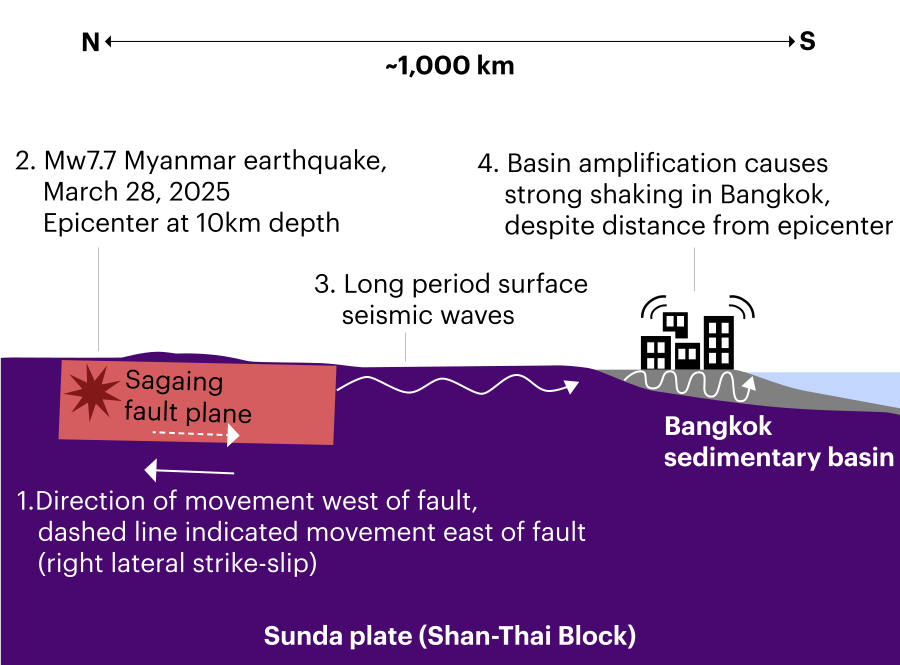
Figure 1. Cross sectional diagram showing long-period waves travelling from earthquake epicenter in Myanmar to Bangkok, Thailand and being amplified by sedimentary basin to cause excessive shaking.

These long-distance effects are not a new phenomenon. In 1985, mid-rise buildings in Mexico City collapsed more than 350 kilometers from the epicenter of a Mw8.0 earthquake, as lakebed sediments amplified long-period waves. And in 2011, the Mw9.0 Tohoku earthquake generated similar long-period waves that traveled over 370 kilometers, causing high-rise buildings in Tokyo and Osaka to sway for minutes and sustain non-structural damage.

Long-period waves are a known hazard, and most catastrophe models do attempt to capture their effects. But for insurers and other risk managers with exposure in sedimentary basins — such as San Francisco, Seattle and Istanbul — it's worth asking three pointed questions to better understand modeled loss estimates.

  1. 01

    Are distant seismic sources included — even those beyond the model domain?

    Long-period motions can originate from earthquakes far outside the local hazard zone or even national borders. To avoid underestimating risk, it’s important to ensure that distant rupture sources, including those outside a model’s core geographic domain but still capable of causing losses in your region of interest, are properly considered. For places such as Bangkok, accounting for these distant sources is crucial. The 2025 Myanmar earthquake generated ground motions in Bangkok in the 0.8 to 3.4 second period range, which corresponds to the natural resonant frequencies of buildings between 13 and 55 stories tall. The 30-story tower collapsed because its natural vibration period aligned with the earthquake's dominant shaking frequency, which amplified the building’s movement.


  1. So ask your model vendor: Which distant sources are included that could contribute to long-period risk? Which are excluded — and why? Sometimes, the faults that matter most aren’t the ones immediately beneath your exposure but the ones across the border.


  2. 02

    Does the model align with observed impacts in past long-period events — and if not, why?

    Catastrophe models are designed to capture average behavior, but key insights often come from how their simulated events measure up to real earthquakes. In cities such as Bangkok or Mexico City, where long-period shaking is known to cause significant damage, it’s worth asking: Does the model reproduce the character of observed ground motions — or do simplifications obscure important local effects?


  1. Thailand's late adoption of uniform seismic codes (Bangkok was excluded until 2007) means most high-rises were built without seismic provisions. Models should incorporate findings from recent studies of Thai buildings that revealed striking differences between how buildings were theoretically supposed to vibrate during seismic events versus their actual behavior. Although only one under-construction building collapsed completely, over 14,000 damage reports were registered across Bangkok. If the earthquake had been more severe or closer, vulnerability models suggest more widespread failures could have occurred in buildings with these design characteristics.

    If local construction practices and vulnerabilities are not explicitly reflected in modelling, there’s a risk that modelled loss estimates will not match actual damages from long-period shaking events. For catastrophe model users, this gap demands the review of how vulnerability functions were developed, and where necessary, working with engineering experts to build region-specific adjustments that better reflect actual exposures.


Authors


James Dalziel - Earth Risks Research Lead Willis Research Network
Earth Risk Research Lead,
Willis Research Network
Email

Arash Nassirpour,Senior Associate, Natural Catastrophe & Climate Risk
Senior Associate, Natural Catastrophe & Climate Risk
Email

Contact us