
Asia Pacific continues to experience strong economic growth and evolving workforce dynamics, and with it comes a rising challenge for HR leaders: how to attract and retain top talent while maintaining financial sustainability. Salary budgets are rising faster than GDP growth and talent competition is intensifying across industries.
Economic environment across Asia Pacific
The economic outlook across Asia Pacific for 2026 remains stable, with GDP projected to grow by 3.6% and outpacing inflation, which is 2%. However, salary growth is expected to exceed GDP growth, signalling robust demand for talent (Figure 1).
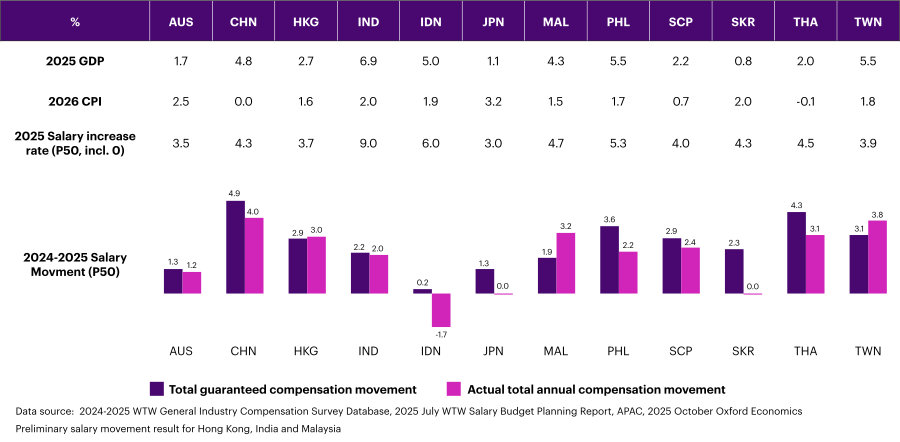
Figure 1. Salary movement across Asia Pacific in comparison with GDP growth rate
- India: The salary growth rate in India is the highest in the region at 9%, surpassing GDP growth of 6.9%. This is driven by strong domestic demand and expansion in tech and shared services sectors. The overall salary movement is at 2% as organisations seek to retain top performers without matching the pay levels of mature markets.
- China: Salary movement in China rose to nearly 4.9% from 2024 to 2025, outpacing the projected salary increase rate of 4.3%. This year’s higher movement is due to companies’ efforts to reward more senior employees that are critical to business growth.
- Hong Kong and Singapore: These markets maintain moderate increases around 3%, balancing cost control with regional competitiveness.
- Indonesia, Malaysia and the Philippines: Salary trends in Southeast Asia show significant variation. Salary growth in Malaysia (4.7%) and the Philippines (5.3%) is expected to outpace GDP, fuelled by demand for shared services and global capability centres. On the other hand, Indonesia remains fairly cautious — the salary increase rate is at 6%, but the total annual compensation movement declined by 1.7% from 2024 to 2025, indicating that companies are controlling variable pay amid inflation and cost pressures.
- Japan, South Korea and Taiwan: Japan and South Korea’s salary movement signal a cautionary business environment, while Taiwan sees a modest growth as the tech industry stabilizes after a cyclical downturn.
Compensation competitiveness across Asia Pacific markets
Singapore continues to set the benchmark for competitive compensation in Asia Pacific, particularly for senior managers (M3) and intermediate career levels (P3). Its strong position reflects the country’s role as a regional hub for multinational corporations and its ability to attract top talent. Hong Kong remains close to Singapore in terms of pay levels, but talent inflow has slowed in recent years as financial services and related roles increasingly relocate to Singapore or Mainland China to align with business operations (Figure 2).
| Actual Total Annual Compensation City Index | ||||||
|---|---|---|---|---|---|---|
| M3 Senior Manager |
P3 Intermediate |
P1 Entry |
||||
| 2025 | 2024 | 2025 | 2024 | 2025 | 2024 | |
| Singapore | 100 | 100 | 100 | 100 | 100 | 100 |
| Hong Kong | 100 | 100 | 92 | 96 | 91 | 88 |
| Australia Melbourne |
84 | 88 | 101 | 104 | 116 | 122 |
| China Beijing |
71 | 70 | 61 | 59 | 45 | 48 |
| South Korea Seoul |
65 | 61 | 67 | 77 | 82 | 87 |
| Japan Tokyo |
61 | 59 | 78 | 71 | 67 | 71 |
| Taiwan Taipei |
60 | 60 | 56 | 56 | 57 | 59 |
| Thailand Bangkok |
51 | 48 | 36 | 35 | 25 | 24 |
| Malaysia Kuala Lumpur |
47 | 43 | 38 | 38 | 31 | 30 |
| Indonesia Jakarta |
37 | 39 | 25 | 27 | 21 | 20 |
| India New Delhi |
34 | 34 | 28 | 27 | 18 | 18 |
| Philippines Manila |
32 | 33 | 22 | 23 | 18 | 19 |
In contrast, compensation levels in China, Japan and Australia remain lower than Singapore’s, influenced by currency fluctuations, cost structures and differences in market maturity. Within Southeast Asia, Singapore still leads overall, but Malaysia is showing notable progress, with senior manager pay levels rising to narrow the gap with regional leaders. These shifts indicate that organisations are striving to maintain cost efficiency while ensuring retention for critical leadership roles.
Hong Kong’s salary increase budget for 2025 stands at 3.7%, slightly lower than previous years, signalling a cautious approach to cost management. Interestingly, the gap between companies at market median (P50) and upper quartile (P75) has narrowed, suggesting that even higher-paying organisations are controlling costs. Promotion activity remains moderate, with about 9% of employees promoted and 91% receiving merit increases, reflecting a focus on internal equity and sustainability.
In Malaysia, minimum wage increases and the introduction of living wage standards are driving wage compression across organisations as lower-level employees receive higher pay while internal salary freezes or capped raises remain for tenured staff. This can potentially impact employee morale, but proactive measures such as adjusting pay bands or incentivising beyond base pay can help organisations mitigate this risk.
Thailand expects modest salary growth and slightly higher variable payouts, but rising voluntary turnover suggests employees are actively seeking better opportunities. Involuntary turnover is also up, reflecting restructuring and cost-cutting measures.
These salary trends show how organisations in Asia Pacific are allocating their salary budget to retain critical talent, which may well be evident until 2026. Our 2026 Thailand People Strategic Planning Survey has found that HR personnel aim to focus on talent attraction, retention and development in the coming year by prioritising compensation and benefits, career management and employee branding. In contrast, business and operational leaders are concentrating on work transformation, manpower optimisation and establishing a performance-driven culture, signifying their goal to optimise resources and drive results. These findings indicate the need for organisations to strike a balance between these differing priorities as they prepare for the business landscape in 2026.
Balancing total rewards with financial sustainability
There is an increasing pressure to manage employee costs in many Asia Pacific countries, even as salary growth projections remain strong. This is somewhat in conflict with the wider trend where projected salary increases are expected to be higher than the forecasted GDP growth for 2026.
For HR professionals, managing costs means either securing lower cost to deliver the same value, or getting more value out of the same spend. To make a significant difference, HR can focus on three key areas:
- Overall labour costs. Benchmarking pay against market reference points is common practice, but it can obscure the bigger picture. To understand true cost competitiveness, organisations should look at overall people cost as percentage of overall operating expenses and see how they compare against the competition. Comparing aggregated costs against the right industry and select peers is essential to ensure competitiveness and long-term financial sustainability.
- Organisation structure and FTE realignment. Companies constantly review their organisational structure to align with new strategies, operating models, regulations or skill requirements. However, instead of optimising the overall design, many organisations add roles or departments, leading to unnecessary head count and higher costs. To maintain financial sustainability, organisations should regularly assess and adjust their structure and related manpower to meet business needs while avoiding excessive hiring.
- Performance management. Getting performance management right can align employee behaviour to the company’s financial goals. According to our 2025 Performance Management Virtual Focus Group study, organisations with effective performance management are 1.5 times as likely to report having significantly higher financial performance than their industry peers. Nearly half of organisations believe optimising performance management could boost productivity by over 10%, which can accelerate project delivery, improve customer satisfaction and drive revenue growth.
By aligning total rewards with fiscal responsibility, organisations can boost productivity, engagement and business outcomes, ensuring the organisation’s sustainable success.
By aligning total rewards with fiscal responsibility, organisations can boost productivity, engagement and business outcomes, ensuring the organisation’s sustainable success.
DEI as a lever for sustainable growth
Fiscal responsibility is not just about cutting costs but also investing in areas that yield sustainable returns. Diversity, equity and inclusion (DEI) strengthen the business case for sustainability by improving talent retention, reducing risk and driving innovation.
Global conversations around DEI are evolving, with emphasis on cultivating inclusion or belonging in the workplace. People want to feel seen and valued in the organisation, making DEI critical for talent retention. Taking a deliberate, structured approach to DEI will make it more meaningful, measurable and sustainable — and one way to approach it is to consider the phases from insight to impact.
- Discover – be clear about what needs to happen and why. Analysing employee experience data, policies, workforce demographics and external benchmarks as well as running listening sessions, leadership interviews and stakeholder alignment workshops can uncover gaps and opportunities that will create a foundation for real change.
- Design – create a tailored, practical strategy that connects with talent, rewards, wellbeing and culture. Organisations can start by defining DEI goals, building inclusive leadership frameworks, shaping the employer value proposition or designing career equity models.
- Execute – bring the strategy to life. Develop inclusive capability programs, update job architecture or pay equity systems, redesign policies and embed inclusive behaviours through tools, nudges and training.
- Track – build DEI dashboards, set key performance indicators, and use pulse surveys and analytics to measure what’s working and what needs to improve. This can help enable continuous improvement and keep leaders accountable.
When DEI is treated as a core business strategy instead of a standalone initiative, it becomes a driver of long-term value.
Conclusion
Asia Pacific’s economic stability and rising salary budgets present both opportunities and challenges for HR leaders. Competitive pay remains essential for attracting and retaining talent, but organisations must balance this with financial sustainability. Organisations can maximise their talent investment while safeguarding long-term business health by benchmarking costs holistically, optimising organisational structures, investing in performance management and embedding DEI into financial strategies.
Authors



Beyond Data on-demand webinar
Planning for 2026 — Salary budgets, performance & inclusion