Leading organizations are now communicating rewards with the ambition of motivating their people, driving appreciation and supporting decision making.
Think about how much time and money you spend on your Total Rewards each year across pay, core benefits, pension contributions, incentive plans, wellbeing initiatives, development opportunities, and the broader experience you offer at work. The effort that's involved in administering your benefits and pension schemes.
Now think about how much effort goes into ensuring that employees appreciate and take control of everything they are offered by your organization. For many companies, the lack of focus here creates a disconnect between the cost of providing reward programs, and the perceived value of these programs to employees. It also leads to employees not using their rewards effectively - think of the number of employees who don't take advantage of matched pension contributions.
Traditionally, the approach to increasing the perceived value of Total Rewards was to issue a Total Rewards Statement - an annual letter posted to the houses of employees each year - which quantified the cost of each element of their rewards package and aimed to tell an employee, "Look how expensive you are".
This approach has key limitations:
- It's inefficient and expensive. Posting letters to thousands of employees and ensuring the data is accurate, is a costly and time-consuming process - missing out on all of the efficiencies of delivering online.
- The information is always out of date. The annual backward-looking snapshot focuses on how much an employee earned last year but tells them nothing about the present or the future.
- “Look how expensive you are” is not the right message. The focus should be on providing value for the employee, not on explaining the cost to provide life insurance or medical coverage.
“Life is expensive. There are a lot of benefits that I may have taken for granted. No longer!!”, Employee at JetBlue.
“Life is expensive. There are a lot of benefits that I may have taken for granted. No longer!!”Employee at JetBlue
Now, organizations are modernizing their approach to communicating Total Rewards, creating an online experience aimed at changing behavior.
WTW’s approach is founded on three elements:
- Simply inspire. By taking a consumer-grade approach, content is focused on creating motivation - inspiring, integrating and nudging the employee to take interest. We focus on the reason 'why' you should care and not just the 'what' you get.
- Future focus. The intent is to help employees focus on progress; to look ahead not back. Data and content is framed to help the employee better appreciate how they can get more from their package and how the package can grow with them.
- Actively support. The behaviors we aim to drive are appreciation and action. The aim is to consider the likely decision employees might make and organize content in a way that intuitively supports better decision making.
8%While three quarters of organizations have technology linked to Total Rewards, only 8% use it well.
WTW Modernising Total Rewards Survey
Improving the Total Rewards Experience at JetBlue
JetBlue, a US airline with over 23,000 crewmembers, wanted to drive more value from its Total Rewards package. It spends over $2 billion each year on Total Rewards programs, but these were under-utilized and appeared underappreciated.
Previously, JetBlue, like many employers, had sent paper statements to the homes of Crewmembers. These statements were generic, depersonalized and outdated - they helped Crewmembers to see the cost of their rewards in the past year, but did nothing to inspire, drive focus on the future or change behavior. Wanting to increase appreciation of their array of benefits, JetBlue needed to create an engaging experience.
Creating a Total Rewards Experience
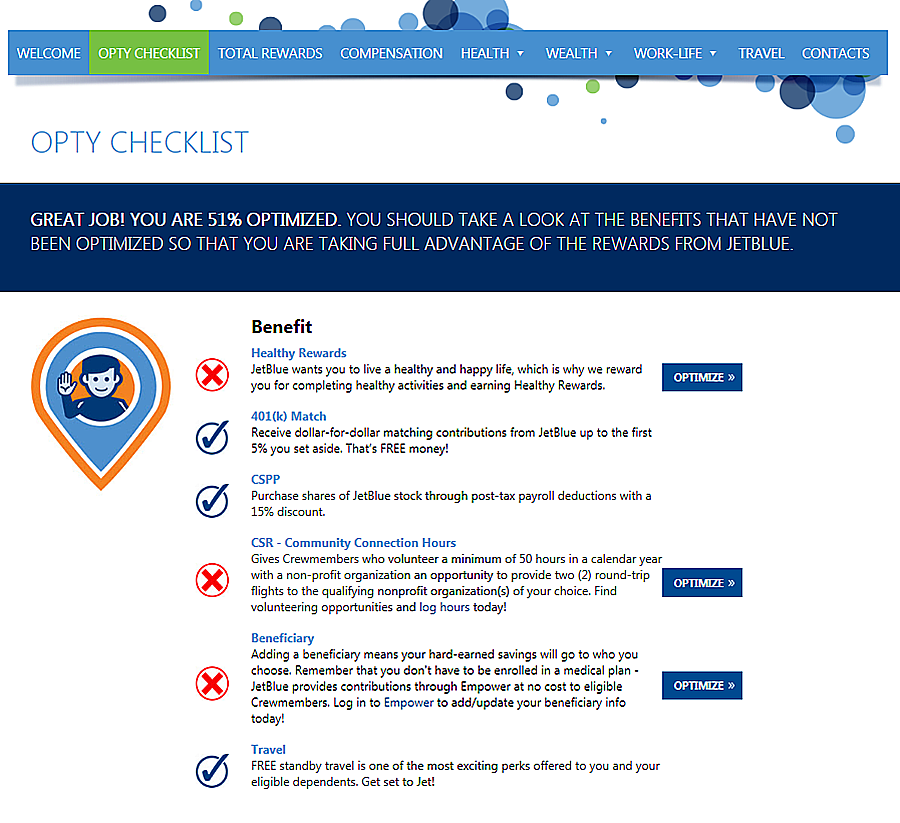
We worked with the airline to create an online experience that empowered personal decision making and helped Crewmembers to see the value of everything they were offered. Our solution was to create a personalized Total Rewards experience.
Here's how their experience changed:
- Delivered online - Instead of receiving a letter to their home once a year that told Crewmembers how much they earned last year, they could access the site from any place and at any time and see up-to-date, future-focused information on their Total Rewards.
- Focused on value - Instead of being presented with a list of numbers and seeing how much each of their benefits cost, Crewmembers were given the ability to optimize their Total Rewards and derive value. Data driven personalization allowed JetBlue to show its Crewmembers how much they could be getting by taking advantage of different programs.
- Creating an experience - Instead of a generic communication, JetBlue could connect people with the airline's brand. As WTW's technology is completely configurable, JetBlue could create a Total Rewards experience that aligned with both its external brand and employer brand.
The result? Higher levels of engagement with Total Rewards, increased participation in the pension scheme and greater utilization of wellbeing programs.
The result? Higher levels of engagement with Total Rewards, increased participation in the pension scheme and greater utilization of wellbeing programs.
Employees now engage with their rewards an average of 12 times per year, in contrast to the once-a-year paper Total Rewards Statements they used to receive. Over 1,000 extra employees have enrolled in the pension plan, and over $1.4m extra has been paid in healthy rewards schemes. By creating a personalized Total Rewards experience, JetBlue have been able to drive appreciation and engagement.
Authors


Total Rewards
Helps your organization thrive in an increasingly dynamic world.