
Solar generation is forecast to meet roughly half of the growth in global electricity demand through to 2027, according to the International Energy Agency’s (IEA) Electricity 2025 report. But headline blackout events in Europe earlier this year are a reminder of how intermittency can create widespread disruption. Stabilizing intermittency is an operational imperative. And investment in battery energy storage systems (BESS) is set to accelerate.
Given the current adoption rates, BESS systems are likely to coexist and accompany utility-scale solar projects in the future.
BESS-solar integrations can boost revenue
BESS improves the predictability of solar photovoltaic (SPV) output by reducing variability in energy supply. Hybrid BESS and SPV facilities capture solar-generated energy during daylight hours, store it, and then export it to the grid during peak evening demand periods to leverage higher electricity prices. This approach enhances the overall yield (P50) and creates an additional revenue stream to offset the cost of integrating BESS technologies. Hybrid projects can also incorporate loss clipping, where excess solar energy that surpasses the inverter capacity is stored in the battery system. Beyond direct revenue benefits, certain markets - notably the U.S. - offer tax incentives such as the Investment Tax Credit, significantly improving a project's financial attractiveness and net asset value [1] .
When considering technologies, it is crucial to conduct a thorough analysis of battery size to optimize its capacity.”Alan McShaneGlobal Head of Risk Engineering, Willis Natural Resources.
“When considering technologies, it is crucial to conduct a thorough analysis of battery size to optimize its capacity. This analysis should consider factors such as the desired autonomy, peak export demand, and the timing of export demand throughout the day. Take into account the output pattern of the PV panels for both charging and exporting energy.” Alan McShane, Global Head of Risk Engineering, Willis Natural Resources.
But hybrid SPV plus BESS systems create specific interface risks due to their inherent complexity.
Top BESS risks at hybrid solar plants
| Risk | Impact |
|---|---|
|
Thermal runaway and fire Incidents such as the 2023 fire at a hybrid facility near Chaumont , New York are stark reminders of how co-locating BESS and SPV may increase fire risks, potentially exacerbating damage caused by a thermal event |
Catastrophic fire, asset loss, injury and death, business interruption, liabilities |
|
Release of toxic gases Emission of hazardous chemicals during fires |
Health risks, environmental damage and liabilities |
|
Electrical failure Faults in battery management systems, wiring, or electrical components |
Fire risk, operational outages and business interruption |
|
Site layout Insufficient separation between BESS and solar infrastructure |
Fire spread, asset damage, injury and death, business interruption, liabilities |
|
Regulation and liabilities Lack of national standards, local opposition |
Project delays and reputational risks |
|
Operational and maintenance Poor monitoring, operation outside specifications |
Increased failure likelihood – property/asset loss, business interruption and liabilities |
Harness the full power of risk engineering to build risk resilience
Although the frequency incidents relative to installed capacity has decreased, the inherent risk remains substantial. Careful planning and mitigation strategies are crucial during design, construction, and operational phases.
| Key risk engineering action | Scope | Value and impact |
|---|---|---|
| Hazard identification and risk surveys | Analyze fire, explosion, thermal runaway and electrical risks, and identify risk controls to prioritize | Prevents incidents and improves safety, supporting stable revenue flow and reducing the risk of disruption |
| Optimize facility design | Design physical layouts that ensure adequate separation of BESS units and solar arrays to limit incident propagation | Boosts system reliability and safety, supporting stable revenue flow and reducing the risk of disruption |
| Ensure compliance | Ensure adherence to National Fire Protection Association, Underwriters Laboratories, International Electrotechnical Commission, local codes | Reduces legal and regulatory risks |
| Plan emergency response | Develop protocols and training | Minimizes incident impacts to first and third parties |
| Monitor and maintain | Use analytics for early fault detection | Reduces downtime and extends asset life |
| Support insurer decision-making | Provide robust risk information, backed by data | Lowers insurance costs and optimizes coverage |
| Assess technologies | Evaluate safer chemistries and fire mitigation technologies | Reduces hazards and identifies opportunities to build operational efficiencies |
Emergency response checklist:
Using risk engineering to build longer-term resilience
Revenue modeling for BESS is complex due to the diverse ancillary service markets available, with up to 21 distinct markets in the U.K. alone. These markets are categorized into contracted revenue and merchant revenue streams.
Merchant revenue is subject to market fluctuations rather than fixed contracts, introducing risk due to value uncertainty. But it also offers significant revenue potential for projects. BESS projects can generate both contracted and merchant revenue at different times of the day or year.
Some BESS facilities engage in tolling agreements, where they sell their services to the grid at predetermined prices. Others participate in energy arbitrage, purchasing energy at low prices and selling it back to the grid when prices are high. Certain BESS facilities are contracted to provide grid resilience services.
Regardless of the revenue stream or service type, there are three primary end-users for these services:
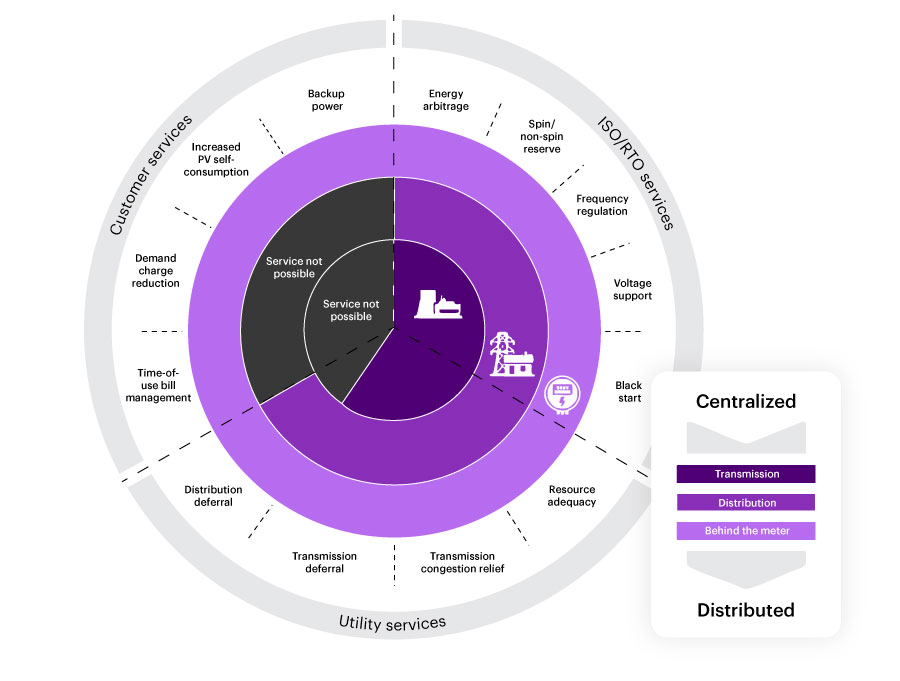
The key stakeholders groups where batteries can deliver service.
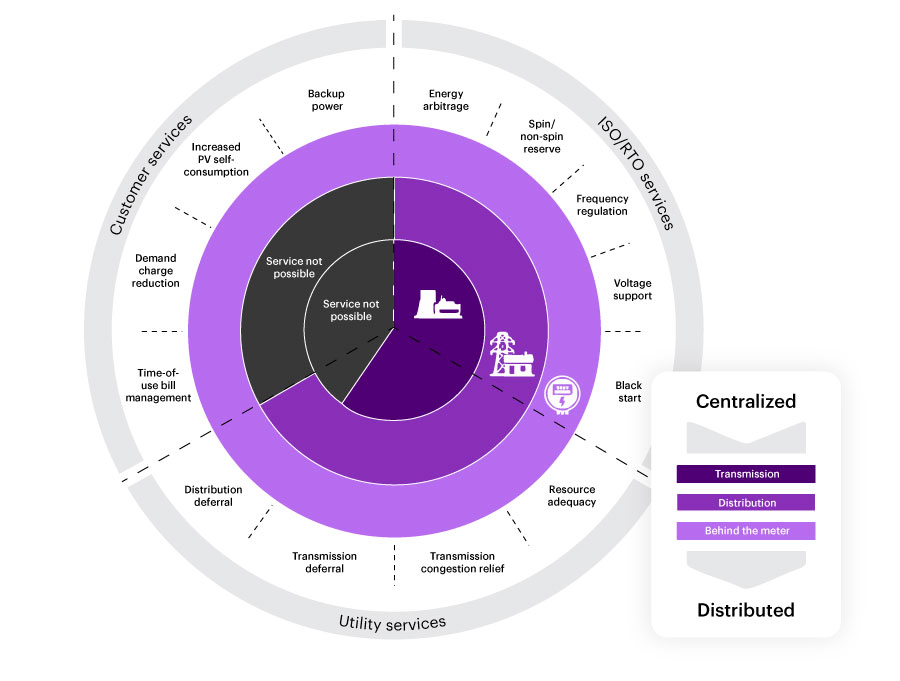
- Electricity customers (residential, commercial, industrial)
- Distribution network operators
- National grid or transmission operators
Whether implemented via an integrated EPC contract or as a retrofit, careful consideration of project layout, grid configurations, and fire safety measures is essential to mitigate interface risks effectively.”Babak EftekharnejadAssociate Director, Risk Engineering, Willis Natural Resources
This complexity directly affects the predictability of charging and discharging schedules, influencing export and import capacities. Co-located solar and BESS systems may compete for limited grid connection capacity at certain times, potentially causing the BESS to miss optimal charging opportunities, impacting revenue from arbitrage and grid flexibility services.
Uncertainties can complicate the accurate declaration of total insured values and maximum business interruption exposures, leading to risks of assets being over- or under-insured.
Integrating risk engineering ensures insurance coverage matches the true risk profile of BESS-solar projects, balancing cost and protection effectively for all stakeholders.
Risk engineering activities and their impacts on the prevention of over/under insurance
| Key risk engineering activity | How it prevents over/under insurance | Outcome |
| Detailed risk assessment and PML | Quantifies actual worst-case losses | Accurate insurance limits and premiums |
| Verification of mitigation | Confirms effective risk reduction measures | Lower risk profile, better insurance terms |
| Early insurer engagement | Aligns design with insurer requirements | Avoids coverage gaps or excessive coverage |
| Continuous monitoring | Provides real-time risk data for insurance adjustments | Dynamic, appropriate coverage over time |
| Full disclosure/ documentation | Ensures insurers have complete risk information | Prevents claims disputes and under-insurance |
“Integrating BESS into SPV projects enhances grid reliability and financial performance. Whether implemented via an integrated EPC contract or as a retrofit, careful consideration of project layout, grid configurations, and fire safety measures is essential to mitigate interface risks effectively.” Babak Eftekharnejad, Associate Director, Risk Engineering, Willis Natural Resources
To find out how risk engineering can help to optimize your BESS risk strategy, contact our team.
Footnote
- Lebowitz, D., Daly, S., & Sundaram, S. (2024). The BESS Book: A Cell to Grid Guide to Utility-Scale Battery Energy Storage Systems. BESS Book. Return to article
Authors

Contact