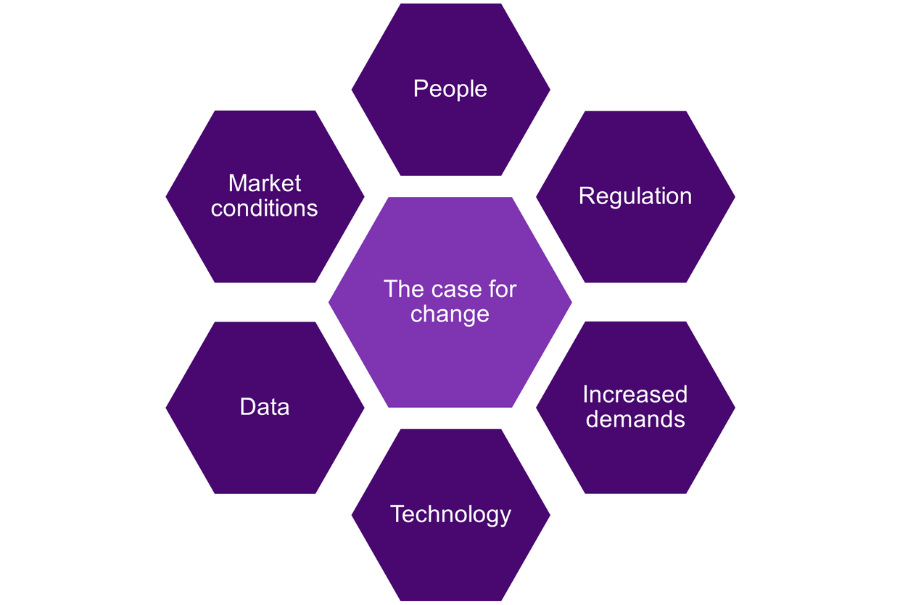
While the role of reserving will continue to include providing assurance and meeting regulatory reporting requirements, it can and should also be recognised as a potential source of genuine business insight. We have worked on many powerful use cases with clients that prove the value in cross-function collaboration on data and solutions; it’s the right time to be open to a shared vision of change and modernisation.
Case study: Reserving transformed
WTW was appointed to help transform an insurer’s reserving function to enable it to provide better support to the company’s other business functions.
The problem
The reserving team was heavily reliant on Excel which left it lacking agility and responsiveness, resulting in a significant number of issues. For example, whenever another function requested analysis on a specific subset of the portfolio or at a specific granularity, this would take the reserving team time to set up, check and deliver. There was also a dependency on IT to make any changes in the data, further slowing down the reserving team’s ability to respond to business requests and to be flexible to changing business needs. This meant they had to frequently decline requests or push back on deadlines, leading to the perception that the reserving team was slow and unhelpful.
Due to the excessive manual effort required to run the process, the team’s view of reserves was restricted to a quarterly basis. As a result, the client’s pricing team effectively ran their own reserving process to feed into pricing models. The MI produced by the reserving function was not widely used within the business, beyond regulatory reporting, as it was too aggregated and did not include a clear explanation of the drivers of the results.
The solution
Working collaboratively with the client, we designed and implemented a transformed reserving process which was flexible, automated and rich with analytics. Highlights of the new process:
- Aggregate analysis is highly automated, with human effort adding genuine value;
- Results are produced automatically at a policy level by cascading aggregate methodology and assumptions down to the policy level (a next step is to calibrate assumptions at the granular level, adjusting them to take into account policy level characteristics);
- There is an automated process to update dashboards, which enables the monitoring of emerging experience outside of quarterly reserving process;
- A data warehouse was introduced, which gives the control of data back to the actuarial team and means they can now query underlying data sources without impacting the source systems themselves.
As part of the transformation project, we significantly reduced the reliance on Excel and implemented a suite of new technology. We used ResQ, WTW’s aggregate reserving software, and Unify, WTWs workflow management tool that provides control and governance across the process as well as full end-to-end automation capability. We also used Power BI for visualisations and embedded these within the Unify environment.