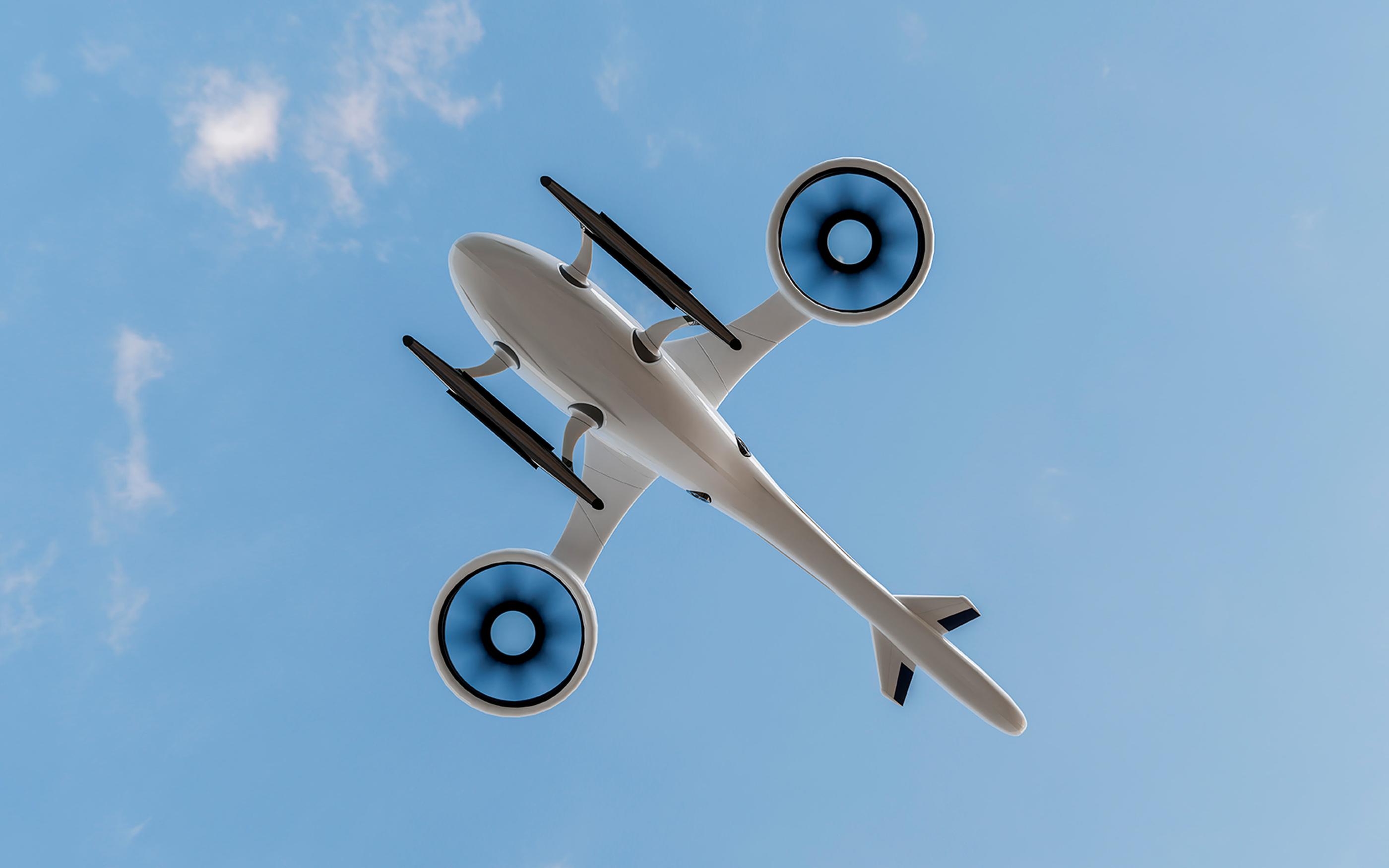
Two years ago, there was a lot of excitement around the concept of electric vertical take-off and landing vehicles (eVTOLs), mostly modest-sized flying vehicles for around four people with a 100–300-mile range.
These vehicles have the potential to revolutionize not just aviation but the whole of the transport sector, simultaneously slashing journey times and carbon emissions, freeing up infrastructure and creating a myriad of business and leisure opportunities.
After the flash in the pan
Whether you are looking at eVTOLs, cryptocurrencies or artificial intelligence, when something new emerges that has the potential to revolutionize an industry, there can be a lot of initial excitement. Investment money can be attracted to the sector in question, but starting up a business, particularly when you are creating a whole new sector, is difficult, expensive and time-consuming. After a little time, the investment that was attracted by headlines and social media starts to drift away in search of quicker, better returns. It is not unusual for some companies to start to struggle.
It doesn’t necessarily follow that the sector is in decline though. Behind the scenes, the hard work is still going on. The companies involved are still burning through the cash, but they aren’t putting out a press release or videos on social media every few days. Instead, they are getting on with the long and complicated process of development, testing and delivery.
Few would disagree that flight is hard and the technology involved is complex. Creating efficient, effective and safe eVTOLs is always going to be complicated and expensive and there aren’t going to be any corners that can be cut. So while there may not be as many excitable social media updates being posted, behind the scenes, there is a lot of hard work being done.
Five years of hard graft
Getting from the initial excitement through to the delivery of a working product is a challenge for even the most established technology-based industries. If you take the example of a commercial aircraft, the design, prototype and manufacturing stages of the process take around five years on average,[1] but can take twice that if an aircraft is particularly innovative and represents a generational shift.
In the case of a commercial aircraft, it might be faster, lighter and more economical than the previous generation, but it is integrating into existing infrastructure. The companies behind eVTOLs are trying to do everything from scratch, not just the design of the aircraft itself but also the infrastructure behind it, from the customer experience right the way through to securing sites for the vertiports of the future. They also need to develop ways to reduce the risk of creating conflicting flight paths in urban areas or around traditional airports and make sure that local fire departments are trained for the types of fires that could happen as a result of the batteries that could be used.
It’s a very long to-do list, and the companies that are trying to work their way through don’t tend to be able to rely on established internal teams to do the groundwork. It’s mostly up to a very lean leadership model to steer the whole process.
The reality is that if it takes some of the largest and most established airframe manufacturers five years to develop a new aircraft, a fledgling eVTOL company is likely to take considerably longer to get from the drawing board and into the air.
Building at scale
To be fair, while transporting people in an eVTOL might still be a nascent industry, some of the heavy lifting is being shared with smaller, local delivery organizations. Various companies in several jurisdictions are developing drone-led last-mile delivery options, and several others are working at the same challenge from medical supply delivery and disaster recovery perspectives.[2]
As these organizations move beyond small-scale, local projects, and start to achieve regional and even national coverage, a new generation of workers with knowledge and expertise will emerge, some of which will scale up to embrace the larger challenges that eVTOL vehicles present.
A new generation of workers with knowledge and expertise will emerge
Meanwhile, regulators in several jurisdictions are working to accommodate what could be on the horizon[3], which tends to be an indicator of a potential growth market. In some cases, regulators are working in parallel to reduce regulatory hurdles and manage the balancing act between safety and nurturing an industry that is already estimated to be worth around $11.5-15.6 billion annually (and has projected annual growth rates of between 20-25% up to 2034).[4]
$11.5-15.6bn estimated current annual value of the eVTOL industry
The risk management perspective
Offering the fledgling eVTOL companies support to their corporate risk management efforts is where the insurance sector comes in, but insurers will also face a great many challenges themselves from the introduction of this technology. Insurers are accustomed to pricing risks for proven aircraft with an established operational history, but eVTOLs present a new challenge.
Insurers will also face a great many challenges themselves from the introduction of this technology
With limited operational data, unknown accident rates and constantly evolving technology, traditional actuarial models are difficult to apply. Underwriters must rely on scenario analysis, benchmarking against analogous technologies and close collaboration with manufacturers to estimate failure rates, so that they can estimate the premium volumes that can be set at an attractive level while still providing adequate returns for the insurers. The lack of historical loss data means pricing is inherently uncertain, and insurers must build flexibility into their rating models.
Turning to potential operators, policy limits for eVTOL operations are another area of complexity. The potential for urban operations, high passenger turnover on short but frequent journeys and integration with existing infrastructure means insurers must consider a wider range of exposures—from passenger liability to third-party property damage and cyber risks. Limits must be sufficient to cover catastrophic events, but excessive limits could make coverage unaffordable for fledgling operators. Insurers are working with clients to model worst-case scenarios and stress-test policy structures.
Regulation is evolving rapidly, with authorities in several jurisdictions working to balance safety and innovation. For insurers, regulatory uncertainty complicates product development and risk assessment. Requirements for pilot training, airworthiness certification and operational standards are still being defined, and may differ significantly between regions. Insurers must stay abreast of regulatory changes and ensure their products remain compliant, while also advocating for harmonization to facilitate cross-border operations.
Regulation is evolving rapidly, with authorities in several jurisdictions working to balance safety and innovation
With so many hurdles to clear, the appetite for insuring eVTOLs varies across insurers. Some are eager to support innovation and capture new business, while others remain cautious due to the lack of available operational data and the potential for large losses. Appetite is influenced by the insurer’s experience with the introduction of aircraft prototypes, their risk tolerance and their ability to access specialist expertise.
Partnership and clear communication between insurers, brokers and manufacturers is essential to share knowledge and develop tailored solutions.
The availability of insurance for these new aircraft can influence the design parameters for the aircraft themselves. As eVTOLs progress from development to deployment, insurers will be central to enabling safe, sustainable operations. The challenges of policy limits, regulation and appetite are significant, but with collaboration and innovation, the insurance sector can help shape the future of urban air mobility.
Footnotes
- How Long Does It Take to Build an Airplane?. Return to article
- Drone delivery: Navigating the path from high-flying hype to last-mile reality. Return to article
- How FAA’s eVTOL Pilot Could Transform U.S. Air Travel. Return to article
- Five Nations Unite to Streamline eVTOL Certification. Return to article
Authors