


Insurers are already taking seriously the growing scrutiny and regulatory demands of their performance through an ESG (environmental, social, governance) lens. Instances though of implementation and continual monitoring, where ESG is an integral part of business strategy aligned with the overall company values, are thinner on the ground. This current gap - between top down and bottom up - raises the prospect of heightened risk and missed opportunities for those that drag their feet in addressing the practical side of ESG into the business.
“What is your company doing about ESG?” By now, it’s highly likely that if you are a senior executive working in the insurance industry, you have been asked this question in one form or another from one or multiple groups of stakeholders.
Growing regulatory pressure aside, one measure of just how prevalent the need to address this question is becoming across the business spectrum is some analysis compiled by FactSet that showed a rapidly rising trend in the number of Standard & Poors 500 Index companies mentioning ESG on their earnings calls. And that is only in the United States, despite Europe having been seen to push the ESG agenda harder with investors up to now.
What is your company doing about ESG?
Typically, insurers will be able to point to a number of workstreams they are pursuing – and are indeed doing well. This might be limiting underwriting criteria on climate or social grounds or allowing for climate and ESG uncertainty in modelling. It may be taking a stronger line on inclusion and diversity and employee wellbeing. It might be publishing a net zero ambition and enhancing reporting on climate and sustainability issues because of growing regulatory pressure. Or maybe it’s adopting a stronger ESG theme as part of asset and investment strategy.
All individually are of course quite valid and further cement how central the insurance industry can be to accelerating ESG and climate transition outcomes given its role in managing risks and the large investment portfolios it controls.
The questions that demand a cohesive approach
As we have outlined in previous climate-related articles, a cohesive strategy must be the next step for many in the industry. By adopting such a strategy, the insurance industry can focus on safeguarding future bottom line financial performance as well as be a powerful force in societal transformation.
Such a strategy will need to contemplate several key questions:
- What does ESG mean for your organisation?
- What response and approach to ESG is commercially viable and achievable for you, now and in the long run?
- How does ESG fit within your company ethos? What role do you want to play in accelerating and incentivising the transition; is it wider than insurance?
- How can you consider both upside and downside risks?
- How can you bring transparency to your ESG strategy and documentation? Where have you made progress? Where have you not and what can you do about it?
- How can claims, underwriting and investments feed into your overall ESG strategy?
- How does the ESG approach build business resilience and identify opportunities?
Trending Topic
ESG In Sight

Regardless of your company and its relative size, the methods and tools needed to answer these questions will, on the whole, be rather similar. These range from building a strategic view of the risks and opportunities using quantitative and qualitative analysis, through developing adjusted underwriting and claims frameworks, to putting together short, medium and long-term plans and implementing and periodically reviewing them to ensure they are both appropriate and fit-for-purpose.
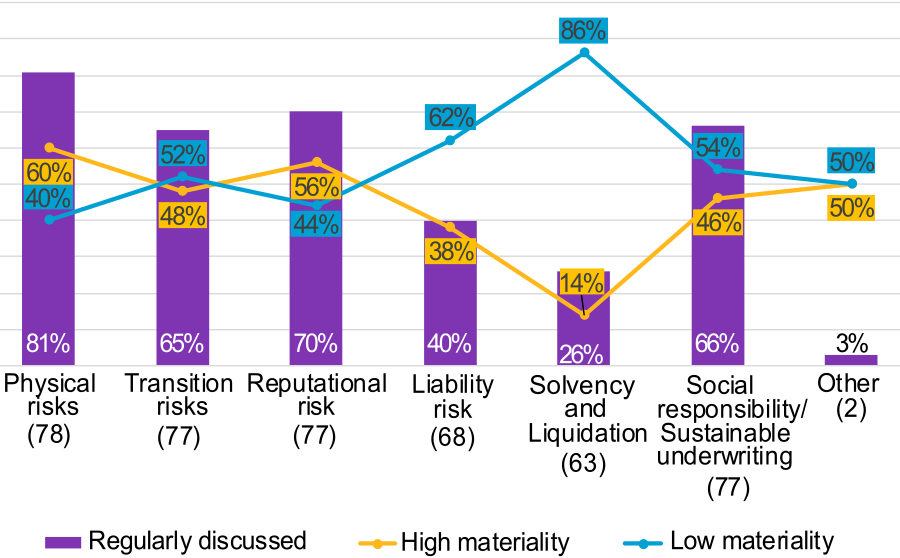
Figure 1: Risks routinely discussed in relation to climate change
Source: TCFD: How are UK and European insurers faring?
No cookie cutters
But there is most definitely not a cookie cutter approach to determining the content and priorities of the strategy.
ESG strategy needs to reflect the reality of the business and its operational factors and constraints, such as whether the business is a parent, a subsidiary of a larger company or a Lloyd’s syndicate. Each insurer’s ESG strategy will (or should) differ depending on the individual definition and context within the business. Put another way, it has to come from the business.
The key is to be proactive across all business functions, knowing that there are support tools out there to help make sense of the imponderables of changing economic and social conditions, such as the STOXX/WTW Climate Transition Indices, that use a value at risk methodology to assess the impact of different climate transition scenarios, or Climate Transition Pathways (CTP) that is designed to incentivise transition.
Moreover, regulatory and compliance expectations will need to be balanced with the transparency and reporting that satisfies numerous stakeholder groups, not forgetting also that ESG strategy should address the need for business resilience as the economy transitions to carbon neutrality. As such, there needs to be a fair dose of pragmatism in assessing what strategic goals are achievable in the short, medium and longer-term.
Among the significant challenges will be those of ownership and stewardship. On ownership, ESG is a collective business strategy, not the responsibility of one or two people with an ‘ESG or sustainability hat’ on within the business. All decision makers play a part.
One newly explored area of fostering this ownership to date has been to link compensation to ESG goals, as evidenced by a late 2020 WTW cross-sector survey of ESG intentions that found 41% of companies planned to introduce long-term incentives linked to ESG measures for senior executives within three years. Stewardship addresses the extent to which the company wants or is able to use its influence – such as voting rights in equity holdings or its right to allocate its capacity and risk capital in ways that it deems socially responsible – for a broader ESG purpose.
Back to the value chestnut
Of course, most areas of strategic business thinking ultimately come back to a dominant strand of thought: what are the risks and opportunity and where is the value?
Here, we can glean insight from investor sentiment on ethical versus traditional investments. While COVID-19 and the turbulence of oil and gas markets have boosted some areas of traditional investment in the recent past, an AJ Bell/Morningstar study found that in a five-year period to the end of September 2021, returns from ethical investment funds had surpassed those of non-ethical ones by 120 basis points on a global basis and by 170 basis points compared with UK All Companies funds.
In addition, on the ‘E’ component of ESG, the world’s largest asset manager BlackRock exemplifies growing investor proactiveness. For example, it announced in July 2020 that it had identified 244 companies it considered were making insufficient progress on climate risk. Consequently, it had taken voting action against 53 of them on climate issues, and 191 had been warned they would risk voting action against management in the short term if they did not make significant progress.
These trends and numbers demonstrate the increasing need to incorporate ESG considerations in every part of the business, including underwriting and investments.
Close the strategy gap
By adopting such a strategy, the insurance industry can focus on safeguarding future bottom line financial performance as well as be a powerful force in societal transformation.
Yet our conversations with insurance companies suggest that many are stopping short of prioritising ESG from a strategic implementation standpoint and many are failing to see the value in doing so.
An accompanying danger of that viewpoint is that the increasing attention on ESG issues from a range of quarters may encourage companies to jump into the latest trends regardless of their contextual relevance for a set of stakeholders and likely benefit to the business. Development of a cohesive approach is a gradual process where the journey is as important as achieving the objectives.
Moving towards a fully aligned and integrated ESG strategy will provide a roadmap for improved consideration of the risks to insurers but also the potentially wide range of opportunities that an integrated approach to ESG will almost certainly deliver, from new products and engaging the workforce to alternative investments and a generally more sustainable business.
Author

Development of a cohesive approach is a gradual process where the journey is as important as achieving the objectives.