
In media coverage of natural hazards, dramatic headlines are frequently used to attract readers. This is particularly evident with hazards such as volcanoes, which, although not easy to predict with any great certainty, show long periods of precursory signals that could potentially indicate an impending disaster.
Over the past few months, this has been highlighted in the reporting on Italy’s Campi Flegrei (Phlegraean Fields) volcano, located near Naples, with suggestions that it is “stretched nearly to breaking point.” [1] Here, we explore the science behind the headlines to provide insights into the likelihood and consequences of an eruption.
Naples is perhaps best known for Mount Vesuvius, located to the southeast of the city, which destroyed Pompeii and Herculaneum in 79 A.D. However, to Naples' west lies Campi Flegrei (Figure 1), an independent volcanic system with a history of significant eruptions.
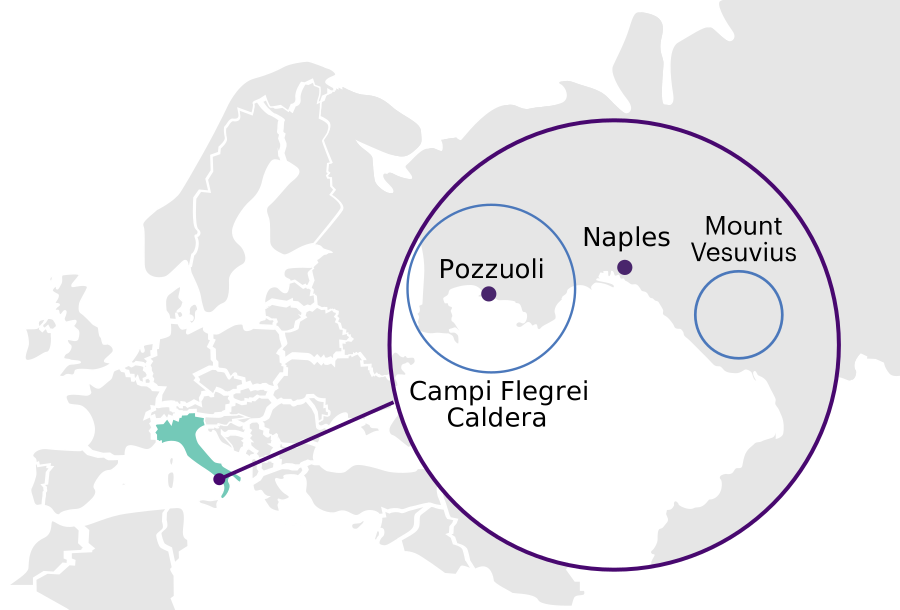
Source: WTW Research Network
About 39,000 years ago, it produced the Campanian Ignimbrite eruption, which was a “super-colossal” (VEI-7) eruption on the Volcanic Explosivity Index (Table 1).
| VEI Classification | Ejecta Volume (Bulk) | Periodicity |
|---|---|---|
| VEI-0 | Effusive <0.0001 km3 | Constant |
| VEI-1 | Gentle 0.0001 – 0.001 km3 | Daily |
| VEI-2 | Explosive 0.001 – 0.01 km3 | 2 weeks |
| VEI-3 | Severe 0.01 – 0.1 km3 | 3 months |
| VEI-4 | Catastrophic 0.1 – 1 km3 | 18 months |
| VEI-5 | Cataclysmic 1 – 10 km3 | 12 years |
| VEI-6 | Colossal 10 – 100 km3 | 50 – 100 years |
| VEI-7 | Super-colossal 100 – 1000 km3 | 500 – 1,000 years |
| VEI-8 | Mega-colossal >1000 km3 | >50,000 years |
This event, thought to be one of the largest in Europe in the past 200,000 years, could have partly contributed to the extinction of the Neanderthals. [2] More recently, Campi Flegrei last erupted in 1538 (VEI-3), significantly reshaping the local landscape and affecting the nearby settlement of Pozzuoli.
Today, Naples is Italy’s third-largest city after Rome and Milan, and its wider metropolitan area is home to over four million people.
While other supervolcanoes surpass it in size, with Yellowstone in the U.S. being nearly 10 times larger in diameter, Campi Flegrei's location near Naples is of significant concern due to its potential to affect a densely populated area.
Despite part of the caldera being submerged under the Bay of Pozzuoli, its land section encompasses a “red zone” housing approximately 500,000 residents, who are most at risk of pyroclastic flows if an eruption were to occur. [3]
In recent decades, the Campi Flegrei caldera has undergone repeated episodes of ground uplift: 1950 – 1952, 1969 – 1972, 1982 – 1984 and 2004 – present. [4] Over the past few months, the caldera experienced swarms of earthquakes, which has fueled speculation about the potential for an eruption and the need for evacuations.
The last eruption in 1538 occurred after an interval of about 3,000 years, but previous intervals between eruptions have varied between decades and several centuries. [5] The 1538 event was also preceded by a long period of uplift, with royal pronouncements needed to establish ownership of new land rising out of the sea in the decades prior, and the coastline moving almost 370 meters in the final few hours. [6] Therefore, a return to eruption after nearly 500 years is a realistic possibility.
However, a recent study led by Chris Kilburn from University College London has found that the unrest since 1950 has produced major structural change in Campi Flegrei’s crust. [4] This makes forecasting an eruption more difficult because we cannot rely on conventional approaches that assume new eruptive episodes will repeat their previous behaviors.
Based on the latest evidence, Kilburn et al. find that there is little risk of an imminent eruption. However, the conditions for an eruption are now more favorable than they have been in the past.
In the short-term, more pressing risks to the local population are the earthquake swarms and ground uplift causing structural damage to buildings and infrastructure. Local civil protection agencies have been allocating resources and raising awareness in preparation for possible evacuations if necessary. [7] Campi Flegrei was last subject to severe and damaging seismic swarms between 1982 and 1984, resulting in 40,000 people being temporarily evacuated from nearby Pozzuoli.
Although science can’t definitively say whether or not there will be an eruption in the near future, historical data and scenario analysis can be used to identify what volcanic hazards and cascading risks may exist for the surrounding population.
Giuseppe De Natale, former head of the Vesuvius Observatory at the National Institute for Geophysics and Volcanology (INGV), has stated that the most likely eruption scenario would initially be phreatic (known as a “steam-blast eruption”), relatively weak and devoid of new magma.[8] But characterization of past activity[9] and probabilistic analysis by INGV[10] suggest that there is also the potential for a violent Strombolian eruption, whereby lava and pyroclastic material are deposited over hundreds of meters.
Based on ejecta from the 1538 eruption, Campi Flegrei has the capacity to produce several million cubic meters of ash and lava,[11] destroying buildings, covering Naples and Pozzuoli, and damaging farmland. The caldera’s partially submerged location also means that there is potential for triggering a tsunami that could affect the Bay of Naples and surrounding islands such as Ischia[12] In addition to more visible dangers, an often-overlooked risk from volcanoes is the emission of volcanic gases[13] These gases can have direct effects, such as asphyxiation, as well as indirect effects, including regional crop failure caused by the cooling effect of sulphate aerosols in the stratosphere.
The capacity for Campi Flegrei to produce an explosive eruption with ash and tephra also presents a significant risk to European air travel, which would likely surpass the disruption caused by the 2010 Eyjafjallajökull eruption in Iceland. Unlike Eyjafjallajökull, which affected air travel primarily in Northern and Western Europe, a large ash cloud produced by Campi Flegrei would directly affect Southern and Central European air space.
Given the centrality of Southern Europe to global tourism and commerce, the economic and logistic repercussions of this would likely be more severe than Eyjafjallajökull, which resulted in a $1.7 billion (in 2010 U.S. dollars) loss to the airline industry[14]. The Mediterranean region also serves as a vital junction for maritime transport and submarine cable infrastructure, which could be disrupted by an eruption[15].
A study conducted by the WTW Research Network and its partners has undertaken a risk assessment for European volcanoes that have significant VEI-2+ eruption risk, including Campi Flegrei.[16] The analysis encompassed 10 volcanoes, each threatening populations of over 10,000 people.
The aggregated economic property exposure across all volcanoes was estimated at $85 billion (in 2010 U.S. dollars), with more than 87% of this value being concentrated around Campi Flegrei and Vesuvius.
The study found that in the case of a moderately sized VEI-3 eruption at Campi Flegrei, 2.5 million people would be exposed to 2 centimeters of ashfall (causing disruption to transport, infrastructure and agriculture), 144,000 people would be exposed to 25 centimeters of ashfall (causing structural damage to buildings), and 200,000 people would be exposed to pyroclastic density currents (causing total destruction). The authors also estimated that $7.8 billion (in 2010 U.S. dollars) in economic residential property value would be at risk of severe damage or destruction. The true cost of an eruption, factoring in non-residential damage and business interruption as well as inflation and exposure growth since 2010, would likely far exceed this number. The government and property owners would bear most of this cost, given Italy's low take-up rate for insurance.[17]
2.5M people would be exposed to 2 centimeters of ashfall
144K people would be exposed to 25 centimeters of ashfall
200K people would be exposed to pyroclastic density currents
The future of Campi Flegrei remains uncertain, despite the wealth of historical information and scientific analysis that has been undertaken. Meanwhile, Pozzuoli and Naples must remain vigilant and adapt to the evolving situation, from both the imminent risks of ongoing unrest and the ominous potential of a major eruption.