

Across the region, HR functions are at a defining moment. Regulatory requirements around technology and data residency have shaped HR operating models and technology choices for years, resulting in processes that are often manual, spreadsheet-based, and time-intensive to manage. While this has ensured compliance, it has also limited speed, insight, and scale.
The rapid advancement of AI has created a clear path to move beyond incremental improvement. HR organizations are now taking the opportunity to shift quickly toward intelligent, insight-driven models through a step change rather than incremental improvement.
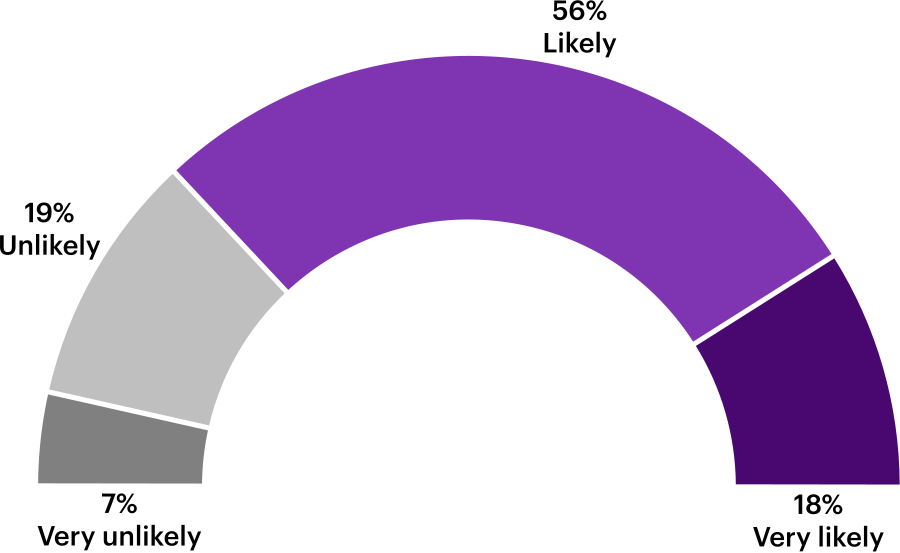
Over the last two years, the acceleration in AI technology has been extraordinary. Nearly two-thirds of HR organizations are actively planning or already deploying GenAI as per a recent Gartner Study. In WTW’s Global 2025 Benefits Trends Survey (Figure 1), 74% of respondents agreed that GenAI was likely or very likely to fundamentally reshape how benefits are designed and managed.
Source: 2025 Benefits Trends Survey, Global
But the adoption is not about chasing technology. It’s about closing a widening gap between rising expectations from the workforce and finite HR capacity. AI helps HR teams do more with less, while improving quality and fairness.
Three reasons drive the momentum:
Automation of the repetitive. AI handles the high-volume, low-value tasks that consume HR bandwidth — freeing people for more strategic work.
Augmentation of decisions. Data-driven intelligence strengthens judgment, reduces bias, and helps leaders make fairer, faster calls.
Personalization at scale. Generative AI is redefining Employee Experience by itsability to hyper personalize content and guidance at scale.
Talent acquisition: Precision at speed
Recruitment has seen the sharpest transformation. AI tools now screen thousands of resumes in minutes, generate inclusive job descriptions, and engage candidates instantly through chatbots.
One global FMCG firm reduced time-to-hire by 75% while improving diversity outcomes. A major facilities management company used an AI assistant that handled over a million candidate queries annually and cut hiring time by 60%. Across sectors, organizations report double-digit improvements in cost-per-hire and quality of hire a undeniable proof that AI isn’t just faster; it’s smarter.
Onboarding and HR operations: Efficiency meets experience
First impressions matter. AI enables personalized onboarding, from tailored learning journeys to automated documentation and system access.
At a leading Asian bank, a generative HR chatbot now resolves routine employee queries, saving around 40 staff hours every month. Companies automating onboarding report up to 50% less manual effort per new hire. The result is not only operational efficiency but also a more seamless employee experience.
Performance and development: Continuous, fair, data-Driven
Performance management is shifting from retrospective to real-time. AI synthesizes feedback, drafts reviews, and identifies development opportunities based on actual data. Managers spend less time on paperwork and more on meaningful coaching.
Predictive analytics reveal emerging leaders, potential flight risks, and critical skill gaps. One financial services organization reduced regrettable attrition by 20% by applying AI-driven insights to its talent reviews.
Employee experience and retention: Engagement that listens
AI-powered HR assistants are now active 24/7 . These systems answer benefit queries, guiding career choices, and offering instant help. Sentiment analysis tools track engagement across channels and surface issues before they escalate.
AI is enabling proactive retention by combining performance, engagement, and market data to predict turnover risks. In WTW’s 2024 Tech Industry Pay Actions Survey, 73% of companies were already using chatbots to handle reward queries, improving responsiveness and employee satisfaction.
Generative AI can boost HR productivity by up to 30%, withn processes with heavy operational load such as recruitment and onboarding showing improvements above 50%.in Time-to-hire, manual effort, and HR operating costs all drop measurably.
But the real value extends beyond efficiency. AI gives HR a stronger seat at the strategy table. Freed from administrative load, HR teams can focus on workforce planning, capability development, and culture, the critical levers that shape business performance. The divide between AI-enabled HR functions and those that remain manual will only widen from here.
While broadly, the efficiency and accuracy of AI functions will depend on the quality of data that they work with, there are some risks to watch out for:
Algorithmic bias and discrimination. AI systems trained on historical HR data can unintentionally replicate and amplify biases related to gender, ethnicity, age, potentially leading to unfair hiring, promotion or performance evaluation outcomes. This risk is especially pronounced in recruitment/assessment tools that filter resumes or assess candidates based on patterns in past decisions.
Lack of transparency and explainability. AI models operate as “black boxes,” making it difficult to understand how decisions are made. This lack of clarity can erode trust and complicate legal compliance particularly related to people decisions. This could also trigger legal and compliance risk in some jurisdictions.
Overreliance and loss of human judgment. While AI can automate routine tasks, it lacks empathy, contextual understanding and ethical reasoning. Employees may feel alienated or anxious when HR processes are automated, particularly if they perceive a lack of human touch or fear job displacement.
Hallucinations and inaccurate outputs. Generative AI tools can sometimes produce misleading or incorrect information known as “hallucinations”. In the HR context, that could mean producing flawed performance reviews, inaccurate assessment, inaccurate policy interpretation etc.
As with all new processes and technologies, it will be paramount not to lose the “human” factor when adopting AI technologies. Whether it’s ensuring the quality and broadness of data being input, or checking and validating outputs, human oversight will remain essential to HR functions even as AI becomes more prevalent.
Start small, start smart. Identify one or two high-impact use cases and scale what works.
Invest in literacy and governance. Build AI fluency within HR, supported by clear ethical and data-governance frameworks and within existing local regulations.
Collaborate, don’t isolate. Partner with technology providers and advisors to accelerate adoption and share lessons learned.
Track and tell the story. Use data to quantify productivity gains, cost savings, and employee outcomes and communicate them clearly.
Keep HR human. AI should empower empathy, not replace it. The future belongs to HR teams that blend intelligence with humanity.
AI is not replacing HR, it’s unleashing it. The future HR function will be smaller, smarter, and far more strategic, where technology handles the process, and people handle the purpose.
The CHROs who act now with with a clear vision will redefine what it means to lead a truly intelligent organization. The next era of HR has begun, and it speaks the language of both data and empathy.
Anuvesh Chandra supports financial institutions across WTW’s CEEMEA region, advising on rewards, productivity and talent management. He is the key account manager for sovereign wealth funds, banks, fintechs and investment firms. With over 14 years of experience, Anuvesh has led HR transformation initiatives across the GCC, specialising in total rewards, HR strategy and organisational design.


