


Most organizations believe they are managing artificial intelligence (AI) because it appears on their risk register. But WTW’s Emerging and Interconnected Risk Survey revealed something surprising: 71 respondents listed AI among their top five emerging risks – yet they used 36 different descriptions. That lack of shared understanding is not a technicality; it’s a strategic vulnerability.
If no one in your organization is talking about the same risk, you are not actually managing AI. You are managing fragments and that misunderstanding can lead to inconsistent governance, uncontrolled exposure and missed opportunities to create value.
AI is not an isolated risk – it is a live, multi-domain disruptor capable of triggering both direct and second-order impacts. One of those AI mentions included the influence of AI on cyber risk. AI and cyber risk are often managed as separate challenges – one as an innovation opportunity, the other as a security threat. In the survey, AI was the top-ranked emerging risk, cyber the leading driver of change over the next two years, and both were highlighted as deeply interconnected across the global risk wheel.
The insight is clear: AI and cyber are not isolated risks. Together, they act as accelerants – creating a risk multiplier effect that traditional, siloed management approach cannot contain. So, in this insight, we examine:
- Interconnectivity in focus: surfacing apparent and hidden connections
- The proof in the present
- What your Monday morning inbox could contain
- How to take control
Interconnectivity in focus: surfacing apparent and hidden connections
When AI is viewed through a single lens – IT, innovation, or compliance – these connections are missed. That’s where the hidden costs emerge. Successful organizations will recognize that the future of cybersecurity is not about choosing between human expertise and artificial intelligence, but about creating a symbiotic relationship where technology amplifies human capabilities by forging a strong partnership between the two.
Organizations that treat AI as just another line item in the risk register will always be chasing its impacts. WTW’s interconnected risk wheel shows AI’s strongest links are to cyber risk, regulatory change, and economic outlook – but the real danger is in the pathways you haven’t mapped.
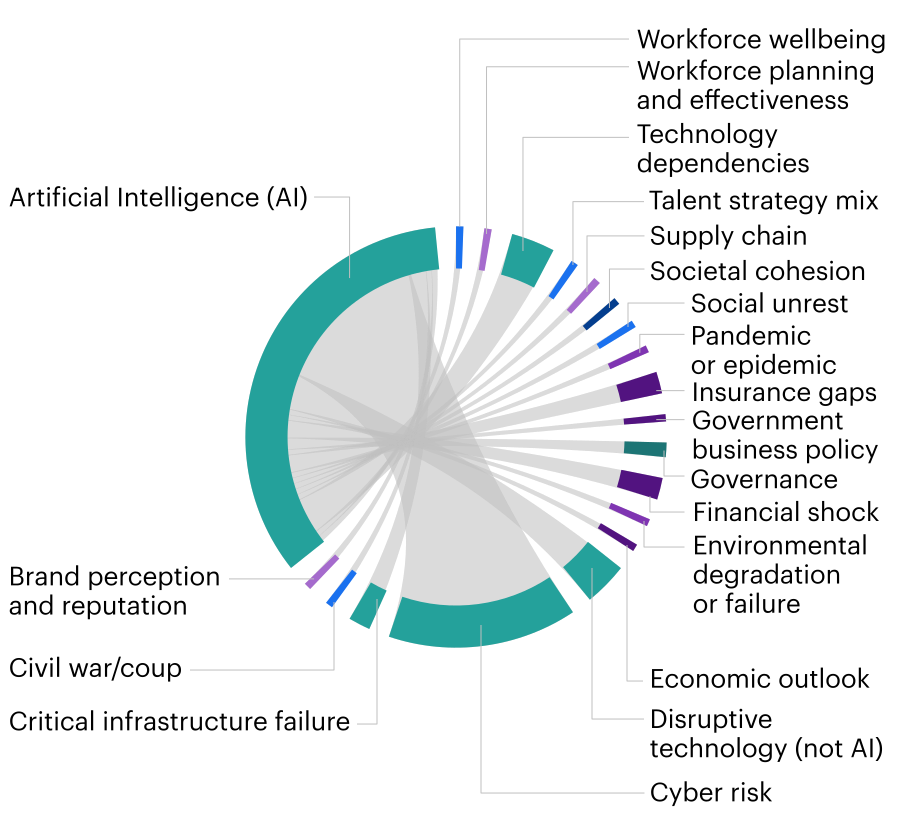
Figure 1. Interconnected causes, consequences and actions of AI
Proof in the present
These touchpoints are already here. Our speciality experts share their proof in the present views on three interconnected dimensions:

Related content
Large organizations face significant vulnerability from AI-powered deepfakes in phishing attacks. To mitigate this risk, adopting a proactive, data-driven cyber risk management approach is crucial - this can help protect against substantial financial and reputational impacts.”Ben FidlowGlobal Head of Core Analytics
As data centers become increasingly critical infrastructure, your AI strategy will need to consider more than just technology – it will need to consider the wide array of risks data centers are exposed to.
$3.9mglobal average cost of a data breach claim
1 in 6data breaches involved attackers using AI
37%AI-generated phishing
35%deepfake impersonation attacks
While AI may not have been a top priority for boards when surveyed last year, conversations since suggest that, for some at least, sentiment is shifting. With a growing array of risks demanding attention – and AI rising up the agenda in the short-term – focusing on asking the right questions can help uncover uncertainties and balance enthusiasm for innovation with informed oversight.”Angus DuncanExecutive Director – Global D&O Coverage Specialist
What your Monday morning inbox could contain
When events haven’t occurred before it can be difficult to imagine what reality could look like. They also rarely happen in isolation.
We used AI to craft a scenario-based view into what could be waiting in your inbox on Monday morning if these events unfold together. While they seem implausible, each one is rooted in a past event or future possibility.
It’s 6:15 a.m. Your phone has been buzzing since 4:00am. Overnight, three crises have erupted across markets where your organization operates, demanding immediate attention.
- Asia: News has broken that an industry peer’s AI risk models were compromised through cyber breach, mispricing major portfolios. A rapid review by your risk team has revealed a troubling oversight – AI risks have been under-recognized at board level. The investor call is scheduled for next week and analysts had already asked for more details on your AI strategy as a growth opportunity. Do you know what AI models are being used across your business and if you’re impacted?
- Europe: reports from Europe that a surge in energy demand during an intense heatwave has pushed national grids to their limits. A state-backed cyberattack disabled key energy assets during peak hours, destabilising industries. Early estimates from the site engineers are that disruption could last at least a week. Do you know what key suppliers are operating in that region?
- North America: An AI-powered disinformation campaign has destabilised a pivotal election in a strategic market. Retaliatory sanctions have disrupted technology exports, fracturing global supply chains. Cyber counterattacks have struck critical infrastructure in multiple countries, threatening energy security and trade continuity. Do you know how sanctions are going to impact your strategy and targets?
Immediate decisions required:
- Mitigate impact
Activate a global audit of your AI/data and energy supply chains for cyber vulnerabilities and geopolitical dependencies. Mobilise cross-functional teams to reinforce digital infrastructure and share threat intelligence with peers, regulators, and insurers.- Seize opportunity
Accelerate development of a unified risk framework that maps AI, cyber, climate, and geopolitical triggers. Embed AI energy demand management and cyber safeguards into your climate transition strategy – positioning your organisation as a leader in enterprise resilience and digital trust.
Take control
In a world where the speed of technology adoption outpaces regulatory adaptation, your competitive advantage won’t come from avoiding every crisis. It will come from your ability to recover faster than your competition and your plan for resiliency. Your responsibility is to plan which may include avoidance, mitigation or transfer but in all cases it includes the need to understand the interconnected nature and plan for resilience.
“Large and complex organizations must prioritize climate resilience and climate transition in energy strategies, assessing data center risks & integrating energy security to stay resilient in an AI-driven landscape.”Ester Calavia GarsaballSenior Director – Head of Natural Catastrophe
Effective leaders have shifted from traditional risk management protocols to more dynamic and responsible governance models for managing AI’s growth across industries and applications while adhering to their values. These leaders adopt principle-based governance practices that allow their organizations to benefit from AI technologies while reducing risks and increasing trust and accountability.
Is your organization ready to integrate AI successfully? Discover more – our global industry and enterprise risk management (ERM) specialists can help you.
References
Authors




Effective leaders have shifted from traditional risk management protocols to more dynamic and responsible governance models for managing AI’s growth…